From Synthetic Video Detection to Ultra-Fast Frame Generation: Expanding Media AI
At IBC 2026 held in Amsterdam, Netherlands, NVIDIA significantly expanded its GPU-accelerated software and NIM microservices designed to support media production and broadcast transmission. The newly introduced synthetic video detection NIM microservice calculates probability values determining whether an input video is an actual recording or an AI-generated output. This detection model records an accuracy of 99.3 percent on text-based video content and 97.7 percent on image-based video content. Media editing and content authentication departments secure precise analysis points during review processes based on these figures.
Broadcast transmission and digital forensics departments can utilize this model as a verification tool amidst the growing process of responding to fake videos. Within production sites, there is a demand to rapidly determine whether deepfakes or AI-synthesized content have been introduced. The quantitative probability values provided by the detection microservice complement the manual determination steps previously performed by content review personnel. Media partner companies such as Dalet and Wowza plan to integrate and deploy this detection technology into their actual production pipelines.
Developers can check related software development kits and specific environment settings on the Holoscan for Media Official Developer Page. The transition to a software-centric production environment reduces customized integration costs between individual application programs. Broadcasters and production companies can independently execute various media functions on top of the same accelerated infrastructure.
In real-time media environments, AI processing and traditional broadcasting functions operate within the same software-defined environment. This leads to structural changes that reduce complex external equipment linkages and lower transmission latency. However, actual adoption speeds may vary by site depending on the existing equipment replacement cycles of individual broadcast transmission systems.
3D Body Pose Estimating Body Joints from Single-Camera Video and Video Enhancement
NVIDIA 3D Body Pose estimates 2D and 3D body joint positions and angles using a single camera video feed without requiring specialized sensors or marker equipment, converting movements into structured data. It bypasses the complex preparatory processes required by marker-based capture systems and precisely quantifies body movements using only general video inputs. In broadcast production environments, this technology is utilized to extract the movements of actors or presenters into real-time data without attaching separate equipment.
Vizrt introduces this technology into live virtual studio environments to implement interactions between virtual spaces and real individuals. Tracked body movements directly control real-time 3D lighting effects, allowing visual elements such as reflections, shadows, and environment rendering to operate in precise synchronization with the individual's movements. This structure drives the light source effects of virtual studios solely through the images captured by cameras without physical sensors.
Video Frame Generation (VFG) is a feature that increases video frame rates by 2x or 4x, connecting various broadcast systems, streaming services, transcoders, and creator tools through a common interface. Ross Video integrates this technology into its Rio Replay platform to generate AI-based slow-motion video in sports production environments, supporting up to 6x slow-motion implementation. This method enhances frame processing efficiency across broadcast transmission and replay equipment overall.
NVIDIA Video Super Resolution (VSR) expands the range of high-definition video processing by newly adding 10-bit video support and streaming mode. Alongside this, NVIDIA TrueHDR converts standard dynamic range video into high dynamic range output in real time, adjusting content brightness in real time while maintaining local contrast to support up to approximately 2,000 nits. It provides a real-time processing pipeline that directly transforms standard-definition video into high-luminance HDR environments.
LipSync and Active Speaker for Multilingual Broadcasting
For broadcast engineers streaming live programs targeting global viewers, this update directly targets the technical limitations of multilingual dubbing and screen synchronization processes. Going beyond simply translating lines, it enables the construction of a pipeline that aligns voice, timing, facial movements, and subtitles in real time.
The NVIDIA LipSync model improves facial occlusion processing accuracy—even in environments where faces are partially obscured by microphones or hands during interviews or discussions—while preserving teeth, lips, and facial textures at the original level. The focus is on reducing visual unnaturalness in screens featuring multiple cast members.
The NVIDIA Active Speaker Detection NIM microservice accurately identifies speakers on screen in multi-audio track environments without requiring separate, complex speaker separation tasks. This structure secures the real-time capability of speech detection in programs where multiple people appear simultaneously, such as interviews or sports broadcasts.
A voice activity detection feature has been added to the new microservice, along with support for the gRPC interface for high-performance communication and broader GPU compatibility. Through this, developers can run real-time translation and dubbing applications for broadcast sites on various hardware configurations.
The Studio Voice feature has been supplemented with a new microphone profile based on the NVIDIA Studio Voice NIM microservice. It provides users with the means to more finely control the tonal character of voices during the voice enhancement process.
In multilingual broadcast environments, these AI features combine with existing production workflows to preserve editing intent and the production quality of originals. However, validating the infrastructure compatibility of individual systems must precede if multi-channel audio and video delays are to be synchronized in real time in actual transmission environments.
Holoscan for Media Connecting Software-Defined Broadcast Infrastructure
The Media Exchange Layer (MXL) has been integrated into NVIDIA Holoscan for Media, providing an open method for real-time video, audio, and data exchange between distributed environments. Holoscan for Media is an open-source reference architecture and developer toolkit for building AI-enabled media functions and applications for software-defined live production. The integration of MXL acts as a common exchange layer that supports software-based media functions in connecting and operating seamlessly.
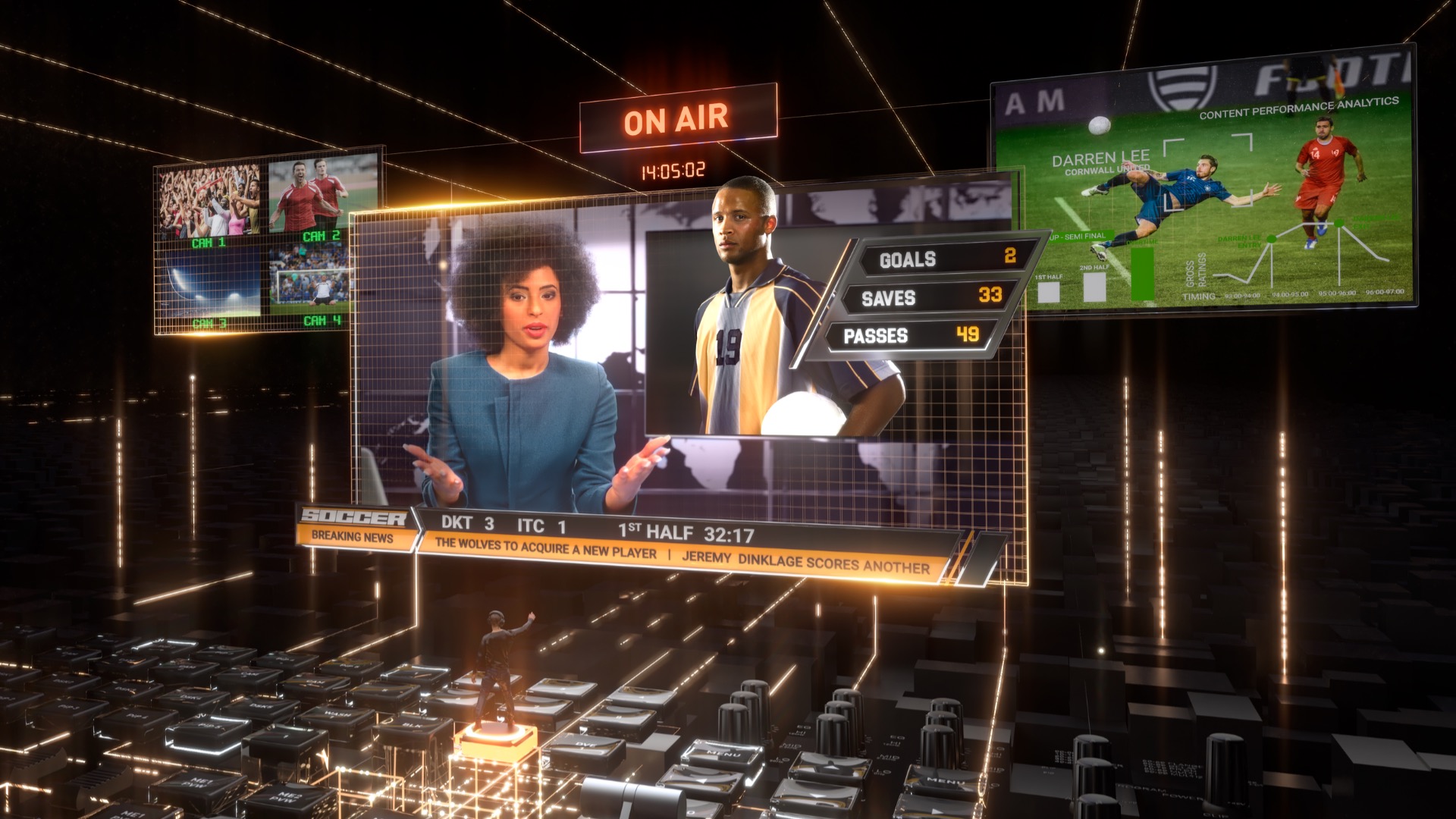
Through this structure, AI processing, video applications, and traditional media functions can be operated in an integrated manner within the same software-defined environment. As broadcasting and streaming infrastructure shifts toward shared accelerated computing, this exchange layer plays a core connecting role. Live on-site demonstrations take place at the European Broadcasting Union (EBU) stand 10.D21, where developers and broadcast technology stakeholders can directly observe integrated operation cases at the booth.
A content localization reference workflow is also provided through Holoscan for Media. Broadcasters, sports leagues, rights holders, and streaming services can integrate subtitles, translated audio, dubbing, synchronized video, and localized graphics into a single software-defined real-time workflow. Developers can select and apply necessary functions by program, market, or distribution channel, reducing the need to build separate individual infrastructures for each language version.
Broadcasters secure practical means to transition from traditional hardware-centric infrastructure to flexible, software-based production environments. Because media applications from various suppliers exchange data through a common exchange layer, the integration complexity between individual systems is lowered. However, specific deployment topologies or hardware requirements vary depending on the on-site deployment environment and the configuration of third-party equipment linked to it.
This open approach presented by NVIDIA accelerates the integration of accelerated computing into broadcast infrastructure without relying on specific vendor monopolies. It can serve as a testing ground to verify the effectiveness of software-defined architectures in live broadcast environments requiring real-time processing and low latency. Developers can directly link the Media Exchange Layer to their own media pipelines via related developer toolkits and the official developer page.
Sports Domain-Specific Models and Real-Time Content Localization Based on Holoscan
With sports video evaluation accuracy improving from approximately 53 percent to 94 percent for multiple-choice and from approximately 5.7 percent to 66 percent for subjective answers, the performance gap between general-purpose models and domain-specific fine-tuning has become distinct. The NVIDIA Sports Intelligence Playbook is a structured framework supporting the fine-tuning of open models so they can learn the unique rules, players, scores, strategies, and situational context of the sports domain.
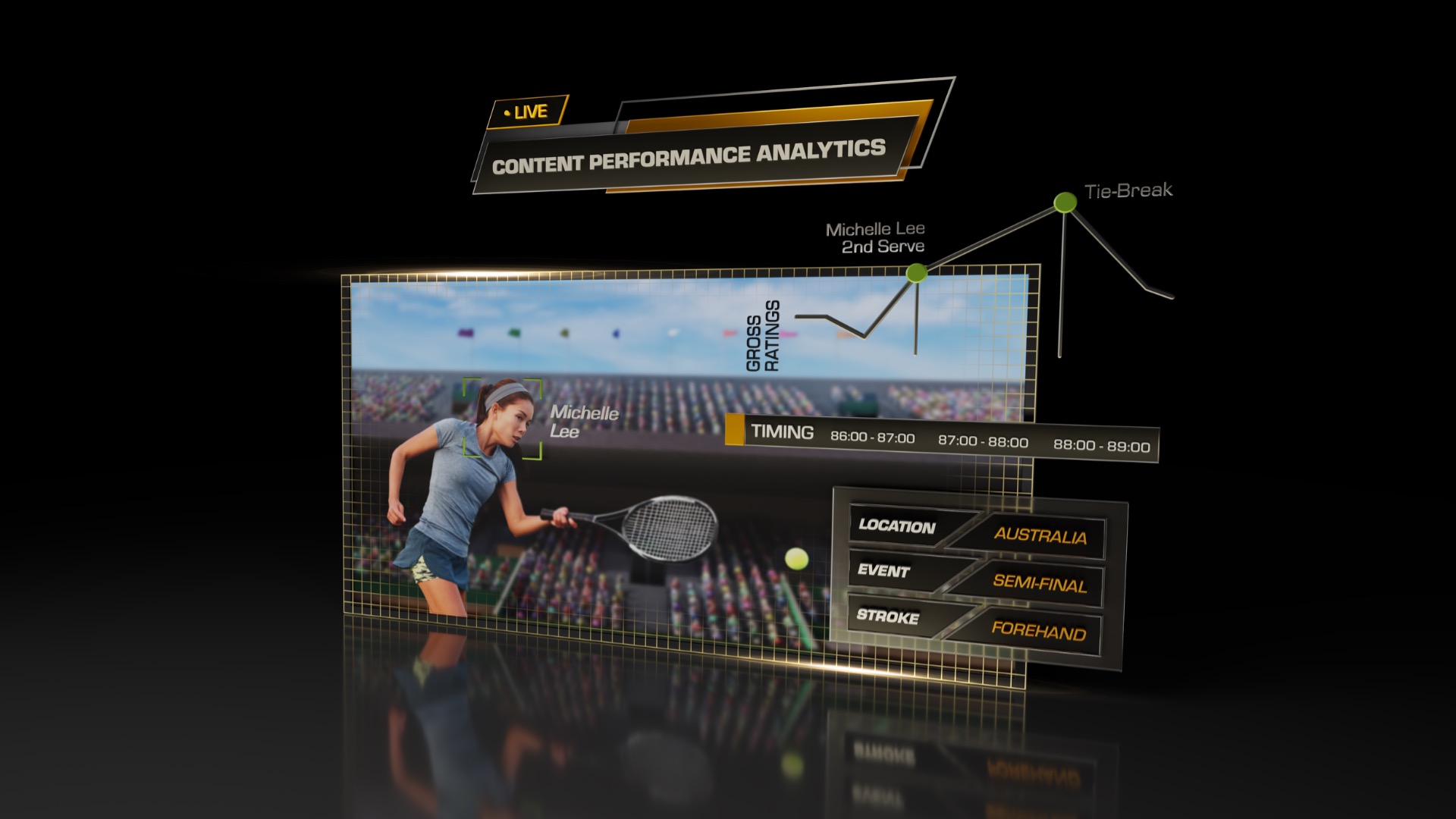
Makina Sports is integrating these Sports Intelligence Playbooks into its sports-native data and agent infrastructure. Through this, rights holders can transform proprietary media assets into on-premises intelligence for live production and fan experiences.
A content localization reference workflow has been added within the Holoscan for Media developer toolkit, which is a real-time media processing platform. Partner companies such as AI-Media, Cambodia AI, Chyron, and Panzura respectively provide technologies ranging from voice and on-screen delivery adaptation to multilingual subtitle generation, translated audio, graphic localization, and the preservation of original facial expressions and identities across live and on-demand content.
Developers can check the scope of supporting technologies required to build real-time broadcast infrastructure through official Holoscan for Media resources.
From the perspective of AX BRIEF, the combination of these sports domain-specific models and content localization toolkits provides a practical benchmark for gauging the infrastructure specs and partner integration scope required when introducing real-time AI pipelines into live broadcasting and media production environments. However, aside from the partner integration cases specified in the original text, individual construction costs or detailed system integration codes have not been disclosed, necessitating individual verification upon on-site deployment.
Image source: NVIDIA