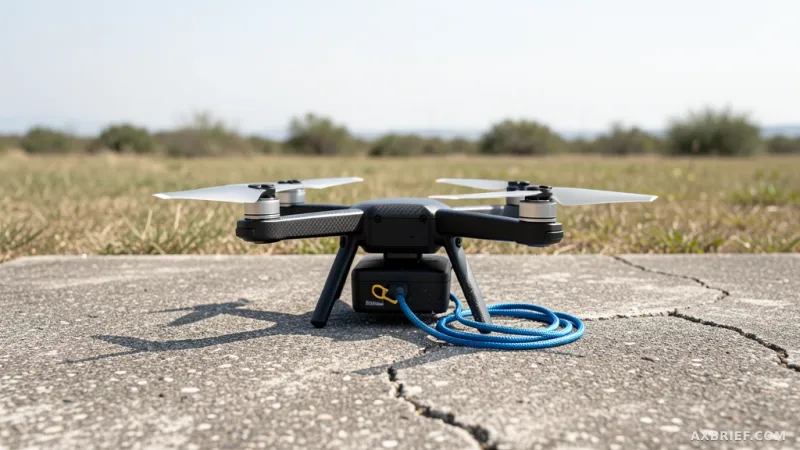
The drone industry is currently navigating a pivotal transition. For years, the sector has relied heavily on the skill of human pilots and the reliability of remote-control links, but the horizon has shifted toward true autonomy. The goal is no longer just flight, but the ability for a craft to perceive its environment, avoid obstacles in real-time, and calculate optimal flight paths without human intervention. However, the leap from remote-controlled hardware to an autonomous agent is stalled by a persistent bottleneck: the tension between high-compute AI requirements and the rigid power and weight constraints of embedded drone hardware.
The Blueprint for Physical AI Integration
To bridge this gap, SiMa.ai, a leader in Physical AI, and Mistral Solutions, a specialist in embedded systems and drone product engineering, have entered into a strategic partnership. The core output of this collaboration is a joint reference design for autonomous drones. In the world of hardware engineering, a reference design serves as a standardized blueprint, providing developers with a proven architectural map that covers everything from hardware configuration to the deployment of AI models. By providing this standard, the two companies aim to eliminate the trial-and-error phase that typically plagues the development of autonomous flight systems.
This partnership is not merely a theoretical agreement but a tangible technical integration. SiMa.ai provides the Physical AI platform, which acts as the intelligence engine of the craft. This platform is specifically engineered to optimize both the hardware and the AI models to enable real-time inference directly on the device. Complementing this, Mistral Solutions contributes its deep expertise in embedded system design, optimizing the hardware interfaces to ensure that these AI models can operate reliably within the strict power and computational envelopes of a drone. The practical application of this synergy will be on public display at the Drone International Expo in New Delhi, held from June 24 to June 26, 2026, where the companies will showcase their results at booth D47.
Shifting the Paradigm from Cloud to Edge
The critical distinction in this partnership lies in the move toward what SiMa.ai defines as Physical AI. Most contemporary AI applications rely on a round-trip to the cloud, where data is sent to a powerful server, processed, and then sent back as a command. In the context of a drone flying at high speeds through a complex environment, the latency introduced by cloud dependency is a liability that can lead to catastrophic failure. By implementing a platform that allows for on-device processing, the drone can respond to environmental changes instantaneously.
This shift transforms the development cycle from a search for raw model performance to a search for integrated efficiency. The reference design provided by SiMa.ai and Mistral Solutions represents the fastest path to autonomous drone deployment because it solves the integration problem before the developer even begins. Instead of spending months attempting to fit a large model into a small chip, developers can use this blueprint to verify real-time inference capabilities immediately. This moves the industry away from bespoke, experimental builds and toward a scalable, standardized ecosystem where autonomous intelligence is a plug-and-play component rather than a research project. Detailed technical specifications and platform details are available via the official site at http://www.sima.ai.
The convergence of embedded optimization and edge intelligence is turning the dream of fully autonomous aerial fleets into a deployable reality.