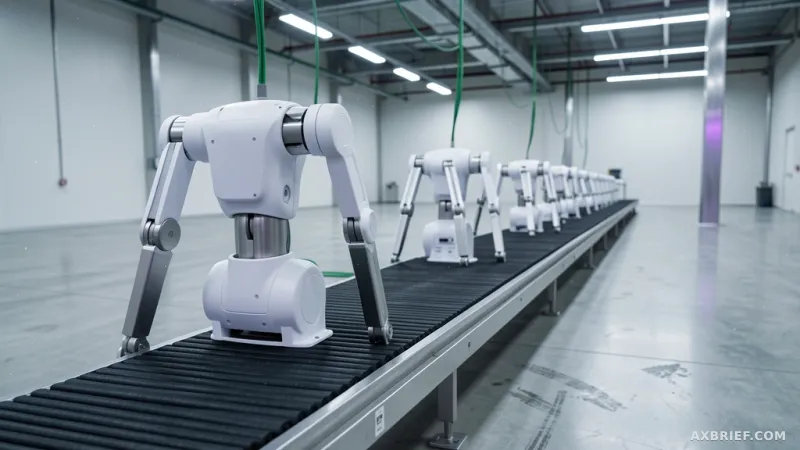
For the past two years, the AI industry has been captivated by the digital screen. We have watched LLMs write code, generate photorealistic imagery, and simulate human reasoning within the confines of a browser tab. But the conversation in the developer community is shifting. The novelty of the chatbot is fading, replaced by a growing obsession with embodied AI—the moment when intelligence escapes the server rack and enters the physical world. We are moving past the era of carefully edited demo videos and entering the era of hardware deployment.
The Blueprint for Artificial Super Intelligence
SoftBank is no longer treating robotics as a side project or a venture capital experiment. The company has officially announced that it has moved into the mass production of Physical AI robots, signaling a transition from research and development to commercial scalability. This move is the cornerstone of a broader strategic pivot toward Artificial Super Intelligence (ASI), a state of intelligence that surpasses all human capabilities. To capture this future, SoftBank has established a four-pillar operational framework focusing on AI models, semiconductors, AI infrastructure, and robotics.
The financial commitment backing this vision is staggering. By October of this year, SoftBank's total investment in OpenAI is projected to reach 64.6 billion dollars. This capital injection is supported by a massive surge in the company's own financial health; for the 2025 fiscal year, SoftBank reported a net profit of 5 trillion yen, a fourfold increase over the previous year and a record-breaking performance for the firm. This liquidity allows SoftBank to move faster than competitors who are bogged down by the high capital expenditure required for hardware.
Beyond the robots themselves, SoftBank is securing the physical foundations of the ASI ecosystem. Masayoshi Son has emphasized that the intelligence of a model is irrelevant if it lacks the power and space to operate. Consequently, SoftBank is constructing large-scale data centers across the United States and Europe to ensure direct control over the computing infrastructure. To solve the looming energy crisis facing AI, the company is currently negotiating a capital alliance with Tokyo Electric Power Company Holdings to accelerate the deployment of AI-specific data centers within Japan.
The Shift From Intelligence to Execution
Most AI players are currently fighting a war of parameters and tokens, competing to see whose model can reason better in a vacuum. SoftBank is playing a different game entirely. By integrating the energy supply, the data center, the semiconductor, the model, and the robotic chassis, SoftBank is building a vertically integrated stack. This is the critical distinction between a software company and an infrastructure power. When a company controls the power grid and the factory line, the bottleneck shifts from algorithmic efficiency to manufacturing throughput.
The real twist in this strategy is the move to mass production. In the robotics world, there is a notorious gap between a prototype that works in a controlled lab and a product that can be manufactured by the thousands. By announcing the start of mass production, SoftBank is claiming that it has solved the reliability and cost issues that have kept Physical AI in the experimental phase. The tension is no longer about whether AI can move a robotic arm, but whether that arm can be deployed in millions of homes and factories at a sustainable price point.
Masayoshi Son, now 68, has signaled his intent to lead this transition for the next 10 to 15 years. This timeline suggests that the current push into robotics is not a short-term play for the current market, but a long-term land grab for the infrastructure of the ASI era. The goal is to create a closed loop where AI designs the robots, the robots build the infrastructure, and the infrastructure powers the next generation of AI.
This transition marks the end of the simulation era and the beginning of the deployment era for embodied intelligence.