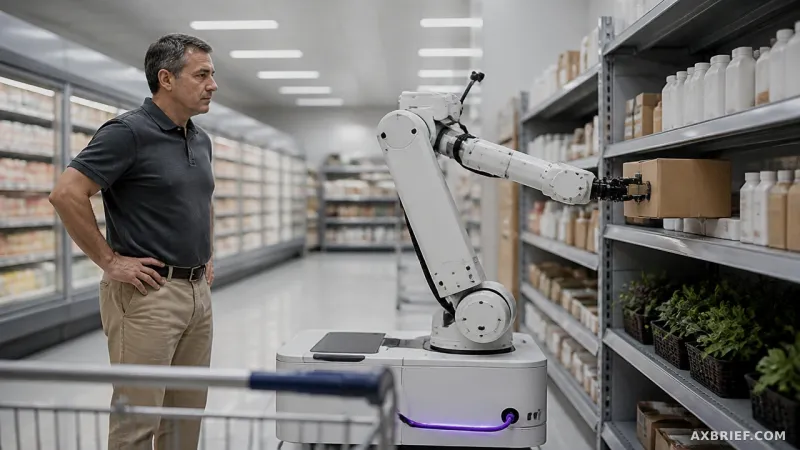
Retail floors are the ultimate stress test for robotics. Unlike the sterile, predictable environment of a factory assembly line, a convenience store or supermarket is a chaotic ecosystem of shifting inventory, erratic human traffic, and unpredictable layouts. For years, the robotics industry has chased general intelligence in a vacuum, but the real battle for utility is happening in the aisles, where the ability to grasp a misplaced bottle or navigate a crowded corridor determines whether a robot is a tool or a toy.
The Architecture of Retail Autonomy
Striding AI, headquartered in Beijing, is attacking this friction by developing a next-generation robot foundation system designed specifically for the physical complexities of retail. The company has identified the retail environment as the ideal entry point for Physical AI because it offers a unique intersection of repetitive workflows and rich operational data. Their system targets high-value, labor-intensive tasks including product shelving, restocking, inventory auditing, and checkout assistance. By focusing on these specific scenarios, Striding AI aims to move beyond theoretical AI and into scalable, real-world deployment.
The core of their performance leap lies in the implementation of human-in-the-loop reinforcement learning. In this framework, humans do not simply provide a static dataset for the robot to mimic; instead, they actively intervene in the learning process to correct behaviors and provide real-time rewards. Internal testing reveals that this approach has increased task success rates by up to 3x. This creates a continuous feedback loop where the robot's failures in the physical world are immediately converted into training data, accelerating both the speed of learning and the precision of execution. To support this, Striding AI utilizes World Action Models, which allow the robot to predict the consequences of its actions on the environment before they are fully executed, effectively bridging the gap between digital reasoning and physical movement.
From Model Benchmarks to Systemic Integration
While much of the current AI discourse focuses on the size of the model or the elegance of the architecture, Striding AI is pivoting toward a systems-first approach. The fundamental insight here is that a sophisticated model is useless if the hardware, data pipeline, and control systems are not perfectly aligned. This is where the company differentiates itself from traditional AI labs. Rather than treating the model as the product, they treat the entire integration—comprising the foundation model, robot hardware, data infrastructure, and deployment engineering—as a single, unified entity.
This philosophy is most evident in their closed-loop robotics architecture. Most traditional robots operate on an open-loop or semi-closed system: they receive a command, execute a movement, and assume the goal was met. Striding AI's system implements a rigorous cycle of perception, planning, execution, feedback, and recovery. For example, if a robot attempts to pick up an object and the item begins to slip, the feedback mechanism detects the change in pressure or position in real-time. The recovery phase then instantly modifies the control values to tighten the grip or reposition the arm. This ability to understand and react to causality in the physical world allows the robot to transfer skills across different environments more effectively. A robot that understands the physics of a retail shelf can more easily adapt to a warehouse bin or a healthcare cart because it has learned the underlying principles of interaction rather than just a set of coordinates.
To make this scalable, Striding AI has built a dedicated infrastructure for edge-cloud orchestration. Real-time control calculations, which require millisecond latency to prevent accidents or failures, are processed at the edge on the robot itself. Meanwhile, the massive computational load required for data analysis, distributed reinforcement learning, and global model updates is handled in the cloud. This hybrid approach ensures that as more robots are deployed, the entire fleet becomes smarter without sacrificing the responsiveness of individual units. The leadership team, drawing from backgrounds in AI semiconductors, autonomous driving, and industrial robotics, has designed this not as a collection of features, but as an integrated pipeline where data, control, and infrastructure evolve in tandem.
CEO Song Yao emphasizes that the innovation in Physical AI does not come from a single breakthrough in model architecture, but from the continuous, mutual evolution of data and infrastructure. With the retail sector serving as the proving ground, Striding AI plans to expand this system into agriculture, logistics, healthcare, and telecommunications. The goal is a robot ecosystem that blends naturally into human environments by learning from experience rather than relying on pre-programmed scripts.
The true measure of a robot's readiness is no longer a benchmark score on a leaderboard, but the flexibility of its system to survive and adapt to the unpredictability of the living world.