
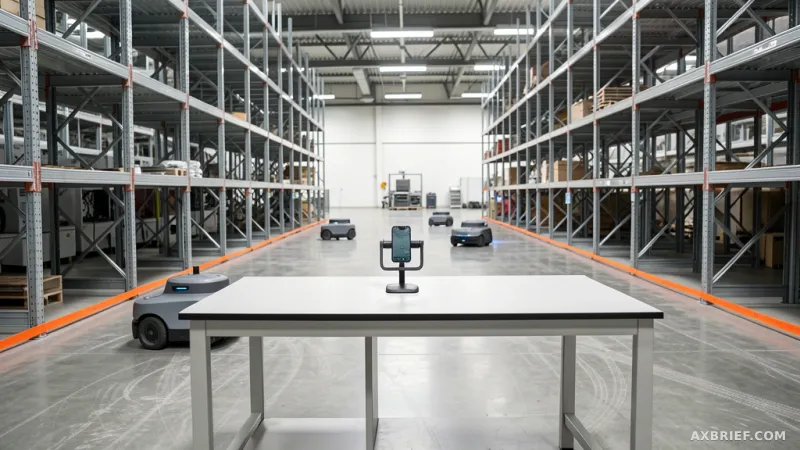
The robotics industry is currently hitting a wall known as the pilot purgatory. For many enterprise leaders, the initial thrill of seeing a single autonomous robot navigate a warehouse floor or a robotic arm execute a precise weld is quickly replaced by a sobering realization. While deploying one or two units is a manageable technical exercise, scaling that operation to fifty or five hundred units introduces a level of complexity that traditional management structures cannot handle. The friction shifts from the hardware's ability to move to the human's ability to manage, as the cost of individual configuration and manual updates begins to grow exponentially.
The Infrastructure of Physical AI
To bridge this gap between demonstration and deployment, Tech Mahindra (NSE: TECHM), a global leader in digital solutions and technology consulting, has announced a strategic partnership with Viam, a specialized software platform for robotics and automation. The core of this collaboration is the delivery of a comprehensive robot fleet management platform designed specifically for the needs of global enterprises. In the context of industrial automation, a robot fleet is not merely a collection of machines but a synchronized system where multiple units are grouped, controlled, and maintained through a single integrated software layer.
This partnership allows Tech Mahindra's global client base to leverage the Viam platform to move beyond the demo phase. Viam operates as a critical enabler of Physical AI, a discipline that integrates artificial intelligence with physical hardware to allow machines to interact with and adapt to real-world environments. By providing the software orchestration layer, Viam ensures that the maintenance and scalability of these robotic systems are handled centrally. Enterprises can now access these tools to build large-scale automation environments without being locked into a specific hardware vendor, a capability detailed further on the Viam official site.
From Individual Units to Orchestrated Systems
The fundamental shift occurring here is the transition from unit-based thinking to system-based thinking. In the early stages of robotics adoption, companies typically relied on expensive external consultants to hand-tune a few robots for a specific task. This approach is sustainable for a handful of machines, but it becomes a liability when an organization needs to push a critical firmware update or a new behavioral logic to a hundred robots across three different continents. The tension lies in the disparity between the intelligence of the individual robot and the inefficiency of the management process.
This is where the value of a hardware-agnostic software layer becomes apparent. Most industrial environments are heterogeneous, meaning they utilize robots from various manufacturers, each with its own proprietary language and management tool. Forcing a team to switch between five different apps to manage five different brands of robots creates operational paralysis. By abstracting the hardware, Viam and Tech Mahindra are introducing a standardization layer that treats the robot as a programmable asset rather than a standalone appliance. This removes the dependency on specific manufacturers and drastically lowers the total cost of ownership for large-scale fleets.
When the software stack can handle the heavy lifting of deployment and monitoring, the focus shifts from the struggle of installation to the optimization of the workflow. The real-world efficacy of Physical AI is no longer measured by how impressively a single robot performs in a controlled demo, but by the availability and reliability of the software stack that keeps a hundred robots running in a chaotic factory environment.
The viability of industrial Physical AI now rests entirely on the ability to orchestrate hardware at scale.



