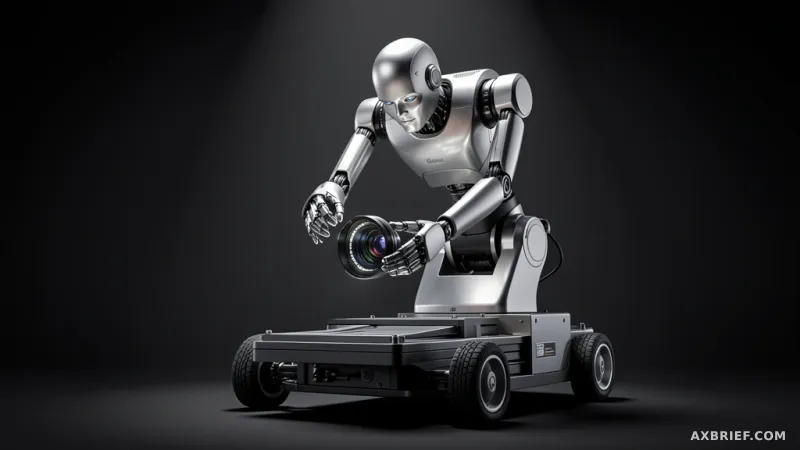
The current humanoid robot gold rush has largely been a spectacle of balance and locomotion. From Tesla's Optimus to Figure AI, the industry has been obsessed with the 'walking' part of the humanoid equation, treating the ability to navigate a room on two legs as the ultimate benchmark of success. But for the engineers actually running high-end assembly lines, a robot that can walk but cannot precisely place a fiber optic cable is little more than an expensive kinetic sculpture. The tension in the developer community has shifted from wondering if a robot can stand to wondering if it can actually perform sub-millimeter tasks without shaking itself apart.
The Hardware Blueprint and the 600 Million Yuan Bet
Elite Robot, a Chinese industrial robotics specialist, has entered this fray not with a bipedal walker, but with the Centaur G1, a wheeled humanoid designed specifically for the rigors of high-end precision manufacturing. This launch is backed by a massive financial injection, as the company recently closed a Series D+ funding round totaling 600 million yuan. This capital is not merely for operational scaling but serves as the engine for a strategy the company has pursued since 2016: the One Brain, Multiple Forms approach. The goal is to decouple the AI intelligence from the physical chassis, allowing a single cognitive model to control various hardware configurations depending on the task.
At the center of the Centaur G1 is the Yuanqi Primo, an upgraded embodied large model platform. This AI brain allows the robot to move beyond pre-programmed coordinates and instead operate via abstract spatial reasoning. When given a command to retrieve materials from a specific storage bin, Yuanqi Primo translates that linguistic intent into a physical 3D map and a set of precise motor commands. The physical capabilities of the G1 are equally aggressive. It features dual robot arms with 7 degrees of freedom (DOF), each capable of handling a 5kg payload, providing a combined lifting capacity of 10kg. Most critically, the system boasts a repeatability precision of ±0.1mm, a figure that places it in a different league than most general-purpose humanoids.
Elite Robot has set a concrete timeline for the transition from prototype to product, with full-scale mass production scheduled to begin in May 2026. This timeline suggests that the company is moving past the demo phase and into the validation phase, where the synergy between the Yuanqi Primo model and the hardware's physical tolerances will be tested in real-world industrial environments. The focus here is not on the novelty of the form, but on the reliability of the output.
The Pragmatic Pivot: Why Wheels Beat Legs for Precision
To understand why the Centaur G1 is a departure from the current humanoid trend, one must look at the physics of precision. Bipedal robots suffer from inherent instability; every micro-adjustment made to keep the robot upright introduces noise and vibration into the upper body. For a robot attempting to insert a fiber optic cable or assemble an optical module, a vibration of even a few tenths of a millimeter is the difference between a successful assembly and a destroyed component. By opting for a wheeled base, Elite Robot has effectively eliminated the balance problem, converting the energy and compute typically reserved for stabilization into raw precision for the arms.
This stability is augmented by a sophisticated sensing loop that functions like a human's visual and tactile system. The Centaur G1 utilizes a multi-layered vision architecture: an RGB-D camera in the head provides global depth information for navigation, while binocular macro cameras mounted on the wrists capture high-resolution, close-up imagery of the workpiece. This visual data is then fused with feedback from 6-axis force sensors embedded in the end-effectors. These sensors detect minute resistances during physical contact, allowing the robot to feel its way into a socket or adjust its grip in real-time to prevent damage to fragile parts.
The real technical breakthrough, however, lies in the 2.5D vision generalization algorithm. Traditional industrial robots rely on fixed coordinates—if a part is moved by two centimeters, the robot fails. The Centaur G1's algorithm allows it to identify objects and perceive their orientation within a complex environment dynamically. By combining LiDAR-based positioning with this adaptive vision, the robot achieves a navigation accuracy of ±0.01m, ensuring it arrives at the exact spot required to then engage its ±0.1mm precision mode. This creates a hybrid identity: the G1 is essentially a high-precision cobot that has been given the mobility of a humanoid and the brain of a large language model.
This shift represents a fundamental reversal in the humanoid philosophy. While others are trying to make robots more human-like in their movement, Elite Robot is making the humanoid form factor a tool for industrial utility. The result is a machine that can navigate a factory floor autonomously but can also perform the kind of steady-handed work that previously required a human technician to hold their breath and use tweezers.
From the Factory Floor to the Living Room
The implications of this precision-first approach extend far beyond the assembly of optical modules. In the realm of scientific research, the Centaur G1 is positioned to automate the most tedious and error-prone parts of laboratory work. Tasks such as precision sampling or the addition of reagents to micro-vials require a level of consistency that humans struggle to maintain over long shifts. By deploying a robot that can map a lab in 3D and execute sub-millimeter movements, research facilities can eliminate human error and run experiments 24/7 with absolute repeatability.
In the commercial sector, the G1's ability to perceive and interact with non-standardized environments opens the door for truly intelligent unmanned retail. Unlike current logistics robots that simply move boxes from point A to point B, the Centaur G1 can identify specific products on a shelf, navigate the crowded aisles of a supermarket using its RGB-D and LiDAR sensors, and pick items with a delicacy that prevents damage to packaging. It transforms the robot from a transporter into a curator.
Perhaps the most provocative application is in elderly care and domestic assistance. While a factory robot seems far removed from a home environment, the core requirements are surprisingly similar: the ability to navigate a complex space and interact with objects safely and precisely. In a caregiving context, the G1 could handle the delivery of medication, assist with the organization of household items, or monitor the health of a resident by analyzing their movement patterns. The 6-axis force sensors that prevent a fiber optic cable from snapping are the same sensors that would ensure a robot does not apply too much pressure when assisting a frail person. The precision developed for the smart factory becomes the safety mechanism for the home.
For AI practitioners and robotics engineers, the Centaur G1 serves as a case study in pragmatic embodied AI. It suggests that the path to mass adoption is not through mimicking human biology, but through solving specific, high-value problems. By prioritizing the sensing loop and repeatability over the aesthetics of walking, Elite Robot has created a platform that is ready for the economy of the next decade.
The era of the humanoid as a laboratory curiosity is ending, replaced by a generation of mobile precision instruments that prioritize the work over the walk.