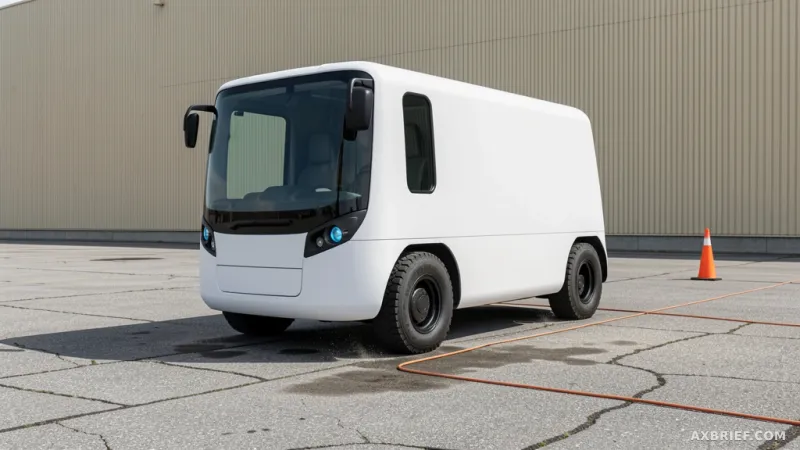
The global logistics industry is currently trapped between two colliding crises: a chronic shortage of long-haul drivers and an aggressive regulatory push toward zero-carbon emissions. For years, the industry has treated these as separate problems, attempting to solve the labor gap with better recruitment and the emissions gap with incremental engine upgrades. However, a shift is occurring in how the world views the cockpit of a truck. The industry is moving away from the idea of the driver as a necessity and toward the concept of the vehicle as a node in a larger, autonomous network. This transition is no longer a theoretical exercise in a lab but a commercial reality moving toward the public markets.
The Financial Engine of Autonomous Freight
Einride, the Swedish pioneer in autonomous electric transport, is now translating its operational momentum into a massive financial milestone. The company is pursuing a listing on the Nasdaq through a merger with Legato Merger Corp. III, a special purpose acquisition company. This move values Einride at a pre-money equity valuation of $1.35 billion, signaling strong investor confidence in the scalability of driverless logistics. Once the merger is complete, the company will trade under the ticker ENRD for common shares and ENRDW for warrants.
To bolster its war chest for global expansion, Einride has already secured $113 million in additional funding through a private investment in public equity, known as a PIPE. This capital injection comes at a time when the company has already established a significant commercial footprint. Einride currently serves more than 30 corporate customers across seven different countries, proving that its model can adapt to various regulatory environments and geographic terrains.
From a revenue perspective, the company is demonstrating the viability of AI-driven freight. Einride reports an annual recurring revenue, or ARR, of approximately $92 million. While this current figure is impressive for a deep-tech hardware company, the long-term trajectory is even more aggressive. Based on joint business plans with its high-tier corporate clients, the company estimates a potential long-term ARR exceeding $800 million. These numbers suggest that the market is not just interested in the novelty of a driverless truck, but in the recurring value of an automated logistics ecosystem.
Beyond the Truck: The Saga OS Strategy
While the sight of a truck without a steering wheel captures the headlines, the actual disruption lies in the software layer. The core of Einride's value proposition is not the vehicle itself, but Saga, an AI-based operating system designed to control the entire flow of logistics. Saga is not a simple autopilot; it is a comprehensive platform that integrates heavy-duty electric autonomous vehicles, the charging infrastructure required to power them, and an intelligent cargo management system. This shift from vehicle-centric design to system-centric design is what allows Einride to scale where others have stalled.
To move from a prototype to a commercial operation, Einride employs a rigorous four-stage deployment process that minimizes risk and maximizes predictability. The first stage focuses on identification, where the system isolates high-volume routes with repetitive patterns. Once these routes are identified, the company evaluates the necessary infrastructure, traffic conditions, and regulatory constraints to build a viable operational plan.
The second stage moves into the digital realm. Einride creates digital models of the identified routes and subjects them to intense stress testing. By pushing the system to its absolute limits in a simulated environment, the company can identify potential failure points and mitigate operational risks before a single wheel touches the pavement. This digital-twin approach ensures that the AI is prepared for edge cases that would be too dangerous to test in real-time.
In the third stage, the company integrates permitted vehicles into a real-time supervision and response protocol. This allows the vehicles to enter actual cargo flows while remaining under the watchful eye of remote operators who can intervene if necessary. The final stage is the scaling phase, where the company incrementally increases the number of vehicles, opens new lanes, and expands operating hours based on the data gathered in the previous steps.
This systematic approach has already yielded concrete results. Using the Saga system and this four-stage framework, Einride successfully completed a driverless operation that crossed the border from Ørje, Norway, into Sweden. This run was more than a technical demo; it was a validation of the company's ability to handle international borders and varying jurisdictions without a human in the driver's seat.
By decoupling the vehicle from the driver and the operation from the manual schedule, Einride is redefining the truck as a piece of programmable infrastructure. The move to the Nasdaq is the final step in transitioning from a Swedish innovator to a global standard for autonomous logistics.