Imagine a developer staring at two monitors late at night, trying to align the internal logic of two different AI models. On one screen, a powerful teacher model like Qwen3 processes the number 201 as a single, cohesive token. On the other, a smaller student model like Llama-3.2 breaks that same number into three separate tokens. This misalignment is not just a formatting nuisance; it is a structural wall that has long hindered the process of knowledge distillation. For years, the industry has been forced to choose between a high-performing teacher with an incompatible vocabulary or a mediocre teacher that happens to share the same tokenizer as the student. This fundamental friction has capped the potential of small language models (sLLMs), leaving a gap between the raw intelligence of frontier models and the efficiency of edge-deployable ones.
The Failure of GOLD and the Rise of X-Token
Knowledge distillation is the primary engine for creating efficient sLLMs, allowing a compact model to inherit the reasoning capabilities of a giant. Traditionally, this requires comparing the probability distributions of tokens between the teacher and student. However, this comparison is only possible if both models speak the same tokenized language. To address this, the industry standard became the GOLD method, which attempts to split tokens into a common set and a non-common set. While this worked in theory, NVIDIA researchers discovered a critical flaw: when the tokenizer segmentation differs significantly, essential data is discarded as noise.
In tests using Llama-3.2-1B as the student and Qwen3-4B as the teacher, the GOLD method struggled with basic numerical data. Because Llama-3 treats 201 as one token while Qwen3 splits it, over 1,100 numerical tokens were excluded from the common set. This resulted in a catastrophic drop in reasoning performance, with GSM8k benchmark accuracy plummeting by 2.56 points. In contrast, using a teacher that shared the same tokenizer, such as Llama-3.2-3B, yielded a score of 12.89. This disparity proved that the tokenizer mismatch was actively suppressing the student's ability to learn complex reasoning.
NVIDIA's X-Token emerges as a drop-in replacement for this pipeline, requiring no changes to the model architecture or additional training components. By implementing cross-tokenizer knowledge distillation based on logit distributions, X-Token allows the student to learn from any teacher, regardless of its vocabulary. The results are stark: Llama-3.2-1B achieved an average performance increase of 3.82 points over the GOLD method. This improvement is driven by two specialized loss functions, P-KL and H-KL, which dynamically adapt to the data characteristics to ensure stable knowledge transfer even when token fragmentation is severe.
Probabilistic Projections and the DP Span Alignment
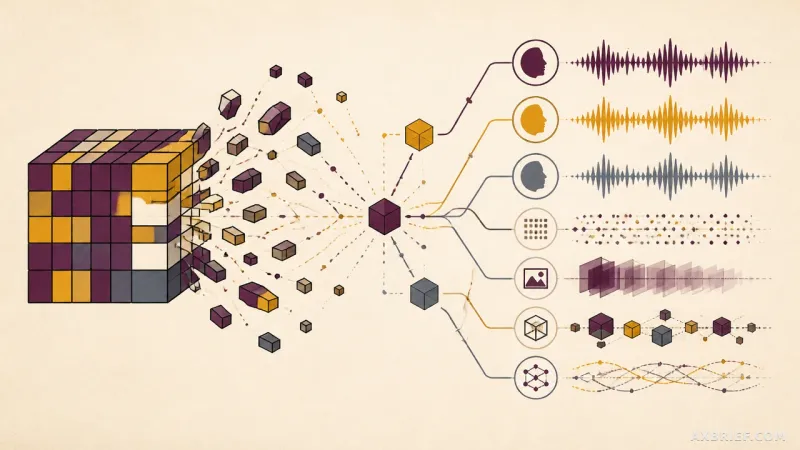
The core innovation of X-Token lies in its refusal to treat tokenizer differences as a binary match-or-fail problem. Instead, it treats the mismatch as a mathematical projection. To achieve this, NVIDIA introduced Dynamic Programming (DP) based span alignment. This system groups sequences from the teacher and student tokenizers into units that decode back to the same original text substring. By using gap movements, the DP alignment maintains synchronization regardless of sequence length, applying a chain rule to combine individual token probabilities within a group into a single, unified distribution.
To bridge the physical gap between vocabularies, X-Token utilizes a projection matrix $W \in \mathbb{R}^{|V_S| \times |V_T|}$. This matrix maps student tokens to a weighted combination of teacher tokens through a two-pass deterministic process. In Pass 1, the system identifies pairs that are exact string matches after normalization and assigns $W[s, t] = 1$. This secures the most reliable alignment data first.
Pass 2 handles the complex cases where tokens do not match exactly. If a student token has no direct counterpart, the system re-tokenizes the student's text using the teacher's tokenizer. If the resulting sequence is four tokens or fewer, it applies an exponential decay weight using $\beta=0.9$ and $\gamma=0.1$. This assigns the highest weight to the first sub-token, based on the empirical observation that the first token in a sequence typically carries the most probability mass. Each row of the matrix is normalized to sum to 1, ensuring no information is lost. Because this matrix is constructed once before training begins, it adds zero computational overhead during the actual learning process.
This approach fundamentally changes how the student perceives the teacher's knowledge. While the GOLD method uses Universal Logit Distillation (ULD) to minimize L1 distance—essentially matching the shape of the distribution while ignoring the meaning of the tokens—X-Token's P-KL (Projection KL) preserves semantic relationships. By projecting the student's probability distribution directly into the teacher's vocabulary space via the $W$ matrix, a complex token like 201 is naturally distributed across the teacher's 2, 0, and 1 tokens. This eliminates the noise and inhibitory gradients that plagued previous methods.
Unlocking Multi-Teacher Distillation for the Edge
The liberation from tokenizer constraints allows developers to stop compromising on teacher selection. Previously, the choice of a teacher model was dictated by vocabulary compatibility; now, it is dictated by performance. A developer can now pair Llama-3.2-1B with the highest-performing available model, whether it is Phi-4-mini or Qwen3-4B, to extract dark knowledge directly.
The choice between P-KL and H-KL loss functions further optimizes this process. In environments where critical tokens are heavily mismatched, such as the Qwen3-4B setup, P-KL outperformed H-KL by an average of 3.55 points. However, in cases where the partition structure is stable and key tokens are already in the common set, such as with Phi-4-mini-Instruct, H-KL provides a sharper, more precise supervisory signal.
This framework also paves the way for multi-teacher distillation. By combining the strengths of different model families into a single student, developers can create specialized sLLMs that possess the diverse reasoning capabilities of multiple frontier models. To prevent the computational cost of DP span alignment from slowing down training, NVIDIA implemented a caching system that pre-calculates alignment results per sequence. This ensures that the transition to X-Token provides a performance boost without requiring additional GPU resources.
For practitioners building specialized sLLMs, particularly in resource-constrained environments like on-device AI or private clouds, X-Token removes the primary ceiling on model quality. The ability to swap a standard loss function for P-KL or H-KL without modifying the underlying architecture means that high-performance distillation is now accessible without deep architectural expertise. It proves that the smallest unit of data—the token—is often the most significant bottleneck in AI performance. By optimizing the bridge between vocabularies, NVIDIA has demonstrated that the efficiency of the tokenizer is just as critical to inference quality as the raw power of the hardware accelerating it.