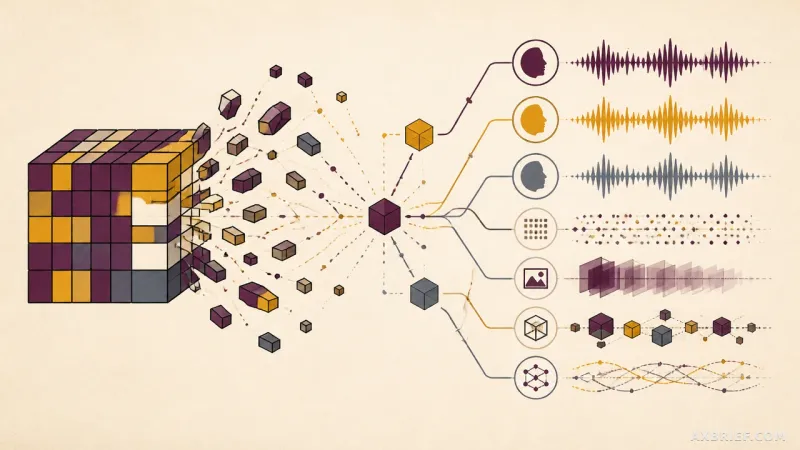
The modern corporate workflow has long been defined by the hand-off. A marketer drafts a campaign brief and hands it to a designer; a product manager identifies a bug and hands it to an engineer; a business lead identifies a financial gap and hands it to an accountant. These boundaries were not just organizational charts but cognitive walls, built on the premise that specialized knowledge required years of formal training and a specific job title. However, a quiet shift is occurring in the prompt bars of millions of users. The friction of the hand-off is disappearing, replaced by a direct line of execution where the person who identifies the problem is now the person who solves it, regardless of their official designation.
The Mechanics of Task Crossover
Recent analysis of over 800,000 work-related messages from ChatGPT users in the United States reveals a phenomenon termed Task Crossover. This occurs when an individual uses AI to perform specialized tasks that traditionally fall outside their professional domain. The data shows that 16.8% of all work-related AI interactions involve tasks unrelated to the user's current job. While this initial figure is significant, it includes a wide array of activities. To isolate the true impact on professional boundaries, researchers applied a rigorous filtering process to separate generic tasks from job-specific ones.
Generic tasks include universal activities such as writing emails, summarizing documents, or managing schedules. Because these activities are common across every single profession, they do not signal a shift in professional identity. When these noise-inducing generic tasks are removed, the data reveals a much more aggressive trend. Among the remaining job-specific messages, 43.5% were identified as Task Crossover. This means that nearly half of the specialized work being performed via AI is being done by people who do not hold the job title associated with that work.
To quantify this shift, the study utilizes the AI Jobs Transition Framework. This analytical system is designed to identify roles with a high probability of substantive change and track how AI reorganizes the actual components of a job. Rather than looking at how AI makes a person faster at their existing job, the framework tracks how AI allows a person to absorb the functions of another job. This suggests that AI is not merely an efficiency tool but a catalyst for the structural reorganization of labor, creating a real-time map of how professional roles are merging and mutating.
The Divergence of Borrowers and Providers
Task Crossover does not happen uniformly across all industries. Instead, different professions exhibit distinct patterns of expansion, which can be categorized as borrowing or providing. Design professionals represent the most prominent borrower pattern. While 35.2% of messages from designers involve tasks from other professions, only 1.7% of tasks performed by other professionals involve design work. Designers are aggressively using AI to expand their utility into other domains, effectively absorbing adjacent roles to become more autonomous.
Engineering roles exhibit the opposite, or provider, pattern. Only 18.5% of engineering messages involve tasks outside their domain, but 7.4% of tasks performed by non-engineers are identified as engineering work. This indicates that the specialized knowledge of the engineer is being successfully exported to the rest of the workforce via AI. Technical troubleshooting and system operations, once the exclusive territory of the dev team, are now being handled by non-technical staff who can leverage AI to bridge the skill gap.
Marketing professionals occupy a middle ground, showing high bidirectional expansion. They exhibit a 24.3% rate of performing outside tasks and an 8.9% rate of their tasks being absorbed by others. Marketing material production, in particular, appeared across five of the seven analyzed professional groups, with a particularly high concentration among designers. This suggests that marketing is becoming a baseline competency rather than a specialized silo. Similarly, financial calculations and technical troubleshooting emerged as the top three crossover tasks across all seven groups, proving that these specific high-value skills are the first to be democratized.
This shift is most acute in smaller organizational structures. Users in workspaces of two to five people show a crossover rate of 18.9%, compared to 16.3% in organizations with over 100 employees. In small teams, the absence of specialized departments forces a faster transition toward the generalist model. A small business owner no longer waits for a consultant to review a contract or a financial analyst to run a basic projection; they use AI to execute these tasks immediately. The data suggests that the smaller the organization, the faster the collapse of professional silos.
Crucially, these patterns reveal a growing gap between the official job description and the actual work being performed. Traditional labor statistics rely on employment contracts and job titles, which are lagging indicators. A company's HR records might still list an employee as a Sales Representative, but their AI usage logs show they are performing data analysis, basic coding, and copywriting. The AI usage pattern is a leading indicator of job evolution, capturing the redistribution of labor in real-time before the organization even realizes the role has changed.
As the 43.5% crossover rate demonstrates, the professional identity is shifting from a fixed set of credentials to a fluid set of capabilities. The ability to navigate these crossovers is becoming the primary competitive advantage in the modern workforce.