
For a modern AI engineer, the most expensive commodity is not the cloud subscription or the API credit, but time. There is a specific, agonizing silence that occurs after hitting the train button on a large-scale model, where the difference between a week of waiting and a day of waiting determines whether a project succeeds or dies in the cradle. This gap is no longer just about who has the best algorithm, but who possesses the physical infrastructure to execute it. As the industry shifts from experimental chatbots to autonomous agents that can write code and manage tools, the underlying hardware has ceased to be a mere component and has become the primary bottleneck of innovation.
The Architecture of Absolute Dominance
The latest rankings from the ISC High Performance conference in Hamburg reveal a landscape that is less of a competition and more of a monopoly. NVIDIA has secured a staggering 81 percent share of the TOP500 list, the definitive ranking of the world's most powerful supercomputers. Out of the top 500 systems globally, more than 400 are now built upon NVIDIA technology. This is not a stagnant lead; the momentum is actually accelerating. In the most recent update to the list, which occurs twice a year, the number of NVIDIA-powered systems grew by 17. Even more telling is the composition of the newcomers: approximately 9 out of every 10 systems newly entering the TOP500 are based on NVIDIA architecture.
This concentration of power reflects a fundamental shift in how the world builds high-performance computing. In previous decades, supercomputers were specialized instruments, designed for narrow scientific tasks like weather forecasting or nuclear simulation. Today, the requirement has shifted toward a hybrid capability where a single system must handle the training of trillion-parameter large language models while simultaneously running complex physical simulations. This has necessitated the rise of accelerated computing. By offloading the repetitive, massive data processing tasks from the central processing unit to dedicated accelerators, these systems achieve speeds that traditional CPU-centric architectures cannot touch. The fact that 81 percent of the TOP500 has adopted this model suggests that accelerated computing is no longer an alternative approach; it is the global standard for scientific and artificial intelligence research.
The Throughput Gap and the AI Factory
While market share percentages are impressive, the true divergence appears when analyzing actual computational throughput. The disparity between NVIDIA and the rest of the world is not linear; it is exponential. When analyzing the TOP500 systems, NVIDIA's AI training throughput is more than twice as high as the combined throughput of all other platforms on the list. In the realm of AI inference—the process of a trained model generating an answer—the gap widens further, with NVIDIA systems delivering roughly three times the throughput of all competing platforms combined. This means that even if every other supercomputing vendor pooled their resources into a single entity, they would still fail to match the raw AI processing power of the NVIDIA ecosystem.
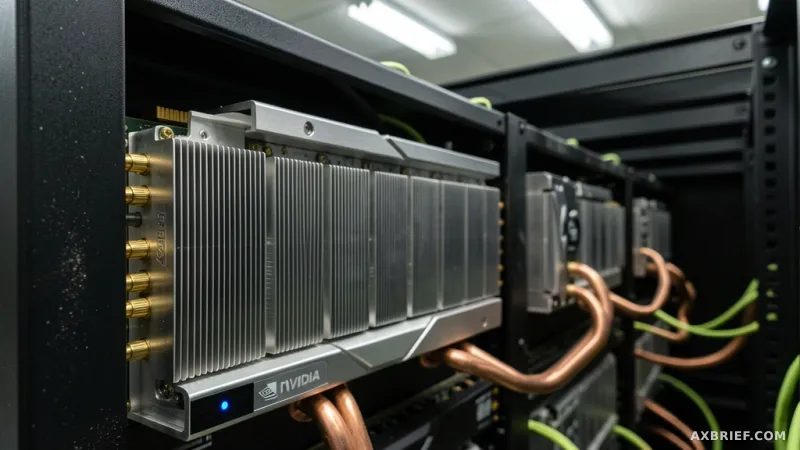
This performance gap is driven by a strategic move toward deep hardware integration. The NVIDIA Grace Hopper superchip represents a departure from the traditional split between the CPU and GPU. In standard systems, data must travel across a relatively slow bus between the processor and the accelerator, creating a bottleneck. The Grace Hopper architecture eliminates this boundary by combining the Grace CPU and the GPU into a single module with shared memory. This design minimizes the overhead associated with data transfer, which is critical for memory-intensive AI workloads. To date, the Grace CPU has been adopted by 26 major systems, with 2.5 million units shipped into production environments.
Building on this, the NVIDIA Vera CPU has been introduced to optimize the high-load workloads required by AI agents. Unlike simple LLMs that generate text, AI agents must execute code, interact with external APIs, and evaluate their own results in a recursive loop. Vera is designed specifically for this level of operational complexity. Meanwhile, the next generation of hardware is already arriving via the Blackwell architecture. Systems utilizing B200 and GB200 chips are now appearing across Asia, Europe, and the United States, with Japan recently debuting its first GB200 systems to accelerate the construction of regional AI factories.
Connecting these individual chips into a cohesive brain requires more than just power; it requires a nervous system. This is where NVIDIA Quantum InfiniBand comes into play. While some systems rely on standard Ethernet, the most demanding high-performance environments use InfiniBand to reduce latency and allow thousands of GPUs to act as a single, massive computational resource. This combination of integrated chips and ultra-high-speed networking is what allows an AI factory to function. Unlike a traditional data center, which acts as a warehouse for storing and managing information, an AI factory is a production facility where raw data is the input and intelligence is the finished product.
Efficiency and the Exascale Frontier
As the scale of these systems grows, power consumption has become the primary constraint. The Green500 list, which measures performance per watt, highlights that raw power is useless if it cannot be cooled or funded. The KAIROS system at the University of Toulouse in France currently holds the top spot on the Green500, powered by the Grace Hopper superchip. It achieves an efficiency of 73.3 gigaflops per watt. The dominance here is nearly absolute, with 9 of the top 10 most efficient systems using NVIDIA technology and 8 of them specifically utilizing NVIDIA GPUs. In an era where electricity costs and cooling infrastructure can bankrupt a project, energy efficiency is the only way to maintain high uptime for massive models.
At the absolute peak of performance, the JUPITER system at the Jülich Supercomputing Centre in Germany has become Europe's first exascale system, capable of performing one quintillion operations per second. JUPITER is not merely a benchmark; it is being deployed for high-precision tasks such as mapping the human brain at a cellular level, simulating global climate patterns, and developing AI algorithms for 6G networks. By crossing the exascale threshold, scientific research is shifting from macro-observation to micro-simulation, allowing researchers to model biological interactions in real-time that would have previously taken decades to compute.
This infrastructure is scaling across entire continents. In Europe alone, 35 NVIDIA AI HPC supercomputers are currently in development, intended to serve over 3 million researchers. This standardization of hardware creates a massive secondary benefit: software compatibility. When an entire continent's research community uses the same technical stack, the friction of sharing models and datasets vanishes. Researchers can stop spending their time optimizing code for specific hardware quirks and instead focus on improving the algorithms themselves.
For the practitioner, this hardware hegemony translates directly into a competitive advantage. In a world of AI factories, the speed of the infrastructure dictates the speed of the software. A team with access to a GB200 cluster can iterate on hyperparameters and validate model versions in a single day, while a team on legacy hardware might spend a month on the same cycle. This creates a feedback loop where those with the best hardware can perform more experiments, find more errors, and optimize their models faster. The gap in hardware performance eventually manifests as a gap in software sophistication. As nations from South Africa to Saudi Arabia and Singapore race to build their own sovereign AI systems, the ability to secure this specific infrastructure has become a matter of national competitiveness.



