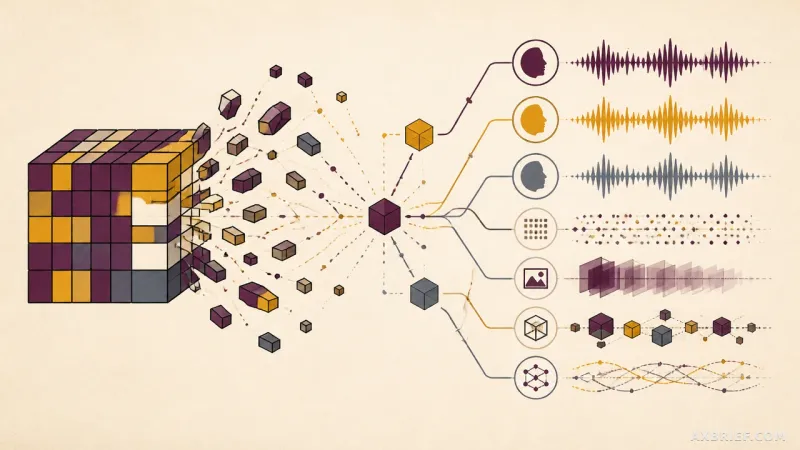
The modern AI engineer lives in a state of perpetual cognitive overload. Every morning begins with a flood of new pre-prints on ArXiv and a wave of trending repositories on GitHub, creating a professional environment where the fear of missing out is a constant psychological weight. For years, the gold standard for growth was exhaustive reading, but this approach has hit a ceiling of diminishing returns. The sheer volume of information has transformed the primary challenge of the field from access to filtration. Engineers are no longer struggling to find information; they are struggling to survive the firehose. This has led to a quiet but decisive shift in how the most effective practitioners learn, moving away from static text and toward curated, visual, and execution-oriented information streams.
The Architecture of AI Education
To navigate this landscape without burnout, the learning process must be categorized into four distinct functional streams: core concept education, research decomposition, practical building, and industry analysis. Each stream serves a specific cognitive purpose, ensuring that the engineer does not just memorize API calls but understands the underlying physics of the models they deploy.
At the foundation are the core concept educators who dismantle the black box of neural networks. Andrej Karpathy, a founding member of OpenAI and former AI Director at Tesla, leads this charge with his Neural Networks: Zero to Hero series. His approach is pedagogical rigor through implementation, where he avoids high-level abstractions to show how mathematical principles translate directly into Python code. By building models from the ground up, learners witness exactly how weights shift and how data flows through a network. Similarly, Harrison Kinsley of Sentdex provides a raw look at the machinery through his Neural Networks from Scratch in Python playlist. By eschewing frameworks like PyTorch or TensorFlow, Kinsley forces the learner to manually code weight updates and backpropagation, ensuring total control over the model's internal operations.
For those who struggle with the abstract nature of statistics, Josh Starmer of StatQuest provides a visual translation layer. His Machine Learning playlist converts complex formulas into intuitive diagrams, making the logic of data classification and prediction accessible without sacrificing technical accuracy. Complementing this is DeepLearning.AI, founded by Andrew Ng, which offers a structured, university-grade curriculum. The AI for Everyone series serves as a critical entry point, stripping away the hype to provide a grounded understanding of what AI can and cannot do, creating a cohesive theoretical framework that prevents the fragmented knowledge typical of tutorial-hopping.
Once the foundation is set, the focus shifts to research and paper breakers. Károly Zsolnai-Fehér of Two Minute Papers specializes in rapid intuition, condensing high-level research on generative video and fluid physics into short, visual summaries. This allows engineers to scan the horizon of possibility quickly. For those who need to move from intuition to implementation, Yannic Kilcher provides the deep dive. His Machine Learning Papers Explained playlist uses a virtual whiteboard to dissect the mathematical proofs and architectural nuances of new papers, providing the blueprint necessary to actually replicate the research.
The third pillar consists of practical AI builders who focus on production-grade deployment. AI Jason focuses on the frontier of orchestration, specifically using LangChain to build multi-agent systems. His tutorials demonstrate how to coordinate multiple LLMs to handle complex, multi-step tasks, moving beyond simple chat interfaces into autonomous agent territory. AssemblyAI complements this by focusing on the integration layer, explaining how to utilize modern APIs to build scalable LLM applications. Adding a strategic layer to this is Vinod Chugani, who emphasizes Agentic AI and the creation of executable frameworks for automation workflows, focusing on the transition from a model that talks to a system that acts.
Finally, industry analysts provide the critical filter. AI Explained offers a skeptical, evidence-based analysis of new foundation model releases. Rather than repeating marketing claims, the channel scrutinizes benchmark numbers against real-world performance, giving engineers an objective metric for deciding which model to integrate into their stack. Matt Wolfe fills the productivity gap with AI News and Tools, identifying software that automates specific business processes. His focus is not on the architecture of the model, but on the efficiency of the workflow, allowing engineers to optimize their own productivity while they study the deeper mechanics of the field.
From Passive Consumption to Production Engineering
The critical insight for the modern practitioner is that these channels are not interchangeable; they are components of a sequential pipeline. The failure of most AI learning paths is the attempt to jump straight into the research or implementation phase without the core conceptual foundation. An engineer who watches Yannic Kilcher's deep dives without first understanding the first-principles approach of Karpathy will find themselves trapped in a cycle of copying code without understanding why it works. The tension lies in the gap between knowing a tool exists and understanding the mathematical necessity of its design.
When a practitioner aligns these streams, a powerful synergy emerges. The research path—combining Two Minute Papers for breadth and Yannic Kilcher for depth—allows an engineer to anticipate the next shift in architecture before it becomes a standard library. Meanwhile, the implementation path—using AI Jason and AssemblyAI—transforms that theoretical knowledge into a functional product. The real twist, however, is the role of the industry analysts. By pairing the technical skepticism of AI Explained with the tool-centric approach of Matt Wolfe, the engineer creates a high-pass filter. They can ignore the noise of the weekly hype cycle and only invest time in technologies that have both technical merit and practical utility.
This structured approach transforms the learner from a passive consumer of content into a production engineer. Instead of following a random assortment of tutorials, the practitioner builds a full-stack learning loop: they master the math, code the mechanism from scratch, analyze the latest paper, implement the architecture via an agentic framework, and validate the result against industry benchmarks. This loop reduces the time spent on ineffective learning and maximizes the time spent on building value.
The Strategy for Selective Curation
For those currently overwhelmed by the volume of information, the solution is a strategy of aggressive subtraction. Rather than subscribing to every emerging AI channel, the most efficient path is to select exactly one channel from each of the four categories and commit to a thirty-day intensive cycle. This prevents the fragmentation of attention and allows the learner to determine if a specific educator's style matches their cognitive speed.
For the professional engineer, the goal is to build a personalized curriculum that mirrors the development of a model: start with a broad base of general knowledge, fine-tune with specific research, and optimize for a particular production use case. This means prioritizing core concept channels when the foundation is shaky and shifting toward industry analysts when the goal is rapid deployment. In a professional environment, the ability to rapidly filter and implement the correct piece of information is significantly more valuable than the ability to read every paper published on ArXiv.
Ultimately, the competitive advantage in the AI era is no longer defined by who has access to the most information, but by who has the most efficient system for processing it. By replacing the chaos of endless scrolling with a curated pipeline of visual and technical expertise, engineers can move from a state of burnout to a state of mastery. The path to becoming a top-tier AI practitioner is not found in the volume of content consumed, but in the strategic selection of the streams that drive actual implementation.