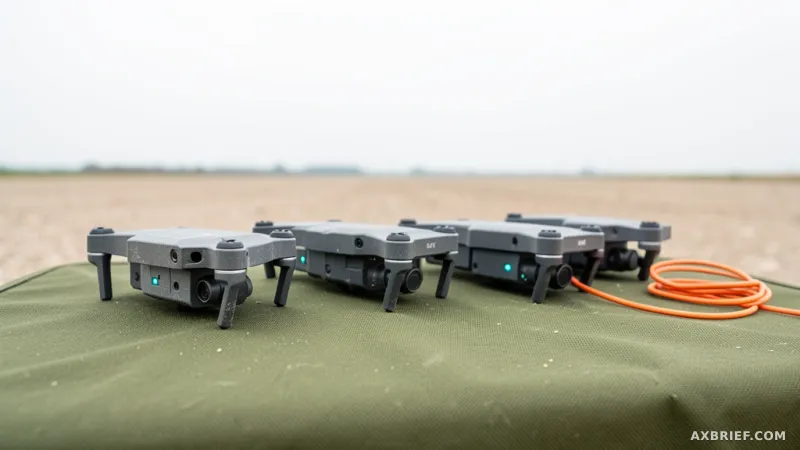
Modern battlefields in Ukraine and the Middle East have fundamentally rewritten the rules of engagement. The era where air superiority was the exclusive domain of expensive jets and specialized pilots has vanished, replaced by a reality where cheap, off-the-shelf First Person View drones can neutralize multi-million dollar tanks in seconds. This democratization of precision strike capability has forced a global reckoning in defense procurement. In response to this shift, the South Korean Ministry of National Defense (MND) announced its Defense Drone and Anti-Drone Development Policy on the 26th, signaling a total pivot toward an unmanned combat system.
The Blueprint for an Unmanned Combat Force
The MND is moving to integrate drones not as a niche asset for specialized units, but as a universal combat tool available to every soldier. At the center of this strategy is the goal to cultivate 500,000 drone warriors. These are not merely operators but soldiers trained to integrate unmanned aerial vehicles (UAVs) into tactical maneuvers as naturally as they handle their primary firearms. To support this massive human capital shift, the ministry is introducing 60,000 domestic educational drones to build a baseline of competency across the entire force.
On the hardware front, the MND is prioritizing quantity and attrition. The plan calls for the acquisition of over 20,000 low-cost disposable drones. Unlike traditional high-precision military aircraft, these are designed to be consumed in the line of duty, performing short-range reconnaissance or acting as one-way suicide drones to identify and strike enemy positions. For more strategic, long-range requirements, the ministry is pushing for the operational deployment of the K-LUCAS (K-Low-cost Uncrewed Combat Attack System), a Korean-made long-range suicide UAV designed to penetrate enemy air defenses.
This offensive capability is being paired with AI-driven swarm technology. By deploying multiple drones that communicate and coordinate in real-time, the MND aims to saturate enemy defenses, forcing the adversary to divide their attention and resources across dozens of simultaneous targets. To counter similar threats, the MND is implementing a tiered anti-drone strategy. Immediate priority is given to deploying commercial anti-drone systems in forward-deployed areas by next year. In the long term, the focus shifts to directed energy weapons, specifically lasers to burn through drone hulls and high-power microwaves to fry electronic circuits instantly. To keep the cost of defense sustainable, the ministry is also developing low-cost interceptor drones to neutralize cheap threats without wasting expensive missiles.
Shifting the Paradigm from Specialist to Standard Issue
The true disruption in this policy is not the number of drones, but the conceptual shift in how the soldier interacts with technology. For decades, drone operations were a top-down support function where a specialized unit provided intelligence to a ground commander. The MND is flipping this hierarchy. By treating the drone as a second personal weapon, the individual soldier gains immediate, organic visibility of the battlefield and an independent strike capability. This removes the latency of requesting air support and places the power of reconnaissance and precision attack directly in the hands of the infantry.
This transition requires a complete overhaul of the defense industrial complex. To avoid the bottlenecks of traditional procurement, the MND is introducing a multiple-award bidding system for the 60,000 educational drones. This is a first for the defense sector, designed to break the monopoly of large prime contractors and allow small and medium enterprises (SMEs) to enter the market. By lowering the barrier to entry, the government is effectively crowdsourcing innovation from the private sector to keep pace with the rapid iteration cycles seen in commercial drone tech.
To ensure these commercial tools are secure, the MND is benchmarking the U.S. Department of Defense's Blue-UAS program to create a Korean military certification system. This allows the military to vet the security and interoperability of private-sector drones before they hit the field. Furthermore, the ministry is coordinating with the Ministry of Land, Infrastructure and Transport and the Ministry of Trade, Industry and Energy to standardize core components like batteries and to develop standardized drone munitions. This ecosystem is managed by the newly established Defense Drone Headquarters, led by a Major General. By consolidating combat development, acquisition, and civil-military cooperation into one hub, the MND is attempting to synchronize the slow pace of military bureaucracy with the lightning-fast cycle of AI and robotics development.
This structural reorganization ensures that the Army, Navy, Air Force, and Marine Corps can develop specialized tactics while remaining under a unified command for all-domain integrated operations. The result is a military that no longer views the drone as a tool, but as a fundamental component of the modern soldier's kit.