
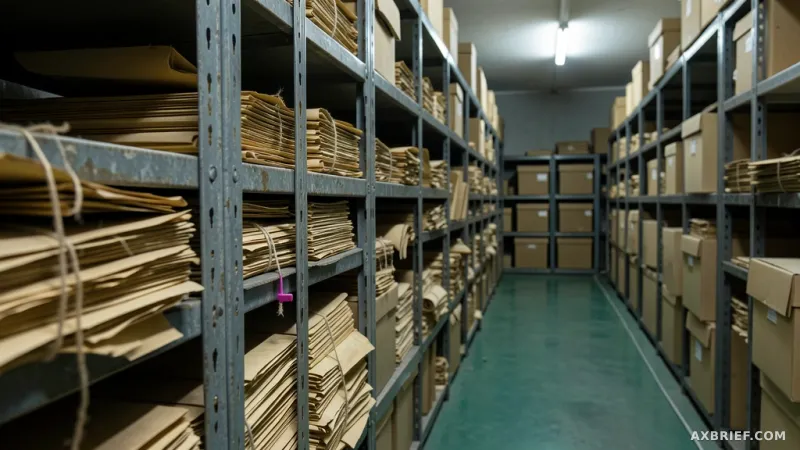
Every serious researcher knows the specific frustration of the digital archive hunt. It usually begins with a promising lead in one database, followed by a tedious journey across five different institutional websites, and ends with a chaotic document of copy-pasted snippets and broken citations. This invisible tax on curiosity creates a high barrier to entry for history, where the effort required to find information often outweighs the joy of discovering it. On July 4, the Theodore Roosevelt Presidential Library in Medora, North Dakota, aims to eliminate this friction entirely by debuting a concept known as the Living Library.
The Architecture of a Living Library
The physical structure in Medora reflects a commitment to the environment, featuring a facade covered in native grasses and a design that maximizes natural light through strategic skylights. While the interior houses meticulous recreations of Roosevelt's private residence and the White House, the true engine of the institution is an interactive AI system. Visitors do not simply look at glass cases; they engage with an AI-driven Roosevelt avatar. This interface allows guests to chat directly with a digital representation of the 26th president, asking specific questions about his leadership philosophy, his life experiences, and the lasting legacy of his conservation efforts. This marks a fundamental shift from the passive observation of records to an active, conversational acquisition of knowledge.
Beyond the physical walls of the library, the institution provides global access through the Campfire Reading Room. This digital research tool allows users anywhere in the world to navigate Roosevelt's vast array of correspondence, images, and historical records. The system removes the need for specialized archival identifiers or complex Boolean search strings. Instead, users employ natural language to query the archive, and the AI retrieves responses grounded directly in Roosevelt's actual documents. This implementation transforms fragmented historical data into a seamless interactive service, making the records of the frontier legend accessible to the general public without requiring a degree in archival science.
From Fragmented Data to the Box 1 Knowledge Base
The technical challenge of this project lay in the extreme fragmentation of the source material. Historically, Roosevelt's records were scattered across 18 different institutions, comprising 32 separate collections. For a human researcher, synthesizing these into a single narrative was a labor-intensive process of manual cross-referencing. To solve this, the Microsoft AI For Good Lab developed a central knowledge backbone called Box 1. This system ingested hundreds of thousands of unstructured archival documents, each arriving in different formats and storage standards, and unified them into a single, coherent digital environment.
The transformation of these documents followed a rigorous three-stage pipeline. First, the system performed an organization phase, where scattered documents were systematically categorized. Second, it entered an augmentation phase, where the AI identified hidden contexts within the text and appended metadata to make the information machine-understandable. Finally, the reconstruction phase linked these fragmented pieces of data to build a comprehensive historical record. The result is not a simple file repository, but a context-aware knowledge base that maintains the relationships between different documents and events.
This methodology provides a scalable model for other cultural institutions struggling with unstructured data. By demonstrating that hundreds of thousands of disparate documents can be structured into a searchable knowledge base, Microsoft has proven the practical efficiency of AI-driven data integration. Because the project aims for an open-source implementation, it establishes a standardized approach that other libraries and museums can adopt to modernize their own archives without starting from scratch.
Persona Engineering and the End of the Static Archive
The transition from 32 fragmented collections to a single natural language interface fundamentally changes the user experience. The barrier to entry for archival research has been lowered to the level of a simple conversation. Users no longer need the guidance of a professional librarian or a complex set of keywords to find a specific historical nuance; they simply ask, and the system retrieves the evidence from the primary sources.
However, the project goes beyond simple retrieval by implementing a digital persona. The AI avatar is trained not only on the facts of Roosevelt's life but also on his distinct personality and sense of humor. During demonstrations, the avatar has shown the ability to engage in witty banter, such as joking with a senator that the office is a place for those who tell the truth, implying that senators might be the exception. The AI is designed to use the general characteristics of social groups to maintain this persona, even when it does not have specific data on a modern individual. This creates an immersive experience where the visitor feels they are interacting with a living personality rather than a search engine.
To ensure the system is appropriate for a public facility, the team implemented PG-rated safety protocols. The AI includes redirection features that allow it to politely decline prohibited topics and steer the conversation back to historical or educational themes. Furthermore, the system is designed for continuous growth. When new documents are added to Box 1 or the underlying generative AI models are upgraded, the avatar's context updates automatically. This eliminates the need for manual prompt engineering or constant retraining, ensuring the Living Library evolves in real-time as more history is uncovered.
The Blueprint for Cultural Heritage AI
The most significant value of the Roosevelt project is not the specific library it serves, but the technical blueprint it provides for the rest of the world. Microsoft AI For Good Lab treated this project as a technical donation, focusing on creating a guide that other cultural institutions can follow. Rather than delivering a closed-box product, Microsoft plans to publish a detailed research paper and release the software as open source.
By providing the theoretical foundation in a paper and the practical implementation in open-source code, the project bridges the gap between academic AI research and real-world application. Developers at other institutions can inspect the internal logic, modify the code to suit their specific data types, and optimize the system for their own collections. For public archives and cultural centers, this represents a strategic shift. Instead of spending massive budgets on proprietary, one-off solutions, they can now leverage a verified open-source model to reduce costs and accelerate deployment.
For the practitioners of digital archiving, the key takeaway is the standardization of the data augmentation and reconstruction workflow. Once the open-source model is available, the primary task for a library shifts from building the system to defining the data cleaning rules and mapping them to the existing architecture. The transition from a static storage unit to an interactive service is now a matter of workflow execution rather than experimental discovery.
The era of navigating fragmented records through endless copy-pasting is ending. As the Box 1 system demonstrates, the integration of AI into archival work transforms static documents into a living, breathable knowledge base. The true value of an archive is no longer measured by the volume of its preservation, but by the density of the searchable context it provides to the world.



