A miniature Formula 1 car screams across a track in Vienna, hitting a ramp at high speed. As the vehicle launches into the air and slams back onto the pavement, the chassis pitches violently, and the horizon shifts. For most autonomous driving systems, this moment of physical instability is a breaking point where the internal map diverges from reality and the vehicle loses its trajectory. This specific struggle with three-dimensional terrain defines the current frontier of physical AI, where the gap between digital perception and physical movement often leads to catastrophic failure.
The Gauntlet of ICRA 2026
From June 1 to June 5, 2026, the international robotics community gathered in Vienna, Austria, for the ICRA 2026 official autonomous driving competition, known as RoboRacer. This event serves as a high-stakes proving ground for the world's leading academic institutions, utilizing 1/10 scale models of Formula 1 vehicles to test the limits of perception, path planning, and control algorithms. The competition featured 37 elite teams from across the globe, including heavyweights such as the University of Pennsylvania from the United States, ETH Zurich from Switzerland, the University of Bonn from Germany, TU Wien from Austria, and the University of Bologna from Italy.
These teams were tasked with developing an end-to-end autonomous stack capable of navigating a complex track while maximizing speed and maintaining precise obstacle avoidance. The UNIST Unicorn Racing Team entered the competition with a point to prove, having secured a runner-up finish the previous year. To move from second to first, the team focused on the most volatile variable of the course: the three-dimensional geometry of the track. By the end of the event, the Unicorn Racing Team successfully claimed first place, outperforming 36 other global teams in a display of superior spatial awareness and vehicle control.
The 3D LiDAR Gamble and the Compute Trade-off
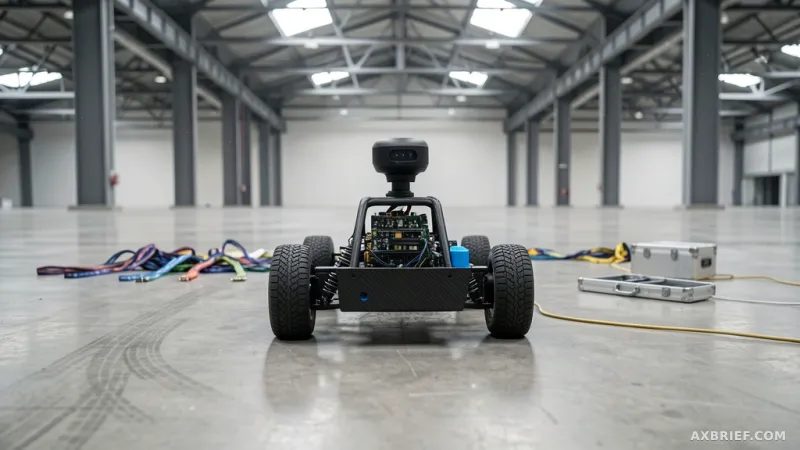
While most competing teams relied on traditional 2D LiDAR sensors, the UNIST Unicorn Racing Team made a strategic pivot by integrating 3D LiDAR. A 3D LiDAR sensor operates by emitting light pulses to perceive the surrounding environment as a dense three-dimensional point cloud, providing a far more granular understanding of the world than a flat 2D slice. However, this advantage comes with a massive computational tax. Processing vast amounts of 3D spatial data in real-time requires significant onboard computing power, a resource that is strictly limited in a 1/10 scale racing vehicle.
This computational burden is why the majority of the 37 teams stuck with 2D sensors; the risk of latency in the control loop often outweighs the benefit of better data. The ICRA 2026 course amplified this tension by incorporating ramps and bridges, creating a truly volumetric environment. When a vehicle jumps or descends, a 2D sensor often misinterprets the change in elevation as a wall or a void, leading to erratic steering or sudden braking. UNIST solved this by developing a specialized integration of 3D localization, path planning, and control algorithms that could operate within the vehicle's limited hardware constraints.
By optimizing how the 3D point cloud data was fed into the control loop, the Unicorn Racing Team ensured that the vehicle could maintain a consistent pace even during high-impact transitions. While other cars struggled with chassis instability and path deviation during jumps, the UNIST vehicle remained locked onto its trajectory. The victory demonstrates that the bottleneck in physical AI is not necessarily the quality of the sensor, but the efficiency of the pipeline that translates high-resolution data into immediate physical action.
This triumph marks a shift in autonomous racing, proving that high-fidelity 3D perception can be successfully deployed in real-time, resource-constrained environments. The ability to maintain stability amidst physical chaos is now the primary benchmark for the next generation of autonomous systems.