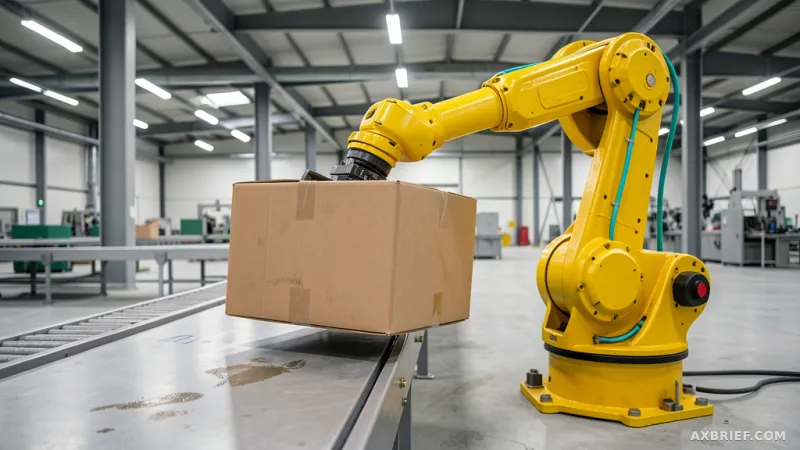
For decades, the deployment of an industrial robot arm has followed a grueling, manual ritual. An engineer spends days, sometimes weeks, painstakingly inputting thousands of precise coordinates to ensure a gripper moves from point A to point B without colliding with a support beam or a conveyor belt. A single decimal error in one waypoint can trigger a catastrophic collision or a line stoppage, resulting in economic losses that ripple through the entire supply chain. This friction has long been the hidden tax on manufacturing automation, turning what should be a software update into a hardware nightmare.
The Architecture of Software-Defined Automation
At Automate 2026, held from June 22 to 25, Vention unveiled a strategic pivot designed to erase this manual overhead through software-defined automation. This approach integrates hardware control directly into software logic, allowing manufacturers to manage physical assets with the same flexibility as a cloud application. To achieve this, the Montreal-based company established a deep integration ecosystem with FANUC America, Universal Robots (UR), and Teradyne Robotics. The goal is to move away from fragmented system integration and toward a unified environment where design, simulation, and deployment happen in a single loop.
This expansion is backed by significant capital. In January, Vention secured $110 million in funding to accelerate the convergence of its modular hardware and AI-driven software. The company has already deployed over 25,000 pieces of equipment across 4,000 factories globally, providing a massive data foundation for its full-stack platform. By combining modular hardware with physical AI, Vention now offers turnkey automation solutions that can be designed and programmed in a matter of days rather than months.
The scope of this integration covers a vast array of industrial needs. For FANUC users, the platform supports everything from the CRX series of collaborative robots to the high-precision LR Mate and the mid-sized LR-10iA. For heavy-duty applications requiring high rigidity and payload, the system integrates the M-710iD and M-20iD series. This allows the software-defined approach to scale across diverse use cases, including machine tending, palletizing, welding, and high-speed industrial pick-and-place operations.
For those utilizing Universal Robots, Vention has built a dedicated design environment that pre-loads the technical specifications and functional limits of the entire UR lineup. This ensures that any configuration created in the software is physically manufacturable and operationally viable before a single bolt is tightened. Furthermore, Vention provides an exclusive automation marketplace for UR+ components, allowing users to select validated end-of-arm tooling (EOAT) and 7-axis systems that are guaranteed to be compatible, effectively eliminating the compatibility risks that usually plague the integration phase.
From Manual Waypoints to AI-Driven Goals
The fundamental shift in Vention's approach lies in the transition from waypoint programming to goal-based automation. In traditional setups, the human operator is the pathfinder, defining every intermediate stop the robot must make. Vention replaces this with MachineMotion, an AI-driven path optimization engine, and MachineLogic, a comprehensive control ecosystem. Instead of mapping a path, the operator simply defines the start point and the end goal. The system then takes over, scanning the workspace and calculating the most efficient trajectory autonomously.
This capability is powered by the Foundation Stereo open model from NVIDIA Isaac. By utilizing stereo cameras that mimic human depth perception, the system employs zero-shot stereo depth estimation. This allows the robot to understand the depth and distance of an unfamiliar environment without requiring prior training on that specific space. The AI generates a high-fidelity 3D map of the surroundings, which is then mirrored in a digital twin. Within this virtual replica, MachineMotion calculates potential collisions between the robot arm and surrounding structures, deriving an optimal trajectory that is then pushed to the physical robot in real-time.
This transition solves a critical pain point for high-mix, low-volume (HMLV) production. In environments where product SKUs change frequently or factory layouts are rearranged to accommodate new orders, manual reprogramming is a productivity killer. With goal-based AI, the robot can adapt to a new layout or a different part geometry almost instantly. The system recognizes the change in the physical environment and recalculates the path without requiring an engineer to rewrite the coordinate list.
To further reduce integration friction, Vention has replaced custom engineering with a system of pre-validated modules. Historically, combining equipment from different vendors meant dealing with mismatched communication protocols and physical interfaces. Vention's modular framework ensures that every hardware component and software module is pre-certified for compatibility. This allows for high-fidelity simulation and cell-to-cell interaction testing before any physical assembly occurs. By validating the logic and the physical reach in a virtual environment, companies can bypass the trial-and-error phase of installation.
Programming flexibility is handled through a dual-track system. For rapid deployment, a no-code visual interface allows operators to adjust settings without writing a single line of code. However, for complex industrial logic that requires granular precision, the platform fully supports `Python`. This ensures that while the barrier to entry is lowered for general operators, power users still have the programmatic control necessary for sophisticated automation tasks.
The New Standard for Manufacturing Agility
For manufacturers facing chronic labor shortages and the pressure of shortened product lifecycles, the ability to redeploy a robot in hours rather than days is a competitive necessity. The traditional model of relying on a few highly skilled specialists to manually program every movement is no longer sustainable in a market that demands extreme flexibility.
By leveraging NVIDIA Isaac's spatial intelligence and a modular hardware approach, the focus of automation has shifted. The primary challenge is no longer the raw specification of the robot arm, but the speed at which that arm can be integrated into a functioning workflow. When the distance between a conceptual design and a production-ready cell is reduced to a software simulation, the risk of deployment vanishes.
Industrial automation is moving toward a future where the physical world is treated as a programmable interface. The ability to eliminate integration risk through pre-validated modules and autonomous pathing means that the factory floor can finally evolve as quickly as the software that controls it.