
The global community treats the ocean as a vast, blue void, despite it covering more than two-thirds of the planet's surface. For decades, the process of gathering high-fidelity marine data has remained a luxury reserved for superpowers and the wealthiest research institutions. To understand what is happening beneath the waves or across the horizon, an organization typically needs to commission a massive crewed vessel or deploy prohibitively expensive specialized equipment. This creates a physical and financial bottleneck where the cost of data acquisition scales linearly with the risk and size of the ship, leaving critical gaps in our understanding of supply chains, national defense, and ecological health.
The Satellite-Linked Architecture of Scout
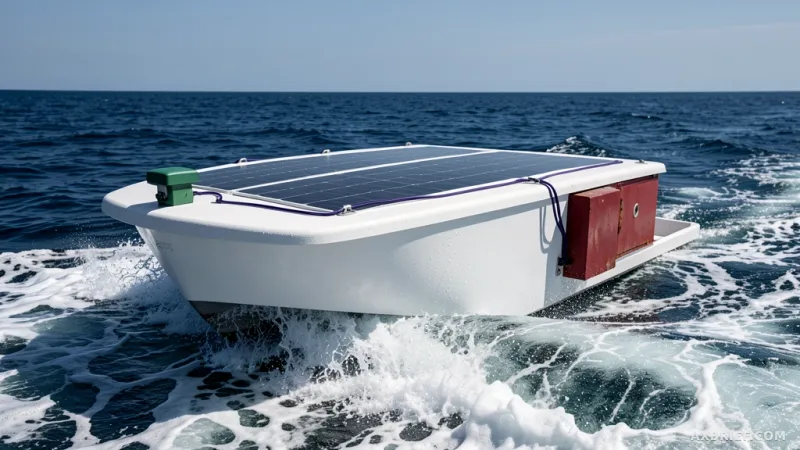
Online Oceans is attempting to collapse this barrier with the introduction of Scout, a solar-powered autonomous surface vehicle designed for long-term endurance. Unlike traditional research vessels that require a crew and a return trip to port to offload data, Scout operates as a persistent presence on the water. Powered by integrated solar arrays, the vessel can navigate the open ocean for several months at a time without human intervention. During these missions, it captures a comprehensive stream of environmental metrics, including wave height, weather patterns, the positioning of subsurface vessels, and biological monitoring data.
The hardware is only half of the equation. To solve the latency problem inherent in remote oceanography, Online Oceans developed Tether, a command center software that integrates directly with the boat via satellite. Instead of storing data on physical drives for later retrieval, Scout streams its findings in real-time through a satellite pipeline. This architecture transforms the boat from a sampling tool into a remote sensor node, allowing operators on land to access and analyze live data as it is collected. By removing the need for physical recovery to obtain information, the company has effectively decoupled the act of data collection from the logistics of ship management.
From Bespoke Shipbuilding to Modular Data Subscriptions
The true disruption of the Scout platform lies in its departure from the traditional maritime engineering philosophy. Historically, if a researcher needed a boat to measure salinity and another to track whale migrations, they would either need two different ships or a single, highly customized vessel that was expensive to build and impossible to repurpose. George Merten, CEO of Online Oceans, describes the Scout platform as the Ford F-150 of the marine environment. Just as a pickup truck provides a standardized chassis and power source that allows the owner to throw whatever tool they need in the back, Scout provides the essential infrastructure of power and communication, leaving the sensor payload as a modular choice for the user.
This modularity shifts the value proposition from the hardware itself to the utility of the data. Merten's vision was sparked during his time at ExxonMobil, where he encountered the Wave Glider from Liquid Robotics and found the pricing to be an insurmountable barrier for most users. The realization was that the market did not necessarily need more expensive boats; it needed a cheaper way to access the data those boats provide. By separating hardware ownership from data access, Online Oceans has introduced a subscription-based model. Users no longer have to shoulder the massive capital expenditure of purchasing and maintaining a fleet of autonomous vessels. Instead, they can subscribe to the data streams they need, effectively turning marine intelligence into a utility rather than a capital asset.
This economic pivot lowers the entry barrier for university labs and private research firms that were previously priced out of the market. The tension in the industry has long been between the high cost of precision and the low quality of satellite-only estimates. By deploying a fleet of low-cost, modular autonomous boats, Online Oceans provides a middle ground: high-precision, in-situ data without the million-dollar price tag of a dedicated research ship.
Online Oceans has already secured the financial backing to scale this vision, starting with a 1 million pound angel investment from Koro Capital and SolarCity founder Pete Livs. This was followed by a 4 million pound seed round led by Seraphin Space earlier this year to expand production capacity. The market demand is already manifesting in diverse sectors; while the company initially targeted defense, a recent deployment to the University of Hawaii for coral reef monitoring proves the platform's viability for environmental conservation. The company is currently facing a bottleneck where demand is outstripping production, forcing Merten to focus on aggressive hiring and manufacturing optimization to meet the backlog of orders. As they scale, they face a competitive landscape featuring Oshen, which focuses on autonomous swarms, and Quartermaster, which specializes in smart masts, but Online Oceans' bet on the modular, subscription-first approach positions them as the primary infrastructure layer for the next generation of ocean data.



