
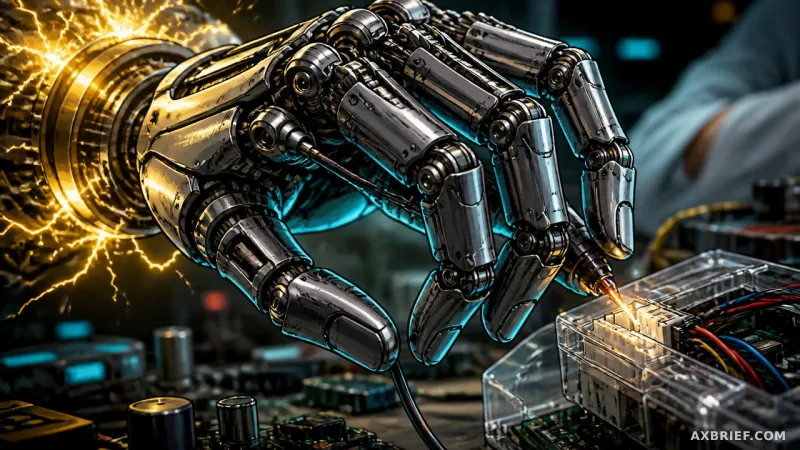
The tech world has become accustomed to the spectacle of humanoid robots. We have seen the viral clips of machines performing choreographed dances or navigating warehouse floors with uncanny balance. Yet, for all the progress in locomotion, a frustrating gap remains at the fingertips. While a robot can walk across a room, it still struggles to perform the mundane tasks that define human domesticity, such as zipping up a jacket or folding a linen shirt. This discrepancy between the ability to move and the ability to manipulate is the final frontier of embodied AI, and it is where the industry is now pivoting its entire focus.
The Precision Pivot at ICRA 2026
At the IEEE International Conference on Robotics and Automation (ICRA 2026), held from June 1 to June 5 in Vienna, Austria, the narrative shifted. The crowd at Messe Wien was less interested in how humanoids walk and more obsessed with how they touch. The central theme of the event was a move away from aesthetic mimicry toward functional dexterity. This shift was evident in the diverse array of specialized models on display. Direct Drive showcased the D1-modular robot, a machine designed for agility that could split its body into two parts to execute jumps, rotations, and navigate rugged terrain. Enchanted Tools presented Mirokaï, a social care robot characterized by its orange chassis and cat-ear design, emphasizing emotional connection over raw power.
Other exhibitors focused on niche utility. Tesollo demonstrated a humanoid with elongated arms capable of picking individual pieces of fruit and placing them into baskets, while Vietnam's Vinrobotics focused on the auditory feedback of joint movements to create a more approachable, interactive experience. Even the small Booster robots, which entertained crowds with kung fu and soccer demonstrations at the entrance, served as a foil to the deeper technical challenge: the manipulation gap. The industry has realized that the path to automating household chores like laundry does not lie in better legs, but in the sophisticated orchestration of the hand.
Into this void stepped TARS with the DexHand. Rather than approximating a hand, TARS attempted to replicate the human physical structure on a 1:1 scale. The DexHand implements 21 degrees of freedom (DoF) across the wrist and finger joints, mirroring the actual range of motion available to a human. This architectural choice provides the physical foundation necessary for fine motor skills, ensuring that wrist rotation and finger flexion work in a synchronized, organic manner.
Beyond the mechanical structure, the DexHand integrates a sophisticated sensory system capable of interpreting real-time tactile data. The fingertips do not just touch; they analyze. The system can distinguish between the slipperiness, roughness, and hardness of an object instantaneously. By fusing this haptic feedback with high-precision control algorithms, the DexHand can execute all 26 hand gestures corresponding to the English alphabet. This allows the robot to understand the state of an object through touch alone, adjusting its grip strength dynamically without relying solely on visual input.
During a live demonstration, the TARS humanoid successfully zipped up a backpack. While this seems trivial to a human, it requires immense precision to grasp the small metal head of a zipper and move it along a specific trajectory. This success highlights a critical realization in the field: the ability to perform fine motor tasks is the actual prerequisite for moving robots out of controlled laboratory settings and into unpredictable industrial or domestic environments.
Decoupling Locomotion from Dexterity
This technical leap by TARS aligns with a broader strategic shift in how robotic intelligence is being developed globally. The Advanced Research and Invention Agency (ARIA), a research body under the UK government, has formalized this approach through its Smarter Robot Bodies program. ARIA has made the strategic decision to treat locomotion and dexterity as two independent disciplines. The logic is that trying to build a perfect human replica in one go creates too many simultaneous bottlenecks. By separating the two, engineers can optimize the algorithms for movement and manipulation independently.
Under this framework, the locomotion division focuses on the unpredictable nature of physical space. Their goal is to ensure a robot can navigate uneven terrain, avoid obstacles, and maintain balance in real-world indoor and outdoor environments. Locomotion is viewed as the gateway; it determines whether a robot can reach the site of a task.
Conversely, the dexterity division focuses on the interaction. This involves solving the limits of how a robot perceives texture and applies force. The objective is to move beyond simple pick-and-place operations toward the nuanced force modulation required for complex assembly. If locomotion determines access, dexterity determines the utility and complexity of the work the robot can actually perform. The Smarter Robot Bodies program is scheduled for an official launch in early 2027, signaling a government-backed move toward functional specialization over general humanoid form.
This philosophy of industrial utility is the driving force behind TARS. Dr. Ding Wenchao, the visionary behind the project, has pushed the company to transition academic achievements into tangible productivity. This aggressive R&D trajectory allowed TARS to secure the largest angel and pre-seed investment in China's embodied intelligence sector within just 18 months of its founding. The funding was not used to make the robot look more human, but to optimize hardware and control algorithms for the factory floor.
The result of this focus was a Guinness World Record. TARS demonstrated that its system could complete the insertion of a robot wiring harness—a task involving flexible, deformable materials that are notoriously difficult for robots to handle—in under one hour. This is a landmark achievement because it proves that high-precision manipulation can meet the strict timelines and accuracy requirements of a real manufacturing process. In his keynote at ICRA 2026, Dr. Ding outlined a roadmap for industrial deployment, emphasizing that the goal is to define a field requirement, set an engineering target, and verify it through rigorous testing.
However, as robots move closer to human spaces, the conversation is shifting from what they can do to how they should do it. At the WOROBET (Robot Ethics Workshop), researchers debated the psychological impact of robotic intervention. Professor Yasuhisa Hirata of Tohoku University pointed to the use of detachable exoskeletons and cycling wheelchairs. He argued that these tools must be designed to support the user's self-efficacy. If a robot solves every problem for the user, it strips away their agency and motivation. The goal is to find the optimal level of assistance—enough to provide confidence, but not so much that the human becomes a passive observer of their own life.
This ethical tension was further explored by Professor Praminda Caleb Solly of the University of Nottingham, who conducted red-team exercises involving a teacher recovering from a stroke using a home assistant robot. The exercise questioned whether it is ethically justifiable for a designer to limit a user's autonomy under the guise of their own safety or benefit. For engineers, this means that the control algorithms for assistive robots must include clear parameters for when the robot should intervene and when it should defer to the user's intent.
Ultimately, the value of a robot is not found in its ability to mimic a human dance, but in its ability to fasten a small button with one second of absolute precision. The TARS DexHand and its 21 degrees of freedom represent a shift toward a more pragmatic era of robotics. The success of physical AI will not be measured by how much it looks like us, but by how much it reduces error and increases productivity in the real world. The threshold for industrial deployment is no longer the shape of the body, but the precision of the fingertip.



