The modern dental experience for a patient needing a crown is often a lesson in endurance and scheduling. It typically involves a grueling cycle of multiple appointments: the initial decay removal, the messy process of taking physical impressions, the fitting of a temporary crown, and finally, the placement of the permanent prosthetic. For the clinician, this translates to significant chair-time overhead and a fragmented workflow. However, a shift toward fully digital dentistry is underway, moving the industry away from manual sculpting and toward a future where the preparation of a tooth is as precise as the milling of the crown itself.
The Architecture of the Miniature Intraoral Robot
To solve the inefficiency of manual crown preparation, a research team at the University of Basel's Department of Biomedical Engineering has developed the Miniature Intraoral Robot, or MIR. This project is the result of a deep collaboration between the University of Basel, the University of Zurich, the University of Bern, and the medical device firm Camlog Biotechnologies GmbH. Funded by the Swiss innovation agency Innosuisse and developed with direct input from the University of Zurich Dental Center, the findings were published in the 2026 edition of IEEE Transactions on Medical Robotics and Bionics.
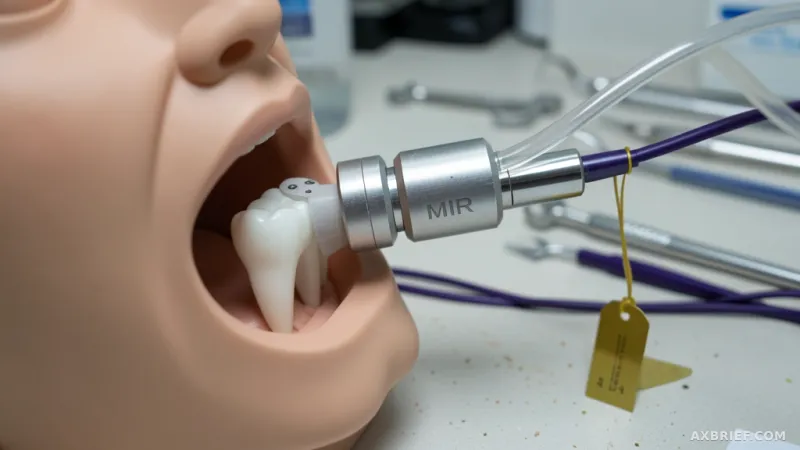
The primary objective of MIR is to automate the removal of tooth material according to a pre-defined digital plan. By integrating the scanning and shaping process into a single initial visit, the robot allows for the immediate ordering of a crown, effectively collapsing the traditional multi-visit timeline. To make this possible within the restrictive environment of a human mouth, the team engineered the robot's chassis to a compact 43x26x28mm—roughly the size of a wine cork.
Achieving this footprint required a radical departure from standard robotic design. Instead of housing motors within the device, the researchers moved the entire control system and motor assembly outside the patient's mouth. The internal unit is connected to the external power source via a network of flexible drive shafts, cables, and tubes. These flexible shafts are critical; they transmit rotational force from the external motors to the internal drill while navigating the curved paths of the oral cavity. This separation ensures that the device remains unobtrusive to the patient while maintaining the high torque necessary to carve through dental enamel.
To handle the complex geometry of a tooth, MIR employs a two-stage drilling mechanism. In the first stage, the robot utilizes a wide-diameter drill to remove the top surface of the tooth and establish the overall height. This initial pass creates a flat plateau, which serves as the necessary clearance for the second stage. In the second stage, the robot switches to a longer, thinner drill. This precision tool reaches deeper into the tooth and shapes the lateral walls with high accuracy, ensuring the final crown fits with a seamless margin. By reducing the drill diameter for the final shaping, the robot minimizes its rotational radius, allowing it to operate in tight spaces without risking damage to surrounding soft tissue.
The Mechanical Triumph of Sensorless Precision
What distinguishes MIR from typical surgical robots is not just its size, but how it achieves its accuracy. In the current prototype phase, the robot operates without any onboard position sensors or real-time feedback loops. Despite this lack of active sensing, the team recorded a positioning error of less than 0.2mm. This level of precision is a testament to the mechanical rigidity and the tight tolerances of the drive shaft system, proving that high-fidelity dental shaping can be achieved through superior mechanical engineering alone.
Safety in the oral cavity is measured not just by position, but by force. The research team ensured that the load exerted during the drilling process remained under 5N. To put this in perspective, 5N is roughly equivalent to the gravitational force of a 0.5L bottle of water. By keeping the force below this threshold, the system minimizes the risk of fracturing the tooth or causing pain to the patient. These metrics—the 0.2mm error margin and the 5N force limit—were validated using both synthetic resin models and ceramic models that mimic the hardness of human enamel. The consistency of these results across different material densities confirms the mechanical reliability of the MIR platform.
However, the transition from a laboratory prototype to a clinical tool introduces a new set of tensions. While the robot is precise in a static environment, a living patient breathes, swallows, and shifts. The current open-loop system cannot account for these micro-movements. To bridge this gap, the researchers are now working to integrate miniature cameras and sensors into the 43x26x28mm frame. This would enable a closed-loop control system capable of adjusting the drill position in real-time to compensate for patient movement.
Beyond movement, the team is addressing the psychological impact of the technology. The high-pitched whine of a dental drill is a primary source of patient anxiety, and the addition of robotic components could exacerbate this. The team is currently conducting acoustic analysis to implement noise-reduction measures. The ultimate engineering challenge lies in the density of the design: adding cameras, sensors, and sound-dampening materials without increasing the robot's physical footprint.
The viability of MIR depends on whether the 0.2mm precision and 5N force limit can be maintained once the device is moved from ceramic models to actual clinical environments. If the team can integrate real-time sensing without sacrificing the compact form factor, the robot will transform crown preparation from a manual art into a predictable, automated science.