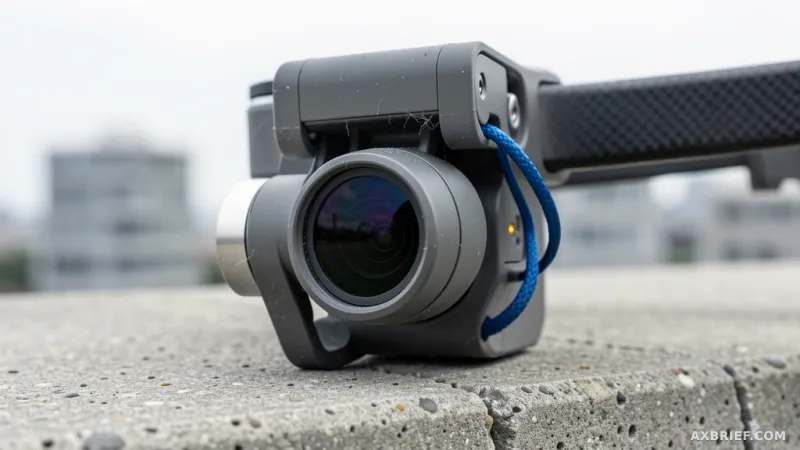
A drone weaving through a dense forest or a warehouse robot navigating a crowded floor relies on a constant stream of visual data to survive. Yet, as these machines increase their operational speed, they hit a physical wall: motion blur. When a camera moves rapidly, the resulting image often smears, turning a critical obstacle into a vague smudge. For the AI models responsible for object detection and SLAM, this degradation is not just a quality issue; it is a failure of perception that leads to erratic behavior or collisions.
The Architecture of the CPP2000
To address this gap in visual reliability, VeriSilicon has introduced the CPP2000, a dedicated Camera Post-Processing (CPP) IP designed specifically for mobile vision applications. While many developers rely on a standard Image Signal Processor (ISP) to handle the initial pipeline, the CPP2000 operates as a specialized extension of that process. In a traditional imaging chain, the ISP is responsible for the foundational conversion of light captured by the lens into a digital signal. The CPP2000 steps in after this initial stage to refine the image quality and enhance the visual perception capabilities of the system.
This IP is engineered for the rigorous demands of robotics, drones, and other mobile vision platforms. By implementing these enhancements at the hardware level, VeriSilicon aims to provide a more stable and reliable visual feed that can withstand the volatility of high-speed movement. Detailed technical specifications and integration options are available through the official VeriSilicon portal.
Shifting Perception from Software to Silicon
The critical distinction of the CPP2000 lies in where the processing occurs. Most current attempts to fix motion blur or image instability happen in the software layer, where algorithms attempt to sharpen frames or compensate for jitter after the data has already reached the main processor. However, software-based correction introduces latency and consumes significant computational overhead, which is a luxury that real-time autonomous systems cannot afford.
By moving post-processing into the hardware IP, the CPP2000 optimizes the data before it ever reaches the software stack. This approach fundamentally raises the visual floor of the system. When the hardware itself ensures that the image is optimized for perception, the downstream AI models are less likely to malfunction due to blurred inputs. This shift transforms the image from something that is merely visible to something that is computationally reliable.
In the realm of Physical AI, the reliability of a system is not determined solely by the resolution of the sensor, but by the precision of the processing pipeline. By integrating ISP expansion options directly into the hardware design, engineers can reduce the environmental variables that typically plague field deployments. The result is a vision system that maintains its integrity regardless of the machine's velocity.
This hardware-centric approach to image refinement ensures that the bridge between raw sensing and AI decision-making remains unbroken during high-speed maneuvers.