
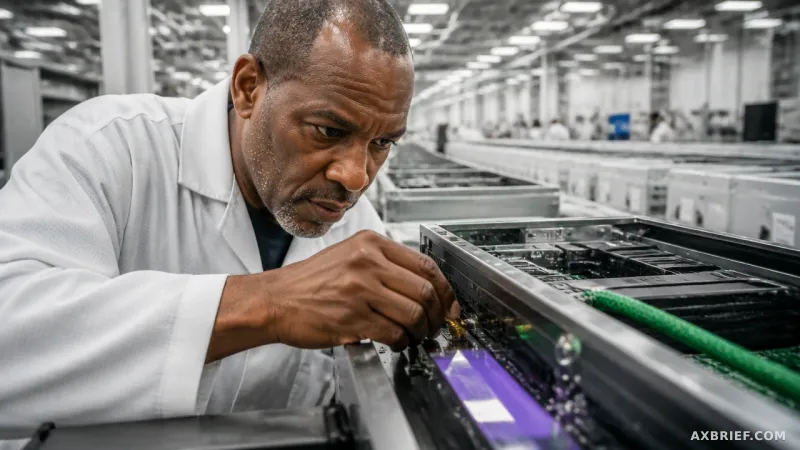
The global conversation around artificial intelligence has long been dominated by the invisible: the elegance of transformer architectures, the efficiency of quantization, and the raw TFLOPS of a silicon die. But as the industry moves from experimental clusters to planetary-scale infrastructure, the bottleneck has shifted from the digital to the physical. The current challenge is no longer just designing a faster chip, but figuring out how to build, house, and deploy massive hardware systems that resemble industrial power plants more than traditional servers. This week, the focus shifted to Fort Worth, Texas, where the physical manifestation of this shift has finally arrived.
The D1 Facility and the GB300 Pipeline
Wistron has officially inaugurated its D1 facility, a 324,000-square-foot greenfield plant in Fort Worth, Texas, marking a massive strategic pivot in the AI supply chain. With a total investment of $700 million, the facility is designed to serve as a primary production hub for the next generation of AI compute. The D1 plant is specifically engineered to mass-produce boards for the NVIDIA GB300 Grace Blackwell Ultra and the upcoming Vera Rubin superchips, with a target capacity of tens of thousands of units per month.
To support this scale, Wistron has already deployed an initial workforce of over 500 specialists, with plans to expand that headcount to 1,000 by the end of the year. This expansion is not merely a corporate growth milestone but a piece of a larger geopolitical and economic puzzle. NVIDIA CEO Jensen Huang has framed the establishment of such facilities as a cornerstone of the re-industrialization of the United States. By integrating chip fabrication, advanced packaging, and system assembly within domestic borders, NVIDIA aims to realize a commitment to manufacture up to $500 billion worth of advanced AI platforms in the U.S.
The operational reality of this partnership was cemented during the opening ceremony, where the first NVIDIA GB300 Grace Blackwell Ultra superchip produced at the D1 facility was unveiled. The act of Jensen Huang personally signing the chip served as a symbolic transition from the design phase to the era of mass production. For Wistron and the Taiwanese government officials in attendance, the facility represents a critical hedge against supply chain volatility, ensuring that the most advanced AI hardware in existence can be scaled and delivered without the friction of transoceanic logistics.
The Digital Twin Blueprint
While the D1 facility is a triumph of physical engineering, its existence was first perfected in a virtual environment. Wistron did not simply break ground and hope for the best; instead, they utilized NVIDIA's full digital twin stack to simulate every square inch of the factory before a single piece of equipment was installed. This approach allowed engineers to treat the factory itself as a piece of software that could be debugged and optimized in real-time.
The technical foundation of this process relied on the NVIDIA Omniverse 3D design collaboration platform, integrated with Metropolis visual AI analysis tools and the PhysicsNeMo physical law calculation framework. By creating a high-fidelity digital twin, Wistron was able to verify the layout of the assembly lines, numerically derive the most efficient paths for component movement, and eliminate design risks that would typically cause costly delays during physical construction. This simulation-first methodology ensured that the transition from blueprint to factory floor was seamless, drastically reducing the time required to reach peak yield.
To further refine the human element of production, Wistron integrated frontier models including Nemotron and Cosmos. These large language and vision models were used to translate complex Standard Operating Procedures (SOPs) into immersive virtual training modules. Before stepping onto the actual factory floor, workers underwent virtual training to master the assembly process, allowing the company to analyze human movement and equipment interference to preemptively eliminate safety hazards. Meanwhile, the PhysicsNeMo framework simulated variables such as component weight, friction, and inertia, ensuring that the mechanical arms and conveyor systems could handle the massive scale of the hardware without failure. By the time the physical plant opened, the design, process verification, and personnel training were already complete, allowing the D1 facility to bypass the typical inefficiency of a startup phase.
This shift in manufacturing philosophy reveals a deeper truth about the current state of AI hardware. The complexity of the GB300 system is so immense that traditional trial-and-error manufacturing is no longer viable. When a single system consists of 1.5 million precision-assembled parts and weighs 2 tons, a minor misalignment in the assembly line can result in millions of dollars in waste. The use of digital twins transforms the factory from a static building into a dynamic, optimizable system, mirroring the very AI it is designed to produce.
The industrialization of the GB300 marks the end of the boutique era of supercomputing. For years, the most powerful AI clusters were hand-built by small teams of elite engineers in a process akin to artisanal craftsmanship. Wistron is now transitioning this into a volume production model, treating the assembly of a $4 million supercomputer with the same standardized rigor used to manufacture smartphones. By removing manual variability and standardizing the process for 1.5 million components, Wistron is addressing the global supply chain bottleneck that has hindered the deployment of massive AI clusters.
Jensen Huang views these AI factories as the new fundamental infrastructure of society, comparable to the roads, railways, and agricultural systems of the past. In this new paradigm, the AI factory is a machine that consumes electricity and produces tokens. The ability to mass-produce the GB300 is not just a business win for Wistron; it is the physical expansion of the world's total cognitive capacity. The competitive edge in the AI race has moved beyond who can design the best chip to who can reliably build and deploy the most massive systems at scale.
As AI systems evolve into two-ton behemoths of silicon and steel, the true measure of power is no longer found in a benchmark score, but in the capacity of a factory floor. The victory in the AI infrastructure war will belong to those who can master the physical logistics of 1.5 million parts per unit and the precision of monthly mass production.



