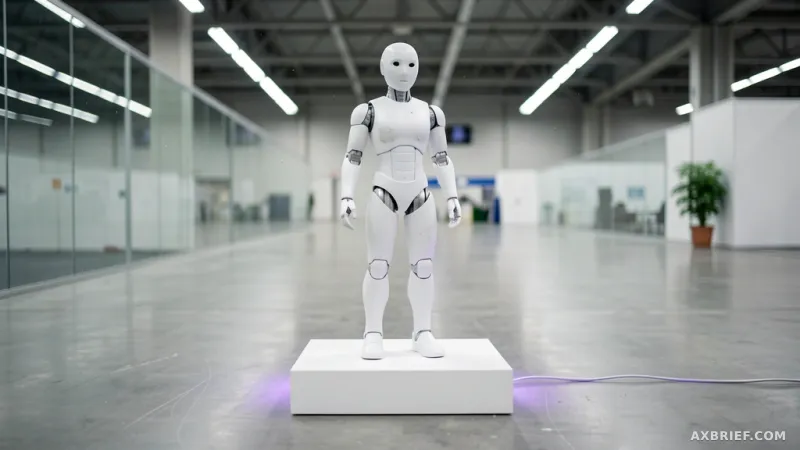
For the past few years, the global perception of artificial intelligence has been confined to the glow of a monitor. We interact with LLMs through text boxes and generate art via prompts, experiencing intelligence as a digital service that lives in the cloud. However, a fundamental shift is occurring. The industry is moving beyond the screen, pushing intelligence into the physical world where torque, friction, and spatial awareness matter more than token probability. This transition from digital intelligence to embodied action is the central theme of the upcoming 2026 World Robot Conference (WRC), which transforms Beijing into a living laboratory for the next era of computing.
The Scale of the 2026 World Robot Conference
Scheduled to take place from August 19 to 23, the 2026 World Robot Conference will be hosted at the Yizhuang International Exhibition Center within the Beijing Economic-Technological Development Area. The event is a joint effort between the Chinese Institute of Electronics (CIE) and the World Robot Cooperation Organization, designed to showcase the current state of robotics on a massive scale. The venue spans an indoor and outdoor exhibition area of over 50,000 square meters, providing ample space for more than 200 domestic and international exhibitors to display their latest breakthroughs in humanoid, industrial, and service robotics.
The scale of attendance reflects the urgency of the current robotics race. Organizers expect over 20,000 industry experts who have already completed pre-registration, alongside approximately 130,000 general visitors. Beyond the crowds, the conference serves as a high-level diplomatic and academic summit, with over 500 invited speakers and VIP guests, including world-renowned scholars and government policymakers. These leaders will gather to establish technical standards and share concrete industrial application cases, moving the conversation from theoretical potential to standardized deployment. A significant portion of the exhibition will be dedicated to robot innovation clusters and government-led innovation centers from across various Chinese regions, highlighting a coordinated national strategy to dominate the robotics supply chain.
From Generative AI to Physical AI: The Embodiment Twist
While the previous wave of AI focused on generative capabilities, the 2026 WRC pivots toward Physical AI. The critical distinction here is the movement from virtual data processing to direct physical interaction. Generative AI operates in a world of symbols and pixels, but Physical AI requires the translation of that reasoning into precise motor control signals. The tension in the industry has shifted from software optimization—making a model faster or more accurate—to the integration of hardware and software. The goal is to give the reasoning capabilities of an LLM a physical body that can manipulate objects and navigate complex environments in real time.
Traditional industrial robots have long been capable of precision, but they operated on fixed coordinate values, repeating the same motion in a controlled environment. Physical AI breaks this paradigm. By integrating generative AI architectures with vision systems and motor controllers, robots can now analyze real-time physical data via sensors to determine the optimal movement for a task they have never encountered before. This is the leap from automation to intelligent labor. In China, this push is driven by a dual pressure: a massive demand for manufacturing automation and a rapidly aging population that necessitates service robots for elderly care, domestic assistance, and public guidance.
This shift is validated through a rigorous three-tier verification system at the conference. First, the World Robot Expo serves as a hardware audit. In an era of highly edited promotional videos, the Expo allows engineers to inspect the actual build quality, response latency, and finish of the hardware. It is a process of stripping away the marketing to see if the physical entity matches the brochure specs. Second, the World Robot Contest introduces unpredictable variables. By forcing robots to compete and collaborate in real-time scenarios, the contest tests multi-robot control and communication synchronization, exposing the lag and synchronization errors that simulations often hide.
Finally, the World Robot Development Report provides the strategic roadmap. This document analyzes the trajectory of humanoid and service robots, offering a blueprint for standardization in fields like precision medical surgery, logistics optimization, and personalized education. By focusing on power efficiency and next-generation sensor technology, the report transforms the conference from a mere trade show into a benchmark for global product development priorities.
The Deployment Ecosystem: Humanoids and Robotaxis
China is no longer treating robotics as a laboratory experiment; it is treating the city as the testbed. The Beijing Humanoid Robot Training Center is a prime example of this approach. Unlike a sterile lab, this center provides a physical environment filled with actual terrain and obstacles. Here, humanoid robots must solve problems of friction, balance, and center-of-gravity shifts that cannot be fully replicated in a simulator. This creates a tight feedback loop where hardware alignment is optimized based on physical failure, accelerating the path to commercial viability.
This philosophy extends to the streets via Baidu's Apollo Park. As a primary hub for autonomous robotaxis, Apollo Park manages the real-time flow of LiDAR and camera data to optimize routing algorithms within the chaos of urban traffic. The value of Apollo Park lies in its ability to identify edge cases—those rare but catastrophic events that a model might not encounter in a million miles of simulated driving. By classifying these edge cases and feeding them back into the training model, Baidu is building a reliability layer that is essential for public trust and regulatory approval.
Even commercial retail is being rewritten. The first robot-integrated complex shopping malls in China now feature a synchronized ecosystem of guidance, delivery, and cleaning robots. These machines are not operating in isolation; they are linked to a central mall management system that optimizes their paths and responds to customer needs in real time. For the industry, these deployments are the only metrics that matter. A benchmark score on a dataset is irrelevant if a robot cannot navigate a crowded mall without colliding with a shopper. The 2026 WRC is designed to showcase these objective indicators of success.
For professionals looking to measure the actual gap between simulation and reality, a specialized delegation is being organized for Korean practitioners. Managed by Robot News and Korea Messe Tour, this group is limited to 30 participants on a first-come, first-served basis, with a registration deadline of Thursday, June 25. The itinerary runs from August 19 to August 22, covering a four-day immersive experience.
The cost for the delegation is set at 2.15 million KRW for a single room and 1.85 million KRW for a double room at the Fengda International Hotel. This fee is all-inclusive, covering round-trip airfare, local meals, and dedicated transportation. Crucially, the tour goes beyond the exhibition floor, providing direct access to the Beijing Humanoid Robot Training Center, Baidu Apollo Park, and the robot-integrated shopping malls. This allows practitioners to distinguish between a polished demonstration and actual field performance, providing a rare opportunity to calibrate their own technical benchmarks against the Chinese ecosystem.
Inquiries and applications are handled through Korea Messe Tour via phone at 02-738-0088, fax at 02-738-0003, or email at [email protected]. For those in the robotics and AI sectors, this is more than a trip; it is a reconnaissance mission into the heart of Physical AI.
The era of AI as a digital ghost is ending. As we move toward August 2026, the focus shifts from what AI can say to what AI can do. The 2026 World Robot Conference in Beijing will be the definitive moment where the industry determines if the promise of embodied intelligence can survive the friction of the real world.