Warehouse managers have long accepted the battery room as a necessary evil of industrial logistics. For decades, the operational rhythm of a distribution center has been dictated by the limitations of lead-acid power: the hazardous fumes, the specialized ventilation requirements, and the grueling process of swapping massive battery packs during shift changes. This infrastructure does not just consume expensive square footage; it creates a rigid bottleneck in the workflow, where the movement of goods is secondary to the maintenance of the machines moving them.
The Architecture of the ERC-VG2 Integrated Power System
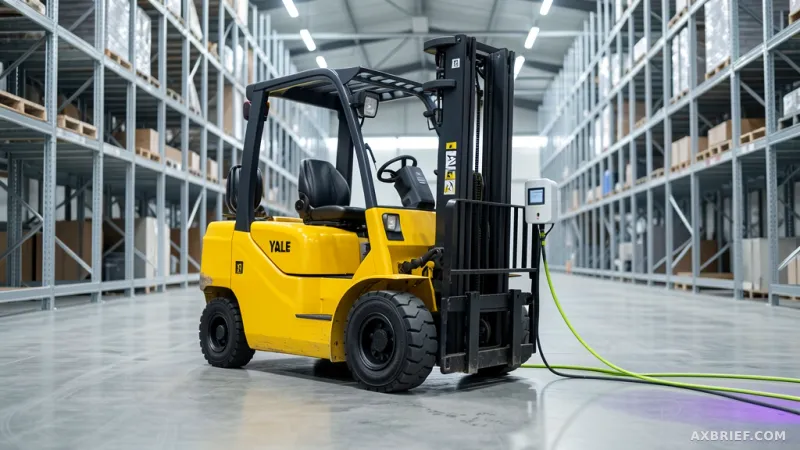
Yale Lift Truck Technologies is attempting to dismantle this legacy infrastructure with the launch of the ERC-VG2 series. Rather than offering a forklift that happens to be compatible with various batteries, Yale has introduced a tightly coupled integrated solution that bundles the electric counterbalance forklift, a dedicated lithium-ion battery, and a proprietary charging system into a single ecosystem. At the heart of this hardware shift is the adoption of Lithium Iron Phosphate (LFP) chemistry.
LFP is selected specifically for its thermal stability and extended cycle life compared to traditional lithium-ion or lead-acid alternatives. The ERC-VG2 system allows operators to select module sizes and capacities tailored to their specific workload, ensuring that the energy density matches the operational demand without unnecessary weight. One of the most significant engineering departures in this series is the modular design of the battery packs. In traditional setups, a failing cell often necessitated the replacement of the entire battery unit. The ERC-VG2 architecture allows technicians to isolate and service individual modules or cells, drastically reducing long-term maintenance expenditures and minimizing electronic waste.
To further reduce the friction of ownership, Yale has implemented an end-to-end service model. By acting as the single point of contact for the vehicle, the battery, and the charger, the company eliminates the compatibility disputes and fragmented warranty claims that typically arise when a fleet manager sources components from multiple vendors. This integration ensures that the electrical handshake between the charger and the motor controller is optimized for the specific voltage curves of LFP chemistry.
From Battery Swapping to Opportunity Charging
The true operational shift occurs when the focus moves from the battery's chemistry to its behavior within the warehouse. The ERC-VG2 is engineered for opportunity charging, a paradigm where the vehicle is plugged in during short breaks, lunch hours, or shift transitions. This eliminates the need for a fleet of spare battery packs and the heavy machinery required to swap them. When charging stations are strategically distributed across the warehouse floor, the forklift becomes a fluid part of the environment rather than a tethered asset that must return to a central hub.
This transition effectively deletes the battery room from the warehouse blueprint. By removing the need for specialized ventilation and hazardous material storage areas, companies can reclaim significant floor space for high-density racking or additional sorting lanes. However, this decentralization of power introduces new safety risks, which Yale addresses through system-level communication. The vehicle and battery maintain a constant data link; if a driver attempts to operate the forklift while it is still connected to the charger, the system prevents movement to avoid catastrophic cable damage or operator injury.
Beyond safety, the integration extends into the digital layer via Yale Visionä. This remote telemetry platform transforms the battery from a passive power source into a data-generating asset. Managers can monitor state-of-charge levels, detect abnormal temperature spikes, and receive low-battery alerts in real-time. This shift from reactive maintenance to predictive management means that a forklift is only taken out of rotation when the data indicates a genuine need, rather than following a rigid, inefficient schedule. The synergy between the LFP hardware and the Visionä software creates a feedback loop that optimizes the entire fleet's uptime.
As the industry moves toward Physical AI and autonomous logistics, the ability to manage energy as a software-defined resource becomes a competitive necessity. The transition to an integrated ecosystem like the ERC-VG2 suggests that the future of material handling is not just about more powerful motors, but about the total elimination of the infrastructure that once hindered them.