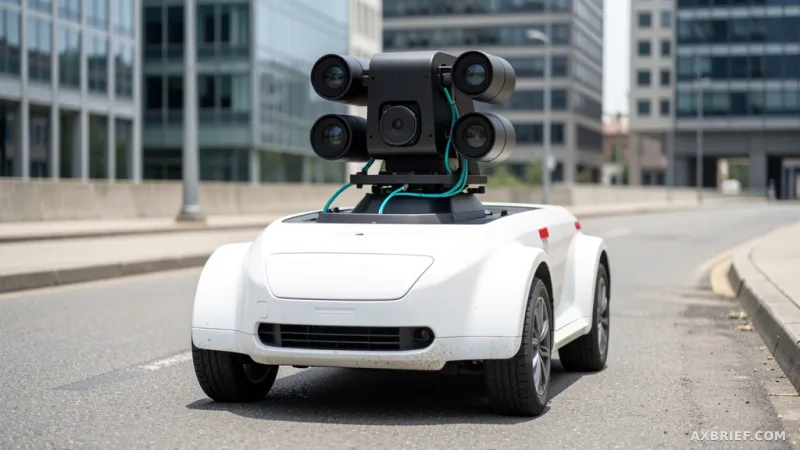
Imagine an autonomous vehicle cruising through a busy urban intersection. In a fraction of a second, the onboard AI must simultaneously detect a pedestrian stepping off a curb, predict the trajectory of a merging cyclist, and map the surrounding traffic signals. This requires running multiple heavy deep learning models in parallel. However, embedded hardware has a hard ceiling. When the GPU memory hits its limit, the system doesn't just slow down; it stutters. In the world of safety-critical robotics, a few hundred milliseconds of memory-induced latency is the difference between a successful stop and a catastrophic collision.
The Architecture of ZeroSwap and the RTAS Milestone
To solve this volatility, a research team led by Professor Hoon-seung Jwa at the DGIST Department of Electrical Engineering and Computer Science has introduced ZeroSwap. This technology specifically targets the memory constraints of low-power embedded AI systems, where the overhead of managing multiple concurrent models often leads to critical computation delays. The significance of this breakthrough was recently recognized at IEEE RTAS 2026, one of the world's two most prestigious academic conferences focusing on real-time systems for autonomous vehicles and industrial robotics.
Out of 108 papers submitted globally to the conference held in France, ZeroSwap was the sole recipient of the Best Paper Award. This achievement marks a historic milestone for the field, as Professor Jwa is the first researcher in the 32-year history of the IEEE RTAS conference to win the Best Paper Award for two consecutive years. The research was made possible through the strategic support of the National Research Foundation of Korea (NRF), the Institute for Information & Communications Technology Planning & Evaluation (IITP), and the AI Star Fellowship.
At its core, ZeroSwap addresses the physical limitations of GPU VRAM. In standard embedded environments, when the GPU runs out of memory, the system typically relies on traditional swapping mechanisms that move data to the system RAM or disk. This process is notoriously slow, creating a bottleneck that spikes latency and disrupts the real-time execution required for autonomous navigation. ZeroSwap re-engineers this pipeline by utilizing the Solid State Drive (SSD) as a high-efficiency extension of the GPU memory, optimizing the data transfer path to ensure that the transition between physical VRAM and storage is nearly seamless.
Shifting the Metric from Capacity to Latency Stability
The true innovation of ZeroSwap lies not in simply adding more virtual space, but in how it handles the transition when that space is needed. In traditional memory management, the moment a system exceeds its physical VRAM, performance typically falls off a cliff. ZeroSwap changes this trajectory. According to the research data, in environments where the workload exceeds the physical memory capacity, ZeroSwap managed to suppress the increase in latency to an average of just 3.6%.
This stability allows for a dramatic improvement in actual performance. The team found that AI task response times were shortened by up to 3.2x compared to existing memory management methods. This suggests that the system can maintain near-native GPU speeds even when it is technically operating beyond its hardware limits. By reducing the cost of swapping data to nearly zero, the technology allows developers to deploy more complex, multi-model pipelines on existing low-power hardware without fearing the sudden latency spikes that trigger system failures.
For engineers designing embedded AI, this shifts the fundamental design priority. Until now, the industry standard has been to simply increase physical memory or prune models to fit within a strict VRAM budget. ZeroSwap proves that the critical metric for safety-critical AI is not the total amount of memory, but the latency suppression rate during memory overflow. When a robot or a car encounters an unexpected edge case that demands more compute resources, the ability to handle that overflow without a performance collapse is what determines the actual safety and reliability of the machine.
This breakthrough transforms the SSD from a passive storage device into an active participant in the AI computation pipeline, effectively decoupling the model's complexity from the physical constraints of the GPU.