
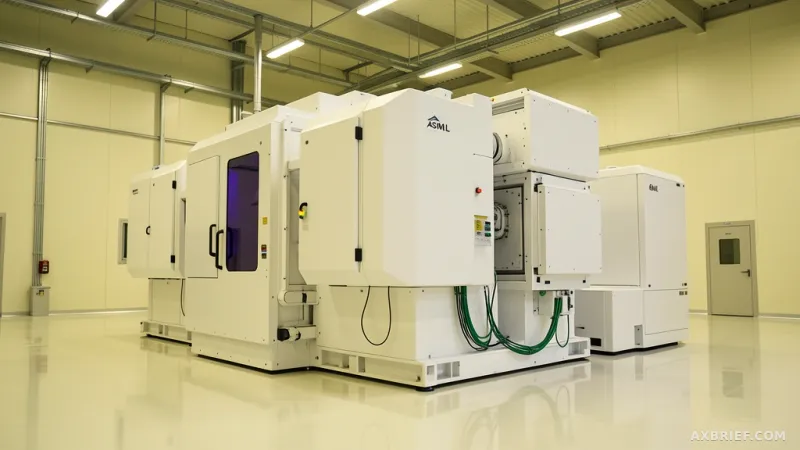
The most advanced AI chips from Nvidia and Apple do not begin their lives in a vacuum of pure software; they are born from the precise, violent application of extreme ultraviolet light. This process happens exclusively within the machines produced by ASML, the Dutch company that holds a total monopoly on the equipment required to carve the smallest circuits on a silicon wafer. Because these machines are the sole gateway to high-performance computing, they have become the most contested pieces of hardware in the geopolitical struggle for AI supremacy. This week, the tension between the United States government and ASML reached a breaking point, transforming a trade dispute into a direct confrontation over national security and corporate integrity.
The Allegation of a Breach in the Silicon Shield
Commerce Secretary Howard Lutnick recently confronted ASML leadership with a grave accusation: that at least one EUV lithography machine has found its way into China. This claim suggests a catastrophic failure of the export controls that have been strictly enforced since the first Trump administration to prevent China from achieving parity in advanced semiconductor manufacturing. The US strategy has been clear—starve the Chinese military and industrial complex of the tools needed to produce the 5nm and 3nm chips that power modern AI and autonomous weaponry.
High-ranking US administration officials told Bloomberg that the government possesses concrete evidence that ASML shipped EUV-related components and specialized transport equipment to China. While the specific evidence remains classified, the implication is that the US-led blockade of advanced chips has a leak. If even a single EUV machine is operational in China, the entire strategic architecture designed to maintain a Western lead in AI hardware is compromised.
Christophe Fouquet, the CEO of ASML, responded with an immediate and categorical denial. Fouquet asserted that no EUV equipment has ever existed on Chinese soil. He explained that ASML employs a rigorous, real-time tracking system for every single unit produced. According to the CEO, every machine is either currently in the hands of a monitored, approved customer or has been returned to the company's headquarters. From ASML's perspective, the US government's claims are not based on operational reality but are instead unfounded assertions.
The Monopoly Trap and the Strategy of Displacement
To understand why this dispute is so volatile, one must understand the nature of the EUV monopoly. ASML spent two decades and billions of dollars perfecting the ability to generate and focus extreme ultraviolet light. This technology is so complex that approximately 80 percent of the accumulated knowledge required to build these machines resides solely within ASML. The company operates on the belief that reverse engineering is virtually impossible without physical access to the machine and the proprietary software that runs it.
Fouquet pointed to ASML's internal security architecture as proof that a leak is unlikely. The company has implemented a strict firewall system that segregates access to EUV technical documentation and training. Specifically, employees stationed in China are physically and digitally barred from accessing the design areas of the EUV pipeline. By isolating the human element, ASML believes it has neutralized the risk of intellectual property theft via its own workforce.
However, ASML is not entirely absent from the Chinese market. The company continues to supply Deep Ultraviolet (DUV) machines, which are older, lower-resolution tools. This allows ASML to maintain a business relationship with China while ensuring a generational gap in capability. The financial stakes of this balance are immense. ASML expects approximately 20 percent of its 2026 revenue to come from these previously authorized DUV sales to China. If the US government successfully pressures the Dutch government to revoke these licenses or if ASML is found to have violated EUV bans, a massive portion of the company's valuation and revenue stream would vanish overnight.
Seeing this dependency as a strategic vulnerability, the US Department of Commerce is now attempting to dismantle ASML's monopoly from the outside. The US government has committed up to 150 million dollars in tax incentives to xLight, a startup developing next-generation light source technology. While xLight claims its hardware can integrate with existing ASML systems as a partner, the underlying US goal is to create a viable alternative to ASML's proprietary technology. Fouquet has remained dismissive of these efforts, stating that xLight's technology is not a necessity for the industry.
This public-sector push is mirrored by private capital. Peter Thiel is currently backing a startup called Substrate, which aims to develop rival EUV technology to challenge the Dutch giant. Simultaneously, the US Congress is pursuing a bipartisan bill that would completely ban the export of even DUV equipment to China. This legislation, which passed through a key committee in April, would effectively sever the 20 percent revenue artery ASML relies on for its 2026 projections. For ASML, a company with a market capitalization of 700 billion dollars, the risk has shifted from technical execution to political survival.
The stability of the global AI supply chain is no longer a matter of engineering milestones or manufacturing yields, but a byproduct of American political will.



