The global race toward renewable energy is currently hitting a physical wall. While the demand for solar arrays is skyrocketing, the actual deployment of these systems relies on a dwindling supply of manual labor and a construction workforce facing high-risk environments. The bottleneck is no longer the cost of the panels or the availability of land, but the sheer speed at which a human crew can physically bolt hardware into the earth. This tension between climate urgency and labor scarcity has created a vacuum for a solution that does not just assist humans, but fundamentally accelerates the physics of installation.
The $34 Million Bet on Infrastructure Automation
Gritt has officially exited stealth mode to address this infrastructure gap, announcing a total funding war chest of $34 million. The capital injection was anchored by a $26 million Series A round led by Obvious Ventures, with significant participation from Union Square Ventures and Active Impact Investment. This follows an earlier seed stage supported by First Round Capital, Climactic, Congruent Ventures, and VSC Ventures. This level of institutional backing signals a shift in investor confidence toward Physical AI—the intersection of digital intelligence and heavy machinery.
This funding is not merely for research and development but is already tied to massive industrial scale. Gritt has secured contracts to install 2.8 gigawatts (GW) of solar panels over the next 18 months. The company has already penetrated the top tier of the industry, counting three of the ten largest power construction companies in the United States among its client base. To meet this demand, Gritt is executing a rapid deployment plan to have 48 systems operational in the field within the next six months, moving the technology from controlled pilots to the chaos of active construction sites.
The Control Layer Pivot: Software Over Steel
Most robotics companies entering the construction space fall into the trap of hardware obsession. Competitors such as Luminous Robotics, Cosmic, and Trinabot have focused on designing and manufacturing proprietary, purpose-built robots specifically for solar installation. This approach creates a massive capital expenditure burden and a slow iteration cycle, as any hardware failure requires a custom part and a specialized technician. Gritt has taken a diametrically opposite approach by treating hardware as a commodity.
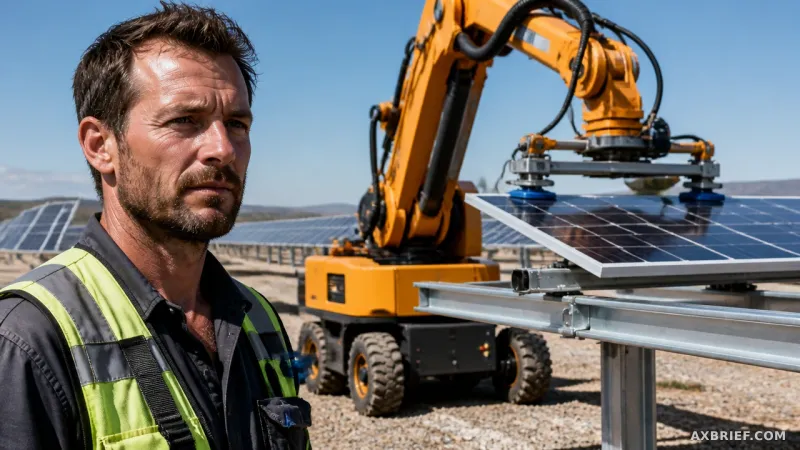
Instead of building a new robot, Gritt utilizes off-the-shelf industrial hardware, integrating Kawasaki robot arms and rented skidders—the heavy-duty vehicles used to drag materials across rough terrain. The core innovation is not the arm or the vehicle, but the general-purpose AI control layer that sits on top of them. This software allows the system to handle the unloading and transport of panels and, more critically, execute placement with sub-millimeter precision. By decoupling the intelligence from the hardware, Gritt avoids the costs of manufacturing and focuses entirely on the optimization of the control layer.
This architectural choice enables a level of generalization that custom hardware cannot match. Gritt uses a unified software pipeline that allows the AI to transfer learned skills across different tasks. While a complex task like stacking concrete blocks might take several weeks to master, the system can learn a different labor-intensive task, such as rebar tying, in a single day. This capability transforms the robot from a single-purpose tool into a versatile agent capable of evolving with the needs of the job site.
The productivity gains from this approach are stark. A standard installation crew of eight people typically manages to install roughly 800 panels per day. When that same eight-person team is augmented by Gritt's system, the daily output jumps to between 3,000 and 4,000 panels. This represents a five-fold increase in installation speed, effectively removing the primary bottleneck in the solar deployment pipeline. By focusing on the control layer rather than the chassis, Gritt has reduced the cost of task switching and lowered the risk of field deployment, as maintenance can be handled using standard industrial parts.
Industrial robotics is moving away from the era of the specialized machine and toward the era of the general-purpose controller.