The pharmaceutical industry has long struggled with a fundamental bottleneck: the gap between a theoretical molecular design and a validated therapeutic. For decades, the process of developing biologics—complex drugs derived from living organisms—has been a slow, iterative grind of manual experimentation and trial-and-error. However, a shift is occurring in the corridors of R&D, where the traditional laboratory bench is being replaced by a computational engine that treats drug discovery not as a series of isolated experiments, but as a continuous data stream.
The Computational Architecture of Biologics
AstraZeneca is now deploying a comprehensive strategy to integrate generative AI and computational tools across the entire lifecycle of biologics development. The objective is ambitious: reducing the time required for drug discovery by up to 50%. According to insights from McKinsey, achieving this level of acceleration requires more than just powerful algorithms; it demands a foundation of high-quality biological data. AI models are only as effective as the signals they receive, and in the realm of drug discovery, the signals found in failed experiments are often as valuable as the successes. By capturing every outcome, AstraZeneca aims to refine its models with a level of precision that manual logging could never achieve.
Puja Sapra, Senior Vice President of R&D Biologics Engineering and Oncology Target Discovery at AstraZeneca, emphasizes that this is not a piecemeal upgrade but a total integration. The company has implemented computationally enhanced methods across four critical pillars: design, manufacturing, testing, and analysis. By applying AI-driven design at every stage, the organization is systematically removing bottlenecks that previously stalled the development cycle. This end-to-end optimization transforms the R&D pipeline from a linear sequence into a high-velocity engine, accelerating the pace at which innovative therapies can reach the clinic.
From Static Models to Autonomous Closed-Loops
The true differentiator in AstraZeneca's approach is the transition from a predictive model to a closed-loop system. Most AI applications in pharma act as a filter, suggesting candidates that humans then test. AstraZeneca is moving toward a build-measure-learn loop where the AI does not just suggest, but drives the experimental process. This is anchored by a proprietary multimodal dataset that integrates molecular structures, binding metrics, safety profiles, and manufacturing outcomes. By leveraging a broad portfolio across various disease areas, the company ensures its training sets are representative and robust. When combined with deep screening—the high-precision analysis of massive compound libraries—the system generates the volume of data necessary to fine-tune frontier AI models.
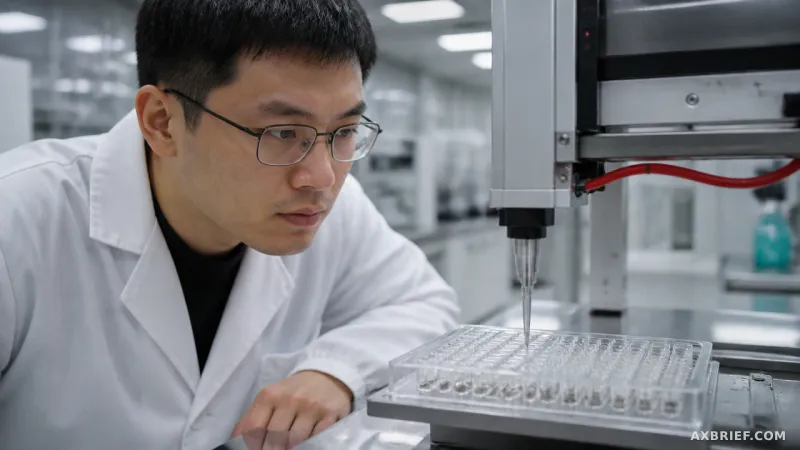
This vision is manifesting physically in Cambridge, Massachusetts. At Kendall Square, AstraZeneca is establishing a lab of the future designed to eliminate the data bottleneck. This facility operates as a closed-loop system where AI predictions trigger robotic execution, and the resulting data from the equipment is fed immediately back into the AI for learning. The logic mirrors that of an autonomous vehicle: the AI perceives the environment, the robot acts upon it, and the resulting sensor data refines the model in real-time. This allows the company to evaluate thousands of molecular interactions per week without human intervention.
This autonomy is particularly critical for the development of multi-specific biologics. These are advanced therapies designed to hit multiple targets simultaneously or deliver payloads to specific cells with surgical precision. Puja Sapra notes that AI allows the team to optimize multiple parameters—efficacy, stability, manufacturability, and safety—concurrently. By controlling these complex biological variables through a data-driven loop, AstraZeneca is now pursuing targets that were previously dismissed as undruggable. The utility of the AI is therefore not found in the sophistication of a single model, but in the automation of the feedback loop between the digital prediction and the physical result.
The convergence of robotics and generative AI is turning the biological laboratory into a self-evolving software system.