For the past two years, the AI developer community has been locked in a frustrating trade-off between power and privacy. To access the reasoning capabilities of frontier models, users must ship their most sensitive data to the cloud, incurring both a privacy risk and a mounting token tax. While the local LLM movement has grown, the barrier to entry remains high, requiring a tedious dance of installing CUDA drivers, configuring inference servers, and manually tuning prompt templates. The dream of a truly autonomous agent that lives on your hardware has existed, but the friction of the setup process has kept it a niche hobby for the most patient engineers.
The Architecture of Local Autonomy
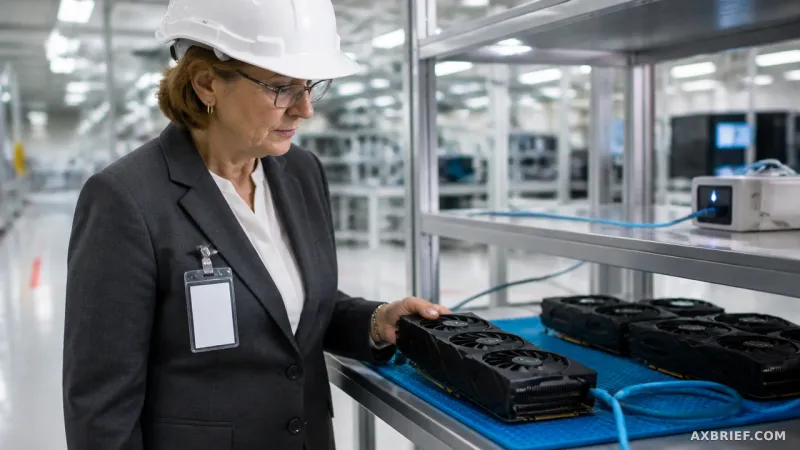
Perplexity, in collaboration with Nvidia, is attempting to collapse this friction with the release of Portable Computer. This is not merely a model release, but a comprehensive agent platform designed to eliminate cloud dependency for the core loop of AI operations. The system is currently optimized for Linux environments and is compatible with Nvidia DGX Spark desktop supercomputers and Linux machines equipped with RTX GPUs. While Windows support is slated for September, the current hardware baseline is strict: users need at least 24GB of VRAM, effectively making the GeForce RTX 3090 or newer the entry point for the platform.
The software stack is built around a selection of high-efficiency models. Out of the box, it supports Qwen 3.8 27B and PPLX 27B, the latter of which is a version of the model post-trained using Perplexity's proprietary harness. Nvidia's Nemotron 3.5 Lightning is scheduled for a future update. The core philosophy of Portable Computer is local-first execution. All initial tasks, user files, and process logs remain on the local device. The system only requests user permission to escalate a task to a cloud-based frontier model when the local model reaches its reasoning limit.
To solve the deployment headache, Perplexity has bundled the entire AI stack into a single package. This includes the model weights, the agent harness, the inference engine, app connectors, and a secure sandbox. By integrating these components, the platform removes the need for users to manually build their own inference pipelines or manage tool connectivity. Access to this integrated environment is currently restricted to Pro, Max, Enterprise Pro, and Enterprise Max subscribers.
The Harness Gap and the Context Fallacy
Running a model locally is one thing; making it function as a reliable agent is another. The true innovation in Portable Computer lies in the co-design of the model and the agent harness—the structural framework of prompts, tools, and orchestration logic. During development, the Perplexity research team identified a critical discrepancy in how local models handle long-form data. While models like Qwen 3.8 27B advertise a context window of 260,000 tokens, the team found that actual performance degrades significantly once the context exceeds 100,000 tokens.
To combat this degradation, Perplexity moved away from the industry standard of stuffing all available tools and instructions into the system prompt. Instead, they implemented a system of on-demand skills. The agent only loads specific capabilities into the context window when the task requires them, keeping the active prompt lean and the reasoning sharp. Furthermore, the team optimized connectivity by converting existing Model Context Protocol (MCP) server-based connectors, such as those for Gmail and GitHub, into compact command-line interface (CLI) tools. This shift drastically reduces token consumption and increases execution speed.
Security is handled through mandatory OS-level sandboxing. The system includes self-verification hooks to monitor task states in real-time. In environments where a secure sandbox cannot be established, the system is designed to completely block tool execution permissions, ensuring that a local agent cannot accidentally compromise the host system. This rigorous approach to the harness is reflected in the benchmarks. On the Local Knowledge Work Bench, which consists of 53 complex tasks, the Qwen 3.8 27B-based Portable Computer achieved 82.6% accuracy. This outperforms the same model running on the Pi harness (77.6%) and the Hermes harness (74.0%). When utilizing the PPLX 27B model, accuracy climbs to 85.4%.
In web research tasks measured by BrowseComp, Portable Computer hit 66.7% accuracy, significantly leading Pi (50.2%) and Hermes (43.9%). More importantly, it achieved these results with a 51% reduction in wall-clock time and a 70% reduction in token usage compared to Pi. The platform also showed a massive lead in multimodal document understanding, scoring 65.1% against Hermes' 34.6% and Pi's 13.9%.
The Economics of Hybrid Intelligence
The practical implication of this shift is a new economic model for AI work. For tasks involving highly sensitive data—such as analyzing 1099 tax forms or private investment documents to find hidden fees—the local environment provides a zero-cost, high-privacy sanctuary. Users can process massive amounts of sensitive data without spending a single cloud credit or risking data leakage. Simultaneously, the system supports hybrid workflows, such as analyzing a local CSV of user funnel data and then using an external connector to push the summarized insights to a Slack channel.
The financial advantage becomes clear when looking at the Terminal Bench 2.1 coding benchmarks. A fully local Qwen model achieves 59.6% accuracy with a marginal cost of 0 dollars. If the user employs a hybrid approach—using the local model for the bulk of the work and calling Claude Opus 5 as an advisor for final verification—the accuracy jumps to 73.0% at an estimated cost of 0.415 dollars per task. In contrast, relying solely on a frontier cloud model pushes accuracy to 82.4% but increases the cost to 0.65 dollars per task.
Unlike a simple chat interface, an agent workflow involves continuous token consumption through iterative self-correction and verification loops. In a cloud-only environment, these loops can lead to unpredictable and spiraling costs. By shifting the iterative loop to local hardware, the marginal cost of reasoning converges toward zero. This allows developers to design a tiered cost structure: local hardware handles the high-volume, repetitive loops and privacy-critical data, while the cloud is reserved for the final, high-difficulty reasoning steps.
This architecture transforms the GPU from a piece of gaming hardware into a strategic financial asset, turning local compute into a hedge against the rising costs of cloud intelligence.