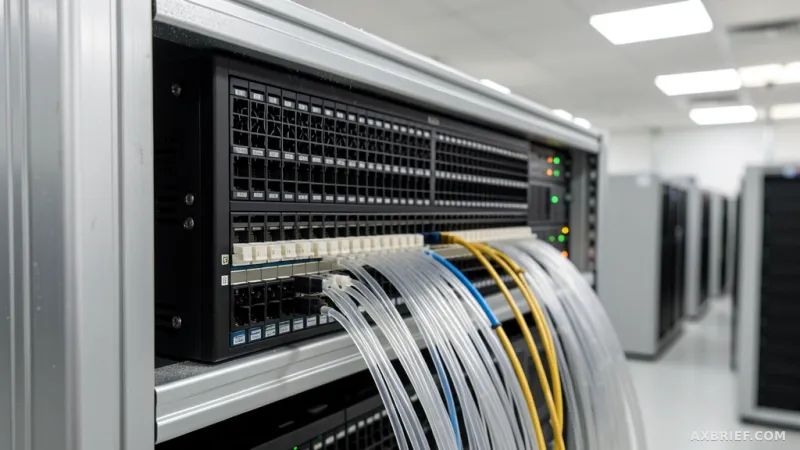
The modern AI race is often framed as a scramble for silicon. Companies spend billions securing the latest H100s or B200s, treating the hardware count as the primary metric of power. However, a quieter, more frustrating bottleneck has emerged in the data center. Once the GPUs arrive, they often sit idle for months. The culprit is not the chips themselves, but the networking layer. Configuring thousands of switches to handle the massive, synchronized traffic of a large-scale cluster is a manual, error-prone nightmare that turns high-performance hardware into expensive space heaters while engineers struggle with cabling and configuration scripts.
The Scale of Network Automation
Netris is targeting this specific operational gap with hardware-accelerated network automation software. The company recently closed a $15 million Series A funding round led by Andreessen Horowitz (a16z). This capital injection is earmarked for aggressive growth, specifically the hiring of specialized engineers and sales personnel, the expansion of supported hardware vendors, and the refinement of its core algorithmic capabilities. To steer this expansion, Guido Appenzeller, a partner at a16z, has joined the Netris board to provide technical guidance and support for global scaling.
Unlike many niche infrastructure tools, Netris has already achieved significant scale. The platform is vendor-neutral, ensuring compatibility with both Nvidia and AMD server-grade data center networking equipment and standards. This flexibility has allowed Netris to penetrate 35 different GPU clusters worldwide. Its current footprint includes deployments at Lightning AI, Foxconn, Visionbay, Hewlett Packard Enterprise (HPE), Tensorwave, and Telus. In total, the software is currently managing approximately 1 million GPUs, proving that automation can work across diverse hardware environments without being locked into a single ecosystem.
Why Determinism Beats AI in the Data Center
To understand why Netris is gaining traction, one must look at the failure of Software Defined Networking (SDN) in the AI era. Traditional SDN abstracts network services into a centralized control plane. While this works for general cloud traffic, the sheer volume and velocity of AI training workloads often overwhelm the processing capacity of the software layer, creating a bottleneck that slows down the entire cluster. Netris solves this by moving network functions directly into hardware acceleration. By spending eight years developing a system where traffic processing is handled physically rather than through a software abstraction, they have effectively removed the latency inherent in traditional SDN.
There is a second, more subtle technical choice that separates Netris from the current trend: the rejection of AI for configuration. While the world is obsessed with LLMs, Netris relies on deterministic algorithms. In mathematics, a deterministic algorithm is a process that produces the exact same output every time it is given the same input. When an engineer needs to push a configuration change to thousands of switches simultaneously, there is zero room for the probabilistic nature of AI. A single hallucinated parameter or a slightly varied output in one switch can crash an entire multi-million dollar cluster. By utilizing strict, repeatable mathematical procedures, Netris ensures that large-scale infrastructure remains predictable and immune to the variability that plagues AI-driven management tools.
This approach is particularly critical for the rise of neoclouds—specialized, GPU-centric cloud providers. These smaller players often lack the massive engineering armies of AWS or Azure, making them vulnerable to the high costs of idle hardware. Every day a GPU sits unused due to a networking misconfiguration is a day of lost revenue and mounting operational expense. Netris mitigates this by providing a network abstraction layer that separates physical hardware settings from logical management. This allows neoclouds to change hardware configurations instantly based on demand. Furthermore, Netris implements multi-tenancy directly at the hardware layer, isolating servers and resources to ensure that multiple users can share the same physical infrastructure without interference or security leaks.
The true competitive advantage in the AI infrastructure market is shifting. It is no longer enough to simply own the most GPUs; the winner will be the one who can activate those resources the fastest. By replacing manual configuration with hardware-accelerated, deterministic automation, the focus moves from the quantity of silicon to the velocity of the operating system managing it.