The modern developer's workflow is a constant battle against context switching. A typical hour is fragmented by jumping between a code editor, a terminal, a browser for documentation, and a chat interface for AI assistance. Every time a programmer shifts focus to type a prompt or copy-paste a stack trace, the cognitive flow is interrupted. This friction has remained the primary bottleneck in AI-assisted development, where the tool is powerful but the interface remains a manual, text-heavy chore.
The Architecture of Hands-Free Development
OpenAI has addressed this friction by natively integrating GPT-Live's full-duplex voice control into the ChatGPT desktop applications for macOS and Windows. This update transforms the interaction model from a sequential text exchange into a simultaneous, multi-threaded environment. By integrating directly with agent systems like Codex and ChatGPT Work, developers can now execute complex operational commands using only their voice.
Technical capabilities are centered around build 26.715, which introduces critical infrastructure for professional environments. This version enables multi-folder project support, allowing the AI to maintain context across an entire repository rather than a single file. Furthermore, the update extends control to iOS, allowing for remote execution. An engineer can now monitor progress or respond to agent prompts via a mobile device, effectively redirecting active tasks across the desktop and mobile ecosystem without needing to manually manage individual processes.
Access to these features is restricted to a closed commercial model. The functionality is available exclusively to users on paid subscription tiers, including Plus, Pro, Business, Enterprise, and Education plans. To maintain a competitive moat, OpenAI has kept the model weights, the specific voice processing pipeline, and the agent state architecture entirely proprietary, meaning third-party developers cannot self-host or modify the underlying system.
Decoupling Voice from Inference
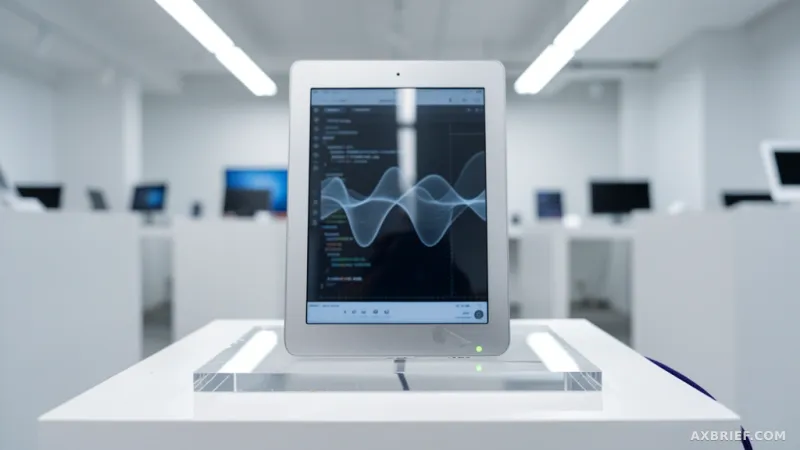
The shift from a standard voice assistant to a coding agent lies in the implementation of full-duplex communication. In traditional voice interfaces, the system operates in a half-duplex mode, similar to a walkie-talkie, where the user must stop speaking for the AI to process and respond. GPT-Live breaks this cycle by decoupling the real-time voice layer from the underlying execution engine.
While the voice layer handles the natural, fluid conversation with the user, the heavy computational lifting is offloaded to background inference models, specifically GPT-5.5. This separation ensures that the AI can maintain a seamless conversation without lagging while it simultaneously performs deep reasoning or executes code in the background. The result is a system that can be interrupted in real-time, allowing a developer to pivot their instructions mid-sentence without breaking the session.
This capability is augmented by a deep integration with the desktop environment's visual context. On macOS, the system utilizes Appshots to capture and analyze visual information from the screen. This allows ChatGPT Voice to analyze the active window, local file structures, and active plugins in real-time. Instead of the developer describing the error they see, the agent already possesses the visual and structural context of the codebase. This creates a true pair-programming dynamic where the AI acts as an asynchronous partner, performing tasks in the background while the developer continues to think and speak aloud.
This architectural shift enables what OpenAI describes as multi-threaded coding. A single natural language prompt can now trigger multiple concurrent workstreams. For example, a developer can instruct the agent to investigate a specific authentication bug, review a pull request for an API migration, and generate corresponding unit tests all in one breath. The agent manages these as separate threads of execution, reporting progress and asking for clarification via voice without requiring the user to leave their primary coding window.
Developers evaluating the transition to this workflow should prioritize checking for build 26.715 to ensure multi-folder support is active. The decision to adopt this system typically hinges on the trade-off between the reduction in context-switching costs and the consumption of the user's paid plan quotas.
This integration signals a move away from the AI as a chatbot and toward the AI as an ambient operating layer for software engineering.