The modern AI race is currently dictated by a precarious logistics chain. For the past few years, the ability of an AI company to scale its services has not been limited by the brilliance of its researchers or the size of its datasets, but by the shipping manifests of a single hardware provider. When a company's growth trajectory is tethered to the availability of H100s or B200s, the supply chain becomes the primary strategic risk. This dependency creates a ceiling on expansion and a vulnerability to market volatility that the world's leading AI labs can no longer ignore.
The Architecture of Jalapeño
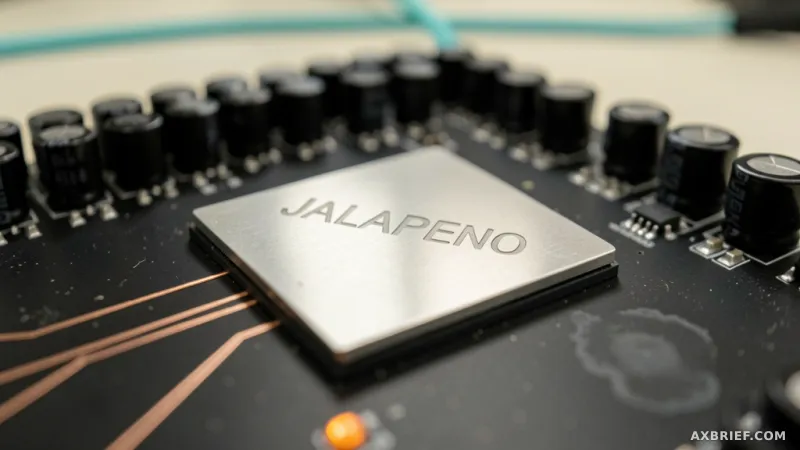
To break this cycle of dependency, OpenAI has introduced Jalapeño, its first custom-designed inference processor developed in close collaboration with Broadcom. Unlike the general-purpose GPUs that have dominated the era of generative AI, Jalapeño is not designed to be a jack-of-all-trades. It is a specialized piece of silicon engineered specifically to meet the unique computational demands of OpenAI's inference systems. By moving away from off-the-shelf hardware, OpenAI is tailoring the physical circuitry to the exact data processing patterns and operational loads found in its production environments.
One of the most striking aspects of the development process is the recursive nature of the chip's creation. OpenAI revealed that its own existing AI models were utilized during the design and manufacturing stages of the processor. By employing AI to optimize the hardware that will eventually run those very models, the company accelerated the development cycle and increased the precision of the chip's architecture. This synergy between software and hardware design represents a shift toward a self-optimizing loop where the model informs the silicon, and the silicon, in turn, empowers the model.
From Raw Compute to Full-Stack Efficiency
While the industry often focuses on the raw power required to train a model, the real economic battle is fought during inference—the phase where a deployed model responds to user prompts. Training is a one-time massive expenditure, but inference is a perpetual operational cost. Jalapeño is explicitly optimized for this second phase. By focusing on the execution of already-trained models, OpenAI is targeting the operational overhead associated with real-time services, particularly for high-demand tasks like real-time coding assistance where latency and cost-per-token are critical.
Early testing indicates that Jalapeño delivers a significant leap in performance-per-watt compared to current state-of-the-art alternatives. In the world of hyperscale data centers, performance-per-watt is the only metric that truly matters for sustainability and profitability. Higher efficiency means less electricity consumed per query and a reduced requirement for expensive cooling infrastructure, directly lowering the cost of providing AI services to millions of users.
However, the chip is only one piece of a larger strategic pivot toward full-stack optimization. OpenAI is not merely swapping one chip for another; it is redesigning the entire infrastructure layer. This comprehensive approach encompasses the chip architecture, the kernel that bridges hardware and software, the memory systems, networking protocols, scheduling logic, and the deployment pipeline. By controlling every layer from the physical transistor to the final product experience, OpenAI can eliminate the inefficiencies that occur when software is forced to run on generic hardware. This vertical integration allows for faster response times, enhanced system stability, and a drastic reduction in the cost of delivery.
The transition to custom silicon marks the end of the era where AI intelligence was decoupled from the hardware it lived on. The competitive edge in AI is shifting from who has the best model to who can most efficiently execute that model at scale.