The current state of humanoid robotics is defined by a frustrating paradox. We have machines that can perform backflips, navigate complex warehouses, and mimic human gait with startling accuracy, yet they still struggle with the basic physics of a door handle or the delicacy of picking up a strawberry. This gap between locomotion and manipulation is the final frontier of the humanoid era. While the industry has focused heavily on the brain and the legs, the hand remains a clumsy appendage, often reduced to a simple gripper that lacks the nuance of human touch. This specific engineering failure has become the primary bottleneck preventing robots from moving out of controlled labs and into the chaotic environments of homes and factories.
The Legal Gauntlet and the $11 Million Pivot
Proception entered this fray with a pedigree rooted in one of the most ambitious robotics projects in history. The company was founded by Jay Li, who previously served as the Technical Lead for Tesla's Optimus program. Li's transition from Tesla to his own venture was not without friction; last year, Tesla filed a lawsuit against him alleging the misappropriation of trade secrets. For months, the startup operated under the shadow of a legal battle that could have ended the company before it shipped a single unit. However, the tension broke earlier this month when both parties reached a settlement, officially closing the litigation.
With the legal risk neutralized, Proception immediately capitalized on its newfound stability. The company closed a seed funding round of $11 million, led by First Round Capital with significant participation from Y Combinator and BoxGroup. This capital injection is earmarked for the development of dexterous manipulation technology intended to bring robotic precision to human levels. Rather than attempting to build a full humanoid robot to compete with the likes of Tesla or Figure, Li has positioned Proception as a specialized hardware provider. The business model is clear: provide the high-precision hands that other robotics firms are too resource-constrained to develop in-house.
This strategic positioning addresses a timeline gap in the industry. Kevin Lynch, Director of the Robotics and Biosystems Center at Northwestern University, has suggested that it may take a decade for robotic hands to achieve true human-like utility. Li, however, believes this timeline is an artifact of inefficient data collection. He views the recent legal battle with Tesla not as a setback, but as a resilience test that forced the team to maintain an obsessive focus on their core technical advantage while the rest of the world watched the courtroom drama.
Breaking the Teleoperation Bottleneck
To understand why Proception's approach is different, one must look at how most humanoid robots currently learn to move. The industry standard is teleoperation, where a human operator wears a VR headset and remotely controls a robot's movements in real-time. The human sees what the robot sees and guides its limbs to perform a task. While this works for basic movements, it possesses a fatal flaw: the lack of tactile feedback. The human operator cannot feel the pressure, texture, or slip of the object the robot is touching, meaning the resulting data is visually driven but haptically blind.
Furthermore, teleoperation creates a massive scaling problem. In a teleoperation setup, the rate of data collection is strictly limited by the number of physical robots available. If a company has ten robots, they can only collect data as fast as ten humans can operate those ten machines. This creates a linear growth curve that is far too slow for the exponential demands of modern AI training.
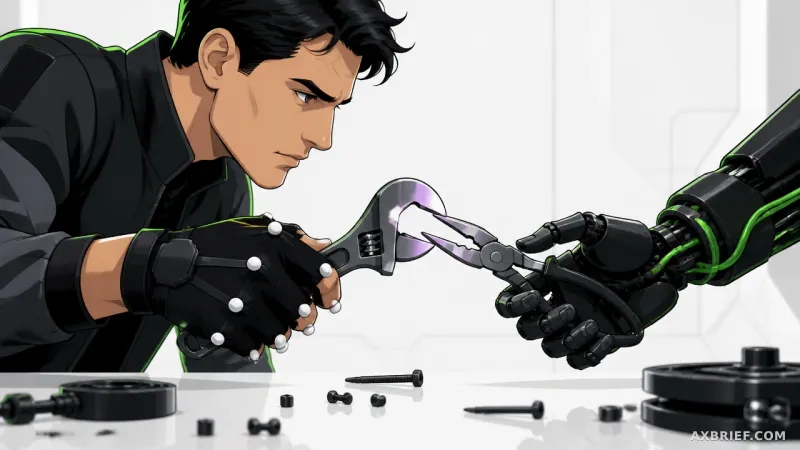
Proception has bypassed this limitation by removing the robot from the training loop entirely. Instead of using a robot to collect data, they utilize a sophisticated sensor glove system. Human testers wear these gloves and headsets to perform tasks, allowing the system to capture high-fidelity interaction data directly from the human hand. Because this process does not require a physical robot to be present, Proception can scale its data collection horizontally. They can employ dozens of humans in gloves to generate thousands of hours of manipulation data without needing a corresponding fleet of expensive humanoid hardware.
This shift transforms the problem of dexterous manipulation from a hardware challenge into a data scaling challenge. By capturing task-specific, high-resolution human movement, Proception can train control models that mimic human dexterity with far greater accuracy than teleoperation allows. The insight here is that the hardware is only as good as the data used to drive it; by decoupling data collection from hardware availability, Proception has found a way to accelerate the learning curve of the robotic hand.
Standardizing the Last Mile of Robotics
The physical manifestation of this data-driven approach is a robotic hand featuring 22 degrees of freedom. By placing multiple joints in each finger, Proception has created a device capable of a vast range of precise motions that exceed the capabilities of standard three- or four-finger grippers. The most critical innovation, however, is the integration of the sensor glove's technology into the robot's own skin. Proception has developed a dense artificial skin that wraps the hardware, allowing the robot to sense pressure and contact points in real-time.
This sensory skin closes the loop that teleoperation left open. When the robot grasps an object, the artificial skin provides the precise tactile information necessary for the control model to adjust its grip, preventing the object from slipping or being crushed. This combination of high-degree-of-freedom hardware and a high-resolution sensory layer is what Bill Trenchard, a partner at First Round Capital, describes as the last mile of humanoid robotics. Without this level of dexterity, a humanoid robot is essentially a walking torso with clumsy clamps for hands.
Proception has already begun shipping its first batch of high-dexterity robotic hands to researchers and robotics companies, officially opening the doors for commercial orders. The implications of this move extend beyond Proception's own balance sheet. By providing a standardized, high-performance hand to the broader market, the company is effectively creating a common hardware platform for the industry. When multiple companies use the same 22-degree-of-freedom architecture, the efficiency of control model training increases across the board, as developers can share insights and benchmarks on a consistent physical standard.
As these standardized hands move into factories and homes, the bottleneck of dexterous manipulation will likely dissolve. The transition from a robot that can simply move a box to one that can delicately assemble a circuit board or fold laundry depends entirely on this marriage of scalable data and high-precision hardware. Proception is betting that by owning the hand, they will control the most critical point of interaction between AI and the physical world.