
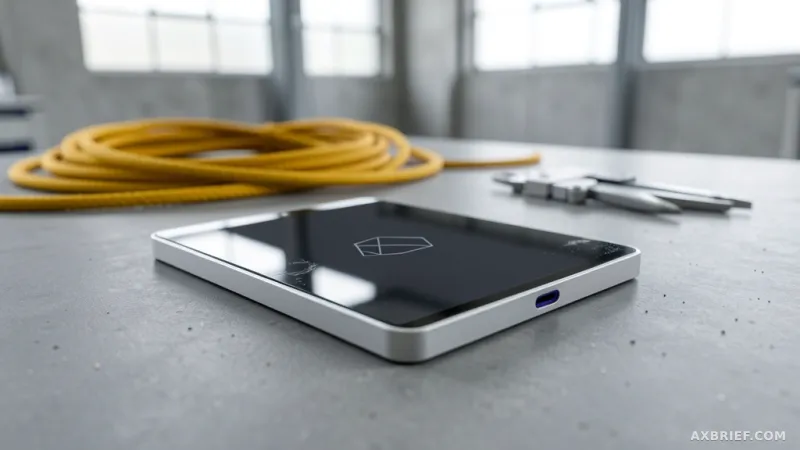
The modern smartphone has reached a state of aesthetic and functional stagnation. For over a decade, the industry has iterated on the same basic premise: a glass slab that serves as a portal to a grid of isolated applications. Users spend their days toggling between disparate apps, interrupted by a constant stream of notifications that fragment attention. This familiarity has created a vacuum for a truly new form factor, one that does not merely host AI as a feature but exists as a physical manifestation of the AI itself.
The Blueprint for a Post-Smartphone Era
The Wall Street Journal recently reported that SpaceX has begun showcasing a prototype of an AI-dedicated handheld device to its investors. According to the report, the device is characterized by a design that is thinner and sleeker than the current iPhone, signaling an attempt to redefine the physical identity of mobile hardware. SpaceX representatives noted that the project is in its early stages, meaning the final design remains fluid and subject to change. However, the intent is clear: to break the physical constraints of the traditional smartphone.
This move does not happen in a vacuum. OpenAI is pursuing a similar trajectory, collaborating with former Apple design chief Jony Ive to create an AI-centric device. Sam Altman has suggested that this hardware would offer a more peaceful user experience than the iPhone, moving away from the chaotic app-switching model. To bolster this effort, OpenAI recently recruited Paul Midler, a former Apple vice president who played a key role in the development of the Vision Pro. By securing top-tier design and hardware engineering talent, OpenAI is attempting to bridge the gap between a software model and a tangible product.
For SpaceX, the strategy extends deeper into the software stack. The prototype is designed to run on a proprietary operating system, a strategic move to avoid dependency on third-party platforms like Google's Android. By integrating technology from xAI, Elon Musk's artificial intelligence venture, SpaceX aims to build a native AI interface. This approach allows the company to project the full performance of its AI models directly onto the hardware without the restrictive layers of a legacy OS, granting them total control over the user experience.
The Vertical Integration Gamble
The pursuit of a dedicated AI device is less about the hardware and more about the power of vertical integration. When a single entity controls the AI model, the operating system, and the physical device, the efficiency of optimization increases exponentially. This structure eliminates the friction typically found in the smartphone ecosystem, where hardware manufacturers must wait for OS updates or API permissions to implement new AI capabilities. In this new paradigm, the speed of integration between the AI engine and the hardware becomes the primary driver of market share.
However, the ambition of SpaceX extends beyond the handset to the very airwaves the device uses. Through Starlink Mobile, SpaceX is expanding into the wireless communication market, positioning itself as a direct competitor to established giants like Verizon and AT&T. The strategic implication is profound: if SpaceX controls the device, the AI, and the satellite network providing the connectivity, it creates a closed-loop ecosystem that is entirely independent of traditional telecom infrastructure. This has led some analysts to speculate that SpaceX might eventually acquire T-Mobile or AT&T to secure a terrestrial network footprint, completing a total monopoly over the communication chain.
Despite this technical synergy, the path to market is littered with wreckage. The AI hardware space has already become a graveyard for ambitious startups. Humane launched an AI Pin that failed to gain traction, and Rabbit's R1 followed a similar trajectory of high hype and low utility. These failures highlight a critical tension in the industry: the gap between a provider's desire to sell a new category of device and the consumer's willingness to abandon the utility of a smartphone. The ability to manufacture a thin device or integrate a powerful model does not automatically translate into a product that solves a real-world problem more effectively than the iPhone.
The challenge for SpaceX is to prove that a model-centric device offers a tangible utility that justifies the cost of switching. While the technical capability for vertical integration exists, the market demand depends on whether an AI-first interface can actually replace the versatility of the app-based economy.
The era of the app grid is fading, replaced by a vision where the AI model is the primary interface. The success of the SpaceX prototype will determine if we are moving toward a new standard of computing or simply adding another curiosity to the AI hardware graveyard.



