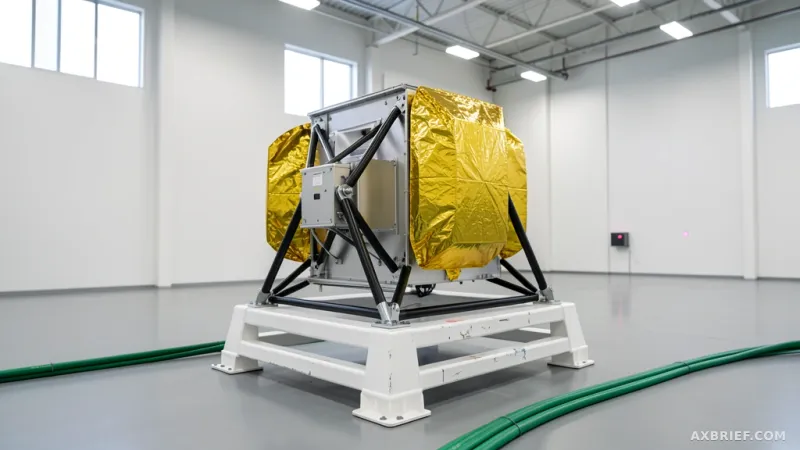
The global race for AI supremacy has traditionally been fought over terrestrial real estate, with hyperscalers scrambling for land, water, and gigawatts of power to sustain massive data centers. However, a new frontier is emerging as the industry realizes that the ultimate bottleneck for compute may not be the availability of chips, but the physical and environmental constraints of Earth. This shift is driving a move toward orbital computing, where the vacuum of space offers a radical alternative for the next generation of AI inference and training layers.
The Blueprint for an Orbital Data Center
Starcloud has positioned itself at the center of this transition, recently securing $250 million in a Series A extension funding round. This capital injection pushes the company's valuation to $2.3 billion. The round was led by Manhattan West Ventures, with a strategic $25 million investment from Nvidia, signaling a deep alignment between the world's leading GPU provider and the ambition to move compute off-planet. The primary objective for this capital is the expansion of manufacturing capabilities and the development of Starcloud-3, a massive orbital data center spaceship specifically engineered for deployment via SpaceX's Starship rocket.
To support this scale, Starcloud has already filed a request with the Federal Communications Commission (FCC) for the operational authority to manage 88,000 spacecraft. While the long-term vision involves massive ships, the immediate roadmap is more incremental. By 2027, the company plans to launch two Starcloud-2 compute satellites via rideshare flights. These units, each boasting 8kW of computational power, are designed to handle orbital inference tasks for a client base that includes various United States government agencies. The physical production of this hardware is centered in a 100,000-square-foot facility in Woodinville, Washington, strategically located to share infrastructure and logistical synergies with nearby SpaceX and Amazon satellite manufacturing hubs.
The Collision of Silicon and Space
What separates Starcloud from previous attempts at space-based computing is the move from edge processing to data-center-grade inference. Most orbital hardware focuses on simple edge processing—filtering data locally before sending it to Earth. Starcloud is the first to successfully operate Nvidia H100 GPUs in orbit to perform actual model training and high-performance inference. This shift transforms a satellite from a sensor into a server, creating a high-performance compute layer that exists independently of terrestrial power grids.
This operational experience has turned Starcloud into a critical feedback loop for Nvidia. The data gathered from running H100s in the harsh environment of space is directly informing the development of the Vera Rubin Space-1, a dedicated space-grade GPU slated for introduction in late 2028. The engineering challenges for the Vera Rubin Space-1 are immense and center on three primary axes. First is the thermal paradox: in a vacuum, heat cannot be carried away by air, meaning the relationship between chip operating temperature and the physical size of the radiators is the primary constraint on performance. Second is the radiation problem, requiring sophisticated shielding to prevent cosmic rays from flipping bits or destroying circuits. Finally, there is the issue of ruggedization, as the hardware must survive the violent acoustic and mechanical vibrations of a rocket launch without losing structural integrity.
Despite the technical promise, Starcloud's business model is tethered to a precarious launch ecosystem. The economic viability of orbital inference depends entirely on the drastic reduction in launch costs promised by SpaceX's Starship. If Starship becomes the reliable, high-frequency heavy-lifter the industry expects, Starcloud can deploy hardware at a scale that allows it to compete with ground-based data centers. However, the current supply chain for launches is dangerously tight. Competitors like Blue Origin's New Glenn and ULA's Vulcan have yet to reach a steady state of regular flight, and Rocket Lab's Neutron remains in the deployment phase.
This creates a critical timing risk. With the Falcon 9 program expected to wind down by 2028, satellite operators face a looming gap in launch availability. If Starship's reusability and launch cadence are not fully proven by 2029, Starcloud's expansion plans could stall. To mitigate this, the company is currently exploring dedicated Falcon 9 contracts and diversifying its partnerships across other launch service providers.
The ultimate success of this venture hinges on the precise synchronization of the Vera Rubin Space-1's release and the full commercialization of Starship.