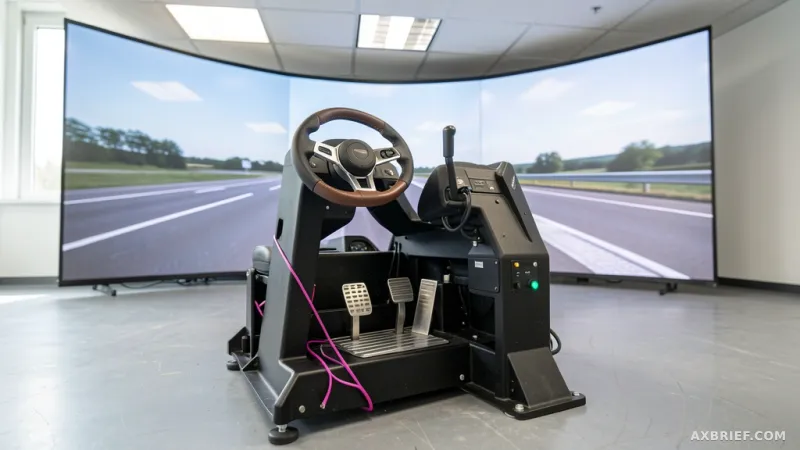
Autonomous vehicle engineers spend the majority of their careers chasing the long tail of edge cases. These are the rare, catastrophic, or bizarre scenarios—a pedestrian crossing the street in a dinosaur costume or a sudden sinkhole opening mid-intersection—that almost never happen during standard road testing but are critical for safety validation. For years, the industry has relied on expensive fleet data collection or rigid, hand-coded simulators that struggle to replicate the chaotic fluidity of the real world. The bottleneck has always been the cost of creating high-fidelity, diverse environments that can actually stress-test an AI driver.
The Architecture of Infinite Roadways
Decart is attempting to break this bottleneck with the release of Oasis 3, a world model designed to generate real-time driving environments from a single line of text. Rather than relying on pre-recorded clips or static maps, Oasis 3 functions as a generative engine that creates high-definition visual streams on the fly. This allows developers to prompt specific scenarios—such as a rainy night in downtown Tokyo with erratic traffic—and immediately begin running simulations. The model is delivered via an API, making it accessible to a broad range of developers who can now synthesize massive amounts of training data without deploying a single physical vehicle.
This project is an evolution of Decart's previous work with Lucy, a real-time video model that already attracted a community of over 100,000 developers. Oasis 3 leverages the foundation established by Lucy to move from general video generation to structured world modeling. To make this commercially viable, Decart has set the API pricing at $0.02 per second, with custom enterprise pricing available for larger scale deployments. This pricing strategy is a deliberate move by CEO Dean Leitersdorf to mirror the developer ecosystem OpenAI built for language models, positioning world models as the next fundamental layer of the AI stack.
The financial industry has responded to this vision with significant capital. Decart recently secured $300 million in funding, pushing its valuation to approximately $4 billion. The investor list reads like a directory of the companies most likely to benefit from synthetic world generation, including Toyota, Adobe, and eBay, with continued backing from Nvidia. These strategic partners are not merely providing capital; they represent the primary target market for a tool that can simulate physical interactions at scale.
The Cost of Fidelity and the Physics Gap
Generating high-resolution video in real-time is computationally ruinous for most companies, yet Decart claims a cost efficiency ten times greater than its competitors. The secret lies in the DOS (Decart Optimization Stack), a proprietary hardware optimization layer. DOS is designed to ensure that models run at peak efficiency across Nvidia, Amazon, and Google hardware. By achieving vertical integration from the hardware abstraction layer up to the software, Decart has managed to keep its cumulative spending under $100 million since its inception, even while scaling a model of this complexity.
However, the technical implementation of Oasis 3 reveals a fundamental tension between generative speed and physical truth. The model operates on an auto-regressive structure, meaning it predicts the next frame based on the previous ones. It generates a multi-camera environment consisting of one front-facing camera and two side cameras. Each single frame consumes approximately 8,000 tokens. When running at dozens of frames per second, the model processes hundreds of thousands of tokens every second, which rapidly fills the context window.
This reliance on auto-regression leads to a phenomenon known as thematic drift. In long-duration simulations, the environment begins to lose its identity. A specific street in New York might gradually morph into a generic Western city, or a driver who turns around to return to a previous intersection may find that the geography has completely shifted. More critically, the model occasionally ignores the laws of physics; vehicles may pass through one another or clip through roadside barriers. Dean Leitersdorf attributes these failures to the data imbalance in the training set, noting that the overwhelming abundance of normal driving data makes it difficult for the model to learn the precise boundaries of physical collisions and rare accidents.
To bridge this gap, Decart is currently researching memory compression techniques and context window expansion. The goal is to allow the model to remember millions of tokens, ensuring that a city remains consistent regardless of how far the agent travels. Future iterations are expected to incorporate the ability to generate worlds based on actual uploaded video footage, which would provide a grounded reference point for the generative process.
Ultimately, the value of Oasis 3 does not lie in perfect physical simulation, but in the economics of iteration. At $0.02 per second, the ability to run a million imperfect tests is often more valuable to a developer than running ten perfect ones.