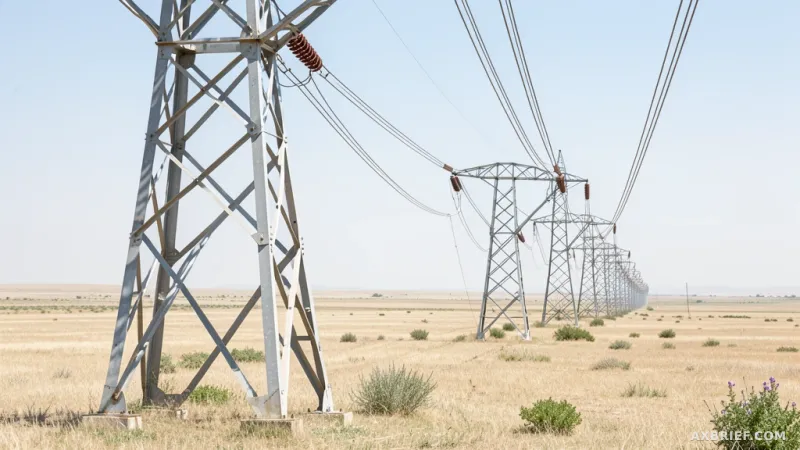
The lights flicker for a fraction of a second across a vast stretch of the American East Coast, from the suburbs of Northern Virginia to the skyscrapers of Chicago. To the average resident, it is a momentary glitch, a blink of the eye. But for grid operators at PJM Interconnection, it is a warning sign of a systemic vulnerability. In a matter of thirty seconds, 3.1GW of electrical load simply vanished from the grid. This was not a blackout caused by a lack of power, but a voltage spike caused by too much of it, triggered by the very systems designed to keep the AI revolution online.
The Anatomy of a 3.1GW Grid Shock
The incident began with a localized power line failure near Washington DC. Under normal circumstances, such a fault is a routine occurrence for a grid operator. However, the proximity of the fault to one of the world's densest clusters of data centers transformed a minor accident into a regional event. As the voltage fluctuated, the automated backup power systems of dozens of data centers detected the instability. Within seconds, these facilities executed a synchronized disconnect from the public utility to switch to their internal backup generators.
This mass exodus created a catastrophic imbalance. When 3.1GW of demand disappears in thirty seconds, the electricity that was flowing toward those servers has nowhere to go. This sudden surplus of energy manifests as a voltage spike, pushing the grid's tension upward and causing the flickering lights observed across the PJM territory, which serves 67 million customers from New Jersey to Illinois. The recovery process, aimed at stabilizing the frequency and voltage of the grid, took more than ten minutes to resolve.
To put the scale of this event into perspective, the 3.1GW loss is more than double the magnitude of a similar incident in 2024, where 60 data centers disconnected simultaneously, removing 1.5GW of load. The growth of AI compute is accelerating this risk. Within the PJM jurisdiction, data centers previously accounted for roughly 6% of the total power load. Current projections suggest this figure will climb to 24% by 2040. As these facilities grow in size and density, the potential for a single point of failure to trigger a massive, synchronized disconnect increases exponentially.
The Backup Paradox and the Ride-Through Mandate
The core of the problem lies in a technical paradox: the mechanisms that ensure 99.999% uptime for AI servers are the same mechanisms that threaten the stability of the public grid. Most data centers are programmed to be hypersensitive to voltage drops. The moment the power quality dips, they sever the connection to the grid to protect their hardware from damage. While this is a victory for the data center operator, it is a nightmare for the grid manager. A small supply shortage is thus amplified into a massive demand collapse, creating a feedback loop of instability.
This has led grid managers, including the Electric Reliability Council of Texas (ERCOT) and PJM, to demand a new technical capability known as ride-through. Ride-through is the ability of a large-scale load facility to remain connected to the grid during short-term voltage fluctuations rather than disconnecting immediately. By forcing data centers to weather the storm for a few seconds, grid operators can prevent the sudden load drops that lead to voltage spikes. The goal is to transform data centers from fragile consumers that flee at the first sign of trouble into resilient anchors that help stabilize the system.
One approach to solving this tension is the implementation of advanced Uninterruptible Power Supply (UPS) architectures. Companies like ON.Energy are deploying solutions that place not only the servers but all campus equipment, including cooling systems, behind a massive battery bank and power conversion layer. This setup acts as a buffer. To the external grid, the data center appears as a constant, steady load regardless of what is happening inside the facility. When the grid is stable, the UPS charges its batteries; when the grid dips, the UPS draws from its reserves to maintain the servers without disconnecting from the utility. This effectively masks the internal power switching from the outside world, preventing the synchronized disconnects that cause regional shocks.
As the AI industry continues to scale its physical footprint, the definition of a successful data center is expanding. It is no longer enough to have a fast chip and a cool rack. The new survival condition for AI infrastructure is the ability to coexist with the grid, shifting the role of the data center from a passive energy sink to an active participant in grid reliability.