The modern developer's workflow has become a repetitive cycle of switching tabs and typing prompts into a chat window. While LLMs have fundamentally changed how code is written, the interface remains stubbornly trapped in the text box. There is a growing friction in the community as developers move from simple code generation to managing swarms of semi-autonomous AI agents. The bottleneck is no longer the intelligence of the model, but the latency of the human-to-AI interface. This week, that friction met a physical solution.
The Hardware Interface for Agentic Workflows
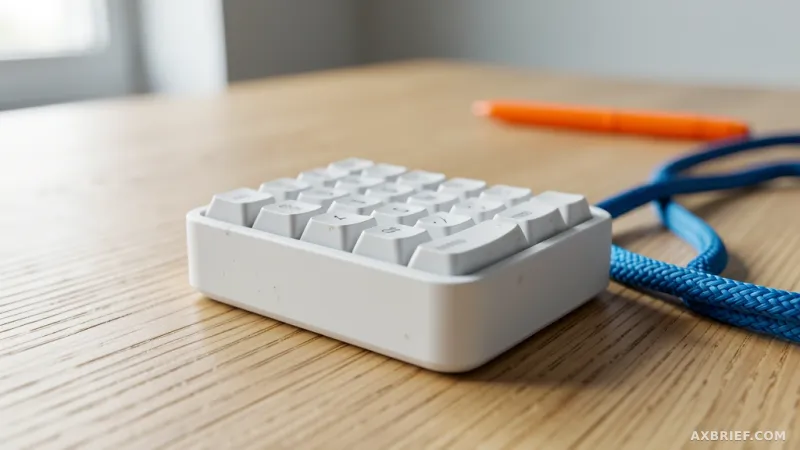
OpenAI has introduced the Codex Micro, a specialized AI coding assistant keyboard priced at $230. Developed in collaboration with professional keyboard designer Work Louder, the device is not a general-purpose peripheral but a dedicated control center for managing groups of semi-autonomous AI coding agents. In this semi-autonomous framework, the AI handles the heavy lifting of implementation while the human operator provides high-level directional steering. By moving these controls from a software menu to a physical deck, OpenAI aims to eliminate the cognitive load of navigating complex UI layers during deep work.
The hardware is packed with tactile shortcuts designed for high-velocity iteration. It features Agent Keys, which use integrated lighting to provide real-time visual feedback on the current status of various active agents. To complement this, Command Keys allow for the immediate execution of frequent functions, while a dedicated joystick enables the user to trigger complex workflows without leaving the keyboard. This shift from mouse-clicks to tactile inputs is intended to transform the act of AI orchestration into a more fluid, sensory experience.
Beyond the keyboard, OpenAI is expanding its physical footprint. Reports from Bloomberg indicate the company is developing a screenless, portable smart speaker integrated with ChatGPT. Unlike a static home assistant, this device is rumored to include mechanical elements that allow for physical movement, suggesting a long-term strategy to move AI out of the screen and into the physical environment. While the speaker remains in the development phase and specifications are subject to change, it signals a broader ambition to evolve AI from a software service into a tangible robotic presence.
The Legal Cost of Rapid Hardware Iteration
While the Codex Micro represents a leap in user experience, it has also become a focal point for one of the most aggressive corporate disputes in the AI era. The transition from software to hardware requires a specific set of engineering competencies that OpenAI has aggressively sought to acquire. However, this talent acquisition has led to a high-stakes legal battle with Apple. The tech giant has filed a lawsuit alleging that OpenAI executives orchestrated a strategic effort to extract trade secrets to accelerate their own hardware development.
Apple's claim goes beyond simple employee poaching. The lawsuit asserts that OpenAI's leadership intentionally targeted specific high-level personnel to systematically siphon off proprietary technical information. According to Apple, these stolen secrets were directly applied to the design and development of OpenAI's new hardware devices. The tension here is a classic industry clash: the boundary between a professional's right to move between companies and a corporation's right to protect its intellectual property. OpenAI has denied all allegations, maintaining that its development process has been legitimate.
Evidence suggests that former Apple engineers played pivotal roles in the design phase of OpenAI's hardware initiatives. The presence of these individuals in the development pipeline provides a concrete link that Apple is using to support its claims of trade secret theft. For OpenAI, the strategy of rapidly building hardware capabilities by hiring from the industry leader has created a significant legal liability. The case now hinges on whether the Codex Micro and its sibling devices are the result of genuine innovation or the byproduct of strategic corporate espionage.
As the industry moves toward agentic AI, the battle for control is shifting from the prompt to the peripheral. By giving users a physical dial to control the depth of an AI's reasoning—effectively managing compute resources with a turn of a knob—OpenAI is redefining the relationship between human intent and machine execution. The ability to master AI agents will soon depend less on how well one writes a prompt and more on how effectively one can manipulate the physical interfaces that govern them.