
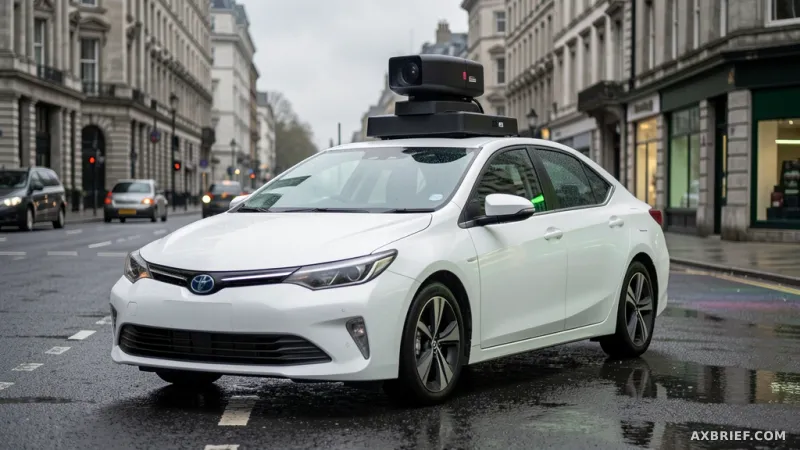
The modern AI engineer no longer views a stock option as a distant promise of wealth tied to a decade-long wait for an IPO. In the current hyper-competitive landscape, where the leap from a senior developer to a founder happens in a matter of months, the traditional equity model is breaking. The industry is shifting toward a new reality where liquidity is provided in real-time to prevent the most critical minds from being poached by rivals or lured by the siren song of their own startups. This tension between long-term corporate growth and immediate personal liquidity has created a new financial instrument in the AI war chest: the pre-IPO tender offer.
The Financial Mechanics of Wayve's Liquidity Event
Wayve, the UK-based pioneer in autonomous driving technology, is leaning heavily into this trend. The company has announced an $85 million tender offer, allowing employees to sell a portion of their vested shares to existing and new investors. This secondary market transaction is not a traditional funding round for the company's treasury, but rather a liquidity window for the staff, executed at a valuation of $8.5 billion. This valuation serves as a powerful signal of the market's confidence in Wayve's trajectory, effectively benchmarking the company as one of the most valuable AI entities in the European ecosystem.
This move follows a massive capital injection earlier this year. In February, Wayve closed a $1.2 billion Series D funding round that read like a who's who of the global tech elite. The round was led by Eclipse, Balderton, and SoftBank Vision Fund 2, with strategic participation from the Ontario Teachers’ Pension Plan and Baillie Gifford. More tellingly, the round included heavyweights like Microsoft, NVIDIA, and Uber, indicating that Wayve's technology is viewed as a critical piece of the future mobility stack by the very companies that provide the compute and the platforms for AI deployment.
This is not the first time Wayve has prioritized employee liquidity. In May 2024, the company conducted a similar tender offer in conjunction with its $1.05 billion Series C funding round. By establishing a recurring pattern of secondary sales, Wayve is effectively decoupling the reward for employee contribution from the volatility of the public markets, ensuring that the people building the system are financially incentivized to stay until the product is fully realized.
The Strategic Pivot to End-to-End AI
To understand why Wayve is spending so much effort on talent retention, one must look at the fundamental difference in how they approach autonomous driving. For years, the industry standard for self-driving cars relied on high-definition (HD) maps—meticulously detailed digital twins of the world that told the car exactly where the curb was to the centimeter. However, HD maps are brittle; they are expensive to create, impossible to scale globally in real-time, and fail the moment a road is repaved or a sign is moved.
Wayve has abandoned this approach entirely in favor of an end-to-end (E2E) neural network. Instead of a series of hand-coded rules and map-dependencies, Wayve's AI learns to drive from data, mimicking the way a human learns through experience and observation. The system takes raw sensor data as input and produces driving commands as output, bypassing the need for the rigid, pre-defined maps that have slowed down the progress of other autonomous vehicle players.
This technical shift creates a massive demand for a specific kind of talent: researchers and engineers who can optimize large-scale neural networks for real-world physical environments. To fuel this ambition, Wayve has aggressively expanded its workforce, doubling its headcount to 1,200 people within a single year. This rapid scaling is a high-stakes bet that the E2E approach will win the race to Level 4 and Level 5 autonomy. The tender offer is the mechanism that prevents this expanded workforce from evaporating under the pressure of competing offers from Silicon Valley.
This trend of using secondary sales for retention is becoming a blueprint for high-growth AI firms. Companies like Decagon, ElevenLabs, Linear, and Clay have all recently utilized tender offers to lock in their core teams. Clay, in particular, has executed two such offers in just nine months. The underlying driver is a paradoxical demand: while the venture capital market has become more selective, there is an insatiable appetite among investors to buy into the few AI companies that show genuine technical breakthroughs. Investors are willing to pay a premium for secondary shares because they believe the eventual exit valuation will dwarf the current premium.
Wayve is now moving from the laboratory to the street. The company is targeting a robotaxi pilot launch in collaboration with Uber by the end of this year, a move that would provide the E2E model with an unprecedented stream of real-world edge cases to learn from. Looking further ahead, Wayve plans to integrate its AI software into Nissan's next-generation driver assistance systems starting in 2027. This transition from a research-heavy startup to a commercial software provider marks the final stage of their current growth phase.
The convergence of aggressive liquidity strategies and end-to-end AI architecture suggests that the winner of the autonomous driving race will not be the company with the best maps, but the one that can most effectively retain the humans capable of teaching a machine how to see.



