For the end user, the magic of a generative AI response feels instantaneous and essentially free. Behind the curtain, however, the reality is a relentless drain of capital. Every prompt processed by a large language model triggers a cascade of astronomical electricity costs and hardware expenditures that threaten the long-term margins of even the most well-funded AI labs. The industry has reached a tipping point where buying off-the-shelf general-purpose hardware is no longer a sustainable strategy for scaling. To survive the cost curve, the next generation of AI leaders must stop buying chips and start designing them.
The Blueprint for Silicon Independence
Anthropic is now moving to secure its own hardware future. According to reports from The Information, the AI startup has entered discussions with Samsung to explore the development of custom AI chips. This is not a finalized contract but an exploratory phase where both parties are aligning on a broader framework for cooperation. At this stage, the specific technical specifications—such as the exact intended use case, the architecture for data center deployment, and the precise performance benchmarks—remain undecided. Anthropic is effectively sketching the boundaries of a partnership before committing to the rigid blueprints of silicon design.
This pursuit of custom hardware does not mean Anthropic is abandoning its current providers. The company maintains a strict diversification strategy to avoid vendor lock-in. In communications regarding its computing strategy, Anthropic emphasized that a diversified hardware stack—incorporating chips and software from Google, Amazon, and Nvidia—remains central to its operations. By spreading its dependencies across multiple giants, Anthropic protects itself from the volatility of a single supplier's pricing or the sudden bottlenecks of a disrupted supply chain. The goal is not to replace Nvidia entirely, but to ensure that no single company holds the keys to their infrastructure.
The Shift from General Purpose to Inference Efficiency
To understand why Anthropic is courting Samsung, one must look at the shift from training to inference. Training a model requires massive, general-purpose compute power to digest trillions of tokens. However, once a model is deployed, the priority shifts to inference—the process of generating a response to a user query. This is where the real economic war is being fought. When a chatbot's response speed increases or its subscription price drops, it is rarely because the software was optimized; it is because the underlying hardware changed.
OpenAI has already signaled this direction through its collaboration with Broadcom to develop a custom inference processor dubbed Jalapeño. The primary objective of such a chip is not raw power, but performance-per-watt. In the world of data centers, power efficiency is the only metric that truly matters at scale. A chip with superior performance-per-watt allows a company to process more data with less electricity, directly slashing the operational overhead of every single interaction. This is the same logic that drove Amazon and Google to develop their own Tensor Processing Units (TPUs). By designing chips specifically for matrix multiplication—the core mathematical operation of AI—these cloud giants bypassed the inefficiencies of general-purpose GPUs to create a vertically integrated stack where the hardware is a perfect mirror of the software's needs.
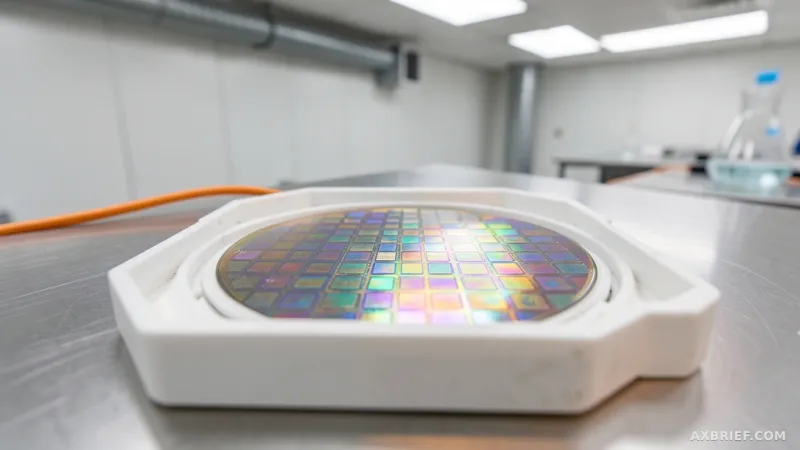
Samsung enters this equation as the critical bridge between design and reality. While Anthropic can envision a chip, they cannot print one. Samsung is already deeply embedded in the AI ecosystem as a primary manufacturing partner for Nvidia, optimizing production processes using Nvidia's own software to ensure precision at scale. Furthermore, Samsung is working with Nvidia to establish dedicated AI chip factories on Korean soil, tightening the bond between design and fabrication. By opening discussions with Anthropic and Google, Samsung is positioning itself as the global foundry of choice for the custom silicon era. The competitive advantage in the next five years will not belong to those who can design the best architecture, but to those who can secure the most reliable and sophisticated manufacturing pipeline.
As the industry moves past the era of brute-force scaling, the battleground is shifting from the size of the model to the efficiency of the silicon. The discussions between Anthropic and Samsung represent a broader realization that the most powerful AI is useless if it is too expensive to run. If the next leap in AI feels faster and more accessible, it will be because the intelligence is finally running on hardware built specifically for it.