For years, the gold standard of digital growth was the deep link. Marketers spent decades obsessing over long-tail keywords, crafting hyper-specific landing pages designed to catch a user at the exact moment of their most granular need. If a user searched for a specific troubleshooting step or a niche product comparison, the goal was to land them on that exact page, deep within the site architecture, and convert them there. But this week, the data suggests that the bridge between the search query and the deep page is collapsing. We are entering the era of the zero-click summary, where the AI provides the answer and the user only leaves the chat interface when they are ready to commit to a brand, not a piece of content.
The Erosion of the Organic Click
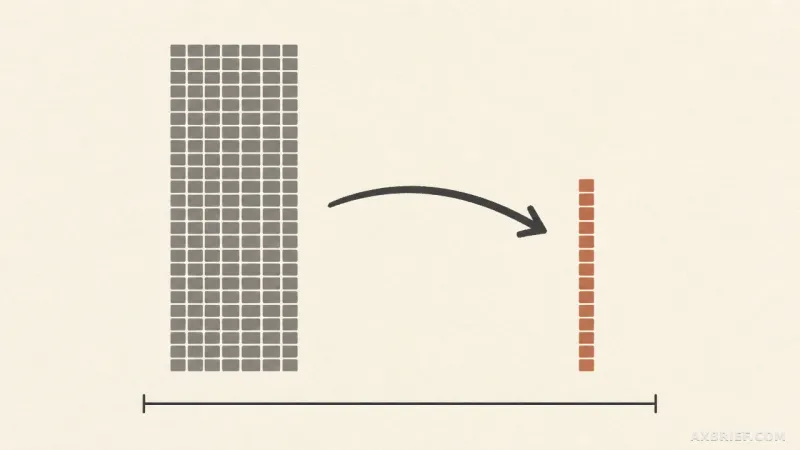
The shift is quantified by a stark decline in user behavior. According to data from the Pew Research Center, which tracked 900 American adults, the introduction of AI summaries in search results has caused the click-through rate for traditional organic links to plummet from 15% to 8%. The situation is even more dire for the citations embedded within the AI responses themselves; these links see a click-through rate of approximately 1%. For publishers, this is not a minor dip but a fundamental threat to their revenue models. Between December 2024 and December 2025, total page views originating from Google search dropped by 34%. Small-scale publishers felt the blow most acutely, losing roughly 60% of their search-referral traffic. Even industry giants are not immune, with Business Insider reporting a 55% crash in organic search traffic over a three-year period.
While human clicks are vanishing, the appetite of AI systems for web data is accelerating. The 2026 Generative AI Landscape report from Similarweb reveals that the proportion of ChatGPT responses containing real-time web citations grew fivefold in a single year, reaching 6.8% by May 2026. In high-intent categories like travel, this citation rate surged to 22.6%. This creates a dangerous feedback loop for creators. Because AI response quality depends on the health of the underlying content layer, a drop in organic visibility eventually leads to a drop in AI visibility. If a site stops attracting humans, it eventually stops being a reliable source for the AI, accelerating a cycle of digital invisibility.
The Paradox of the Deep Page and the Front Door
The most jarring revelation is not that traffic is disappearing, but that the destination of the remaining traffic has fundamentally shifted. On May 7, ChatGPT implemented a search update that prioritized brand links. In the week following this update, referral traffic spiked by 157%. However, the nature of this traffic was different. The percentage of users landing on a brand's homepage jumped from 25% to nearly 60%. This represents a total reversal of the traditional SEO funnel. In the legacy search model, Google acted as a map, directing users to a specific room in a house—the deep page. In the AI model, ChatGPT acts as a concierge. It reads the deep page, synthesizes the answer, and then directs the user to the front door—the homepage—only after the user is convinced and ready to act.
This shift in user intent is reflected in the conversion quality. Brands recommended by AI saw follow-up visit frequencies 2 to 4 times higher than competitors who were not recommended. The AI is essentially performing the research and comparison phase on behalf of the user, delivering a high-intent visitor who no longer needs to browse the site's content to find an answer. Consequently, the financial engine of the web is moving from keyword auctions to contextual placements. By June 2026, sponsored results appeared in 26% of desktop ChatGPT conversations in the US, up from 14% the previous month. Notably, two-thirds of these ads appear only after the second prompt, meaning they target the accumulated context of a conversation rather than a single keyword. These ads maintain a click-through rate of about 0.50%, directly challenging the keyword-based dominance Google has held for two decades.
Google's grip on the market is visibly slipping. eMarketer projects that Google's share of US search advertising will fall below 50% in 2026 for the first time since 2004. Much of this lost ground is being captured by Amazon's sponsored product search, which is currently growing three times faster than Google's ad business. This commercial decline is compounded by legal pressures. Following the US Department of Justice antitrust ruling in December 2025, which banned exclusive default search agreements and mandated the sharing of search data, Google's role as the sole tollgate of the web has effectively ended.
For the modern web operator, the new metric of success is the gap between the cited page and the landing page. Similarweb data shows that while 65% of the URLs ChatGPT cites are deep pages located two or three levels deep in a site's hierarchy, 58.8% of the actual resulting traffic lands on the homepage. Ahrefs analysis supports this, finding that over 80% of AI-driven traffic flows toward homepages, product pages, or free tools rather than editorial content. Interestingly, 28.8% of ChatGPT referral sessions now lead to internal site search pages—areas of the website that were previously neglected because Google handled the navigation.
This new reality proves that traditional SEO success does not guarantee AI visibility. Ahrefs found that 28.3% of the most cited pages by ChatGPT had zero organic visibility on Google. Furthermore, 67% of the most cited sources are outside the control of marketers, with Wikipedia alone accounting for roughly 30% of citations. There are, however, technical levers that still work. Pages utilizing natural language URL slugs saw a citation rate of 89.78%, compared to 81.11% for those that did not.
Websites must now pivot their architecture to survive this transition. Deep pages containing documentation or benchmarks must be structured with clear headings and natural language URLs to maximize their citability. Homepages must be redesigned; they can no longer be simple introductions but must function as high-conversion hubs for users who arrive with full context from an AI conversation. Finally, internal search functionality must be treated as a primary acquisition surface, reclaiming the navigation role that external search engines once performed.
The web is no longer a collection of destinations to be discovered, but a database to be queried, where the homepage is the only door that still matters.