The trading floor is currently navigating a high-stakes tension between engineering ambition and market liquidity. For months, the narrative surrounding SpaceX has been one of inevitable dominance, a company that treats the vacuum of space as its primary laboratory. But as the company transitions from a privately held powerhouse to a public entity, the focus has shifted from the trajectory of rockets to the trajectory of a stock ticker. The excitement of a historic debut has collided with the cold reality of public market volatility, leaving investors to wonder if the company's valuation is anchored in fundamental value or mere scarcity.
The Mechanics of a Blockbuster Valuation
On June 12, SpaceX set a massive benchmark for its market value by raising approximately 86 billion dollars. This capital injection established an IPO price of 135 dollars, a figure that served as the psychological and financial floor for the company's public valuation. For a brief window following the launch, the market responded with euphoria, driving the share price well above 200 dollars. At that peak, SpaceX was briefly trading at a valuation that rivaled the scale of legacy big-tech giants like Microsoft and Amazon.
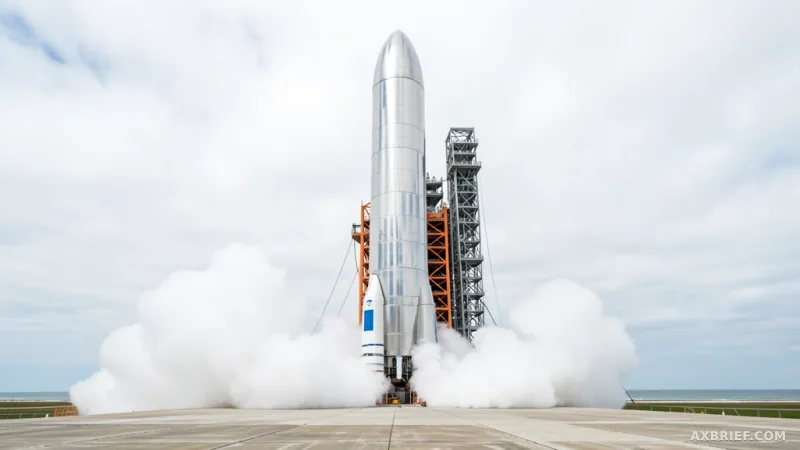
However, that momentum proved unsustainable. By Wednesday afternoon, the stock experienced a sharp decline, slipping below the 133 dollar mark. While the price has since fluctuated, occasionally recovering to the 135 dollar baseline, the stability that investors expected from a market leader has been replaced by erratic swings. This volatility coincides with a critical technical milestone: the upcoming test flight of the Starship spacecraft on Thursday. Unlike traditional aerospace missions where failure is a catastrophe, SpaceX employs a fly, fail, fix methodology. The current flight plan is designed for total destruction; both the booster and the upper stage are programmed to simulate a landing in the Gulf of Mexico and subsequently explode.
The Scarcity Trap and the AI Warning
To understand why a dip to 133 dollars is causing such a stir, one must look at the structure of the stock rather than the success of the rocket. The volatility is not necessarily a reflection of waning confidence in Elon Musk's vision, but rather a result of an extremely low float. Currently, only 4% of SpaceX's total shares are trading on the Nasdaq. In a low-liquidity environment, even modest buy or sell orders can trigger disproportionate price movements. The scarcity of available shares has created a pressure cooker effect where the stock price reacts violently to every piece of news, turning the share price into a high-beta instrument rather than a stable store of value.
This instability creates a cautionary tale for the next wave of tech giants preparing for their public debuts. Specifically, the market is watching SpaceX as a proxy for the upcoming IPOs of OpenAI and Anthropic. Both AI labs have secretly initiated their IPO processes, though neither has confirmed a definitive date. The industry is currently obsessed with whether the astronomical valuations of AI companies can survive the transition to public markets. If SpaceX, a company with tangible assets and a dominant market share in satellite launches, struggles to maintain its IPO floor due to liquidity issues and technical risks, the path for OpenAI and Anthropic becomes significantly more treacherous.
Investors are now analyzing the SpaceX curve—the rapid ascent to 200 dollars followed by a steady weekly decline—as a blueprint for the AI bubble. The core question is whether the perceived value of these companies is derived from their transformative technology or simply from the scarcity of their shares. As SpaceX prepares to watch its most advanced rocket explode in the Gulf of Mexico for the sake of data, the financial markets are performing a similar experiment to see if the hype of the next generation of tech titans can withstand the scrutiny of public shareholders.
The market is no longer just betting on the colonization of Mars; it is testing whether the prestige of the next great tech dynasty can survive the volatility of public liquidity.