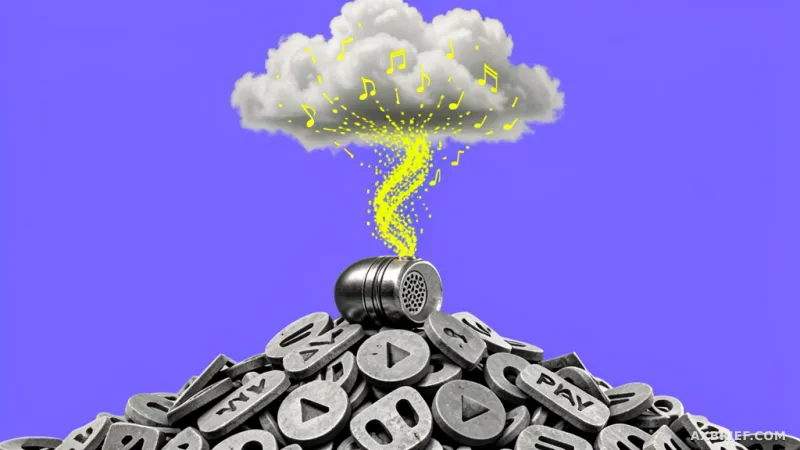
The digital landscape of the Suno subreddit reveals a striking shift in behavior: users are no longer just experimenting with AI music generation; they are becoming their own primary artists and listeners. A growing cohort of users reports abandoning major streaming platforms like Spotify and Apple Music entirely, opting instead to fill their daily listening hours with tracks they have generated themselves. This phenomenon marks a transition where musical taste is no longer defined by external celebrity culture or label-backed artists, but by the convergence of individual prompts and algorithmic output.
The Rise of AI-Exclusive Listening Habits
For decades, the consumption of popular music has been tethered to the infrastructure of major labels and the curation of massive streaming libraries. Suno, a generative AI platform that creates songs from text prompts, is effectively dismantling this model. Within the Suno community, users are sharing workflows where they bypass external platforms to construct bespoke, private playlists. These users spend their time not browsing the vast catalogs of traditional services, but refining prompts to generate music that aligns perfectly with their specific moods and aesthetic preferences.
This behavior represents a move toward a closed-loop ecosystem. The user acts as both the producer and the sole consumer, creating a feedback loop where the external world of commercial music becomes increasingly irrelevant. For these individuals, music is no longer a static product to be discovered through a recommendation engine; it is a dynamic data set that can be manipulated and output on demand. As users dedicate more time to adjusting parameters and prompt engineering, the utility of traditional streaming platforms—which rely on the assumption that users want to discover new, pre-existing content—begins to erode.
The Shift from Curation to Personal Control
While many users continue to pay monthly subscription fees of 11,000 KRW for traditional streaming services, their actual engagement time on these platforms is trending toward zero. The value proposition of a streaming subscription is rooted in access to a library and the accuracy of recommendation algorithms. However, when a user can generate a song that matches their exact genre, instrumentation, and emotional state in seconds, the platform's curation loses its competitive edge. The generative model does not just predict what a user might like based on historical data; it executes the user's current intent in real-time.
This shift is driven by a psychological change in the source of satisfaction. Consuming commercial music is a passive act of interpreting a creator's intent. In contrast, using an AI model to generate music provides the user with a sense of agency and creative efficacy. The user is no longer a passive recipient of a curated feed; they are the architect of their own auditory environment. From a developer's perspective, this indicates that the boundary between content production and consumption is collapsing. The metric for success is no longer the size of a music library, but the speed and precision with which a model can translate a user's intent into a physical audio file.
The Future of Content Platforms
As users increasingly prioritize the freedom of generative tools over the breadth of external catalogs, the traditional streaming model faces a significant threat to its user retention. If a platform does not integrate generative interfaces that allow users to participate in the creation process, it risks becoming a secondary utility rather than a primary destination. The core value of a music service is migrating from the volume of available content to the responsiveness of the generation engine.
To compete in this new environment, developers must prioritize interface convenience and the speed of the iteration cycle. The goal is to provide a model that allows the user to feel like the primary creator, as this sense of control is what ultimately drives the replacement of traditional streaming hours. As users move into these closed-loop ecosystems, the data pipelines of the past—which relied on tracking consumption of third-party content—must be redesigned. Companies that succeed will be those that can capture the prompts and feedback loops generated by users, using that data to refine personal models rather than simply serving existing tracks. The winner in the music industry will not be the one with the largest library, but the one that provides the most efficient tool for turning human intent into sound.