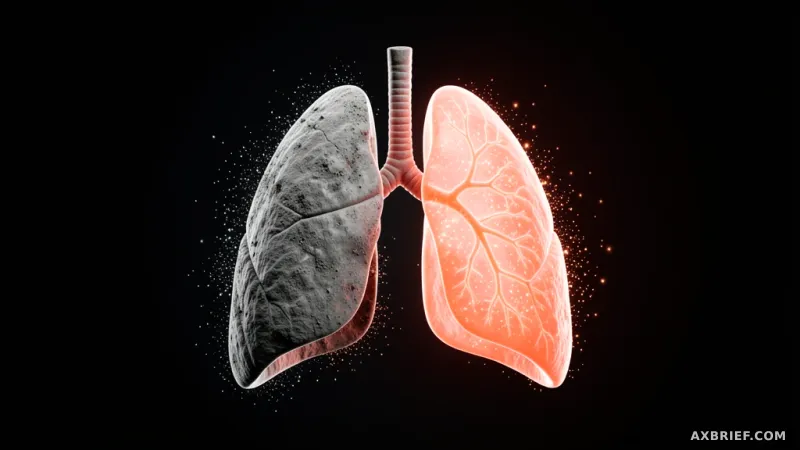
For millions of patients living with Chronic Obstructive Pulmonary Disease (COPD), the act of breathing is a constant, exhausting negotiation with their own body. The sensation is one of permanent restriction, an air hunger that persists regardless of the environment. For decades, the medical consensus has been grim: once the delicate alveolar structures of the lungs are destroyed, they are gone for good. The clinical goal has never been recovery, but rather a disciplined form of damage control, relying on oxygen tanks and maintenance drugs to slow an inevitable decline. The biological clock of the lung, once broken, was thought to be impossible to rewind.
The Mechanism of BCLXL-PROTAC
Recent research has challenged this permanence by targeting the cellular debris that prevents the lungs from healing. The focus is on senescent cells—often called zombie cells—which accumulate in the small airway epithelial cells and fibroblasts of COPD patients. These cells have ceased dividing, yet they refuse to die. Instead, they remain metabolically active, secreting a cocktail of inflammatory factors that poison the surrounding healthy tissue and accelerate the destruction of the lung architecture. While these cells possess the internal machinery for apoptosis, or programmed cell death, they survive by overexpressing BCLXL, a protein that acts as a biological shield against death signals.
To break this shield, researchers utilized BCLXL-PROTAC, a Proteolysis Targeting Chimera. Unlike traditional inhibitors that merely block a protein's activity, PROTACs act as molecular matchmakers. They bind the target protein, BCLXL, to an E3 ubiquitin ligase, effectively tagging the protein for destruction by the cell's own waste disposal system, the proteasome. By forcibly degrading BCLXL, the PROTAC strips the senescent cells of their survival mechanism, triggering the apoptosis that should have occurred years prior.
The efficacy of this approach is evidenced by a sharp decline in established senescence markers. In experimental models, there was a significant reduction in p21CIP1 and p16INK4a, as well as a decrease in senescence-associated β-galactosidase activity. More importantly, the removal of these zombie cells created a vacuum that allowed for actual repair. This was confirmed by an increase in Ki67, a primary marker of cellular proliferation, indicating that the lungs were beginning to regenerate. To ensure these results were not limited to simplified lab cultures, the team tested the treatment on precision-cut lung slices obtained from actual COPD patients. These slices showed a marked decrease in p21CIP1 expression, proving that BCLXL-PROTAC can function within the complex, diseased environment of human lung tissue. Detailed findings on this mechanism are available in the study published at https://doi.org/10.1111/acel.70487.
From Symptom Management to Cellular Regeneration
This shift in strategy represents a fundamental departure from the current standard of care. For years, the COPD pharmacopeia has been dominated by bronchodilators to open airways and corticosteroids to dampen inflammation. While these tools are vital for quality of life, they are essentially palliative; they optimize the remaining lung function without ever addressing the loss of tissue. They treat the smoke, not the fire. BCLXL-PROTAC introduces a senolytic strategy, moving the goalpost from management to elimination and regeneration.
The precision of this attack is what makes it viable. Healthy cells generally maintain low levels of BCLXL or do not rely on it for survival, meaning the PROTAC can selectively prune the senescent population without harming the functional tissue. This is a critical distinction from earlier generations of drugs that attempted to modulate intracellular signaling pathways, which often resulted in off-target effects or the development of drug resistance. By utilizing the proteasome for physical degradation, PROTACs essentially throw the problematic proteins into a cellular trash can, leaving the cell with no choice but to expire.
This transition is mirroring a broader trend in the biopharmaceutical industry. Investment is pivoting away from chronic symptom suppressants and toward cellular reprogramming and regenerative medicine. The PROTAC platform is particularly attractive because of its scalability. Since the technology can be engineered to target almost any protein, the success seen in COPD lungs provides a blueprint for treating other age-related degenerative diseases. The ability to selectively remove the cellular barriers to healing transforms the lung from a static, decaying organ into a dynamic system capable of renewal.
The objective of respiratory medicine is no longer just to help a patient breathe through the day, but to restore the biological integrity of the organ itself.
Now, the focus of treatment moves from slowing the decline to resetting the biological clock of the lungs.