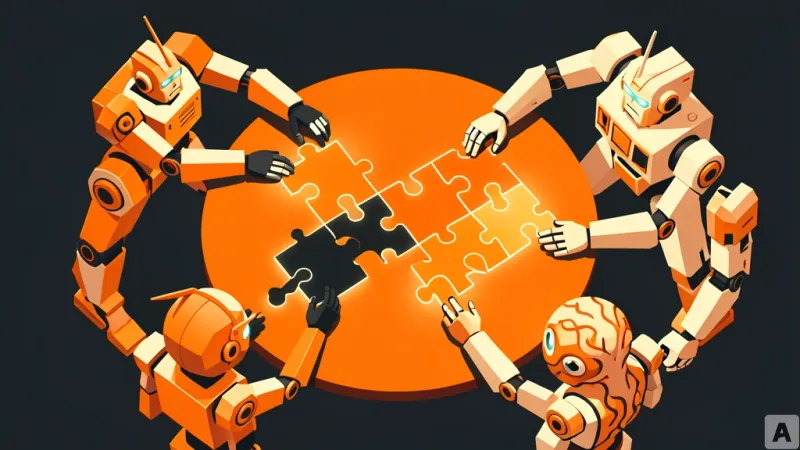
Modern enterprise AI deployments are hitting a wall that has nothing to do with model intelligence and everything to do with isolation. As companies rush to deploy specialized AI agents—one for customer support, another for codebase maintenance, and a third for data analysis—they are finding that these programs are effectively mute to one another. When agents are built on disparate frameworks or hosted in different cloud environments, they function like employees who speak different languages, unable to hand off tasks or share context. This fragmentation forces developers to build brittle, custom bridges that break the moment a workflow changes, leaving the promise of autonomous AI workflows largely unfulfilled.
The $17 Million Bet on Agent Interoperability
This week, BAND, a startup focused on the infrastructure of agent-to-agent communication, announced a $17 million seed funding round to address this exact bottleneck. The company is positioning itself as the connective tissue for the agentic web, providing an infrastructure layer that allows AI agents to communicate as easily as humans use messaging apps. While traditional API-based integrations often struggle to maintain state or context during complex, multi-step operations, BAND introduces an "Agent Mesh." This network architecture allows agents to discover one another, negotiate task delegation, and maintain a shared stream of information. By treating agent communication as a first-class networking problem rather than an afterthought, BAND aims to move beyond the limitations of standard RESTful API calls that frequently lose the thread of a conversation when passed between multiple autonomous actors.
Deterministic Routing vs. The Black Box
Historically, connecting two agents required developers to write custom glue code—bespoke scripts designed to translate the output of one system into the input of another. These connections are notoriously fragile and difficult to debug. BAND replaces this manual labor with a dedicated communication layer that utilizes deterministic routing. Unlike systems that rely on LLMs to interpret and route every message—which introduces latency and the risk of hallucinated instructions—BAND uses predictable, rule-based paths to ensure data integrity. By adopting the architectural principles used by global messaging platforms like WhatsApp or Discord, the system ensures that messages are delivered reliably even as the number of agents in a network scales into the thousands. This approach treats the agent network as a robust messaging backbone, ensuring that the "who, what, and where" of a task handoff remains consistent and verifiable.
Breaking the Vendor Lock-in Cycle
For developers, the most significant shift is the move toward model-agnostic infrastructure. Current agent frameworks provided by major players like OpenAI or Anthropic are often optimized to keep traffic within their own proprietary ecosystems, effectively locking enterprises into a single vendor's stack. BAND operates as an independent intermediary, functioning regardless of the underlying model or cloud provider. Furthermore, the platform addresses the critical enterprise requirement of security by allowing for on-premise deployment. This allows companies to maintain strict control over their data and security tokens. With BAND, an agent can safely pass a security token to another agent to complete a task without exposing the underlying credentials to the broader network. By providing a centralized management layer for these permissions, BAND is shifting the focus from simply making agents work to making them manageable, secure, and truly autonomous within a corporate environment.
This infrastructure marks the transition from isolated AI experiments to a cohesive, interconnected workforce of digital agents. As these networks mature, the bottleneck for enterprise AI will shift from model capability to the efficiency of the communication fabric that binds them together.