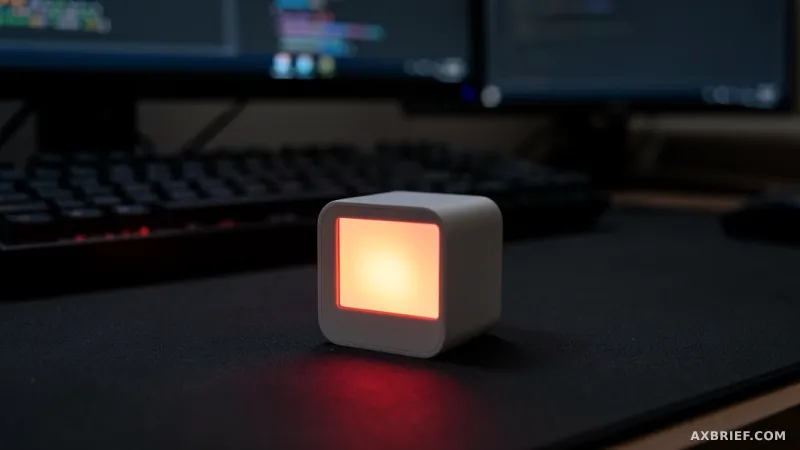
A developer sits at a desk cluttered with monitors, where a small, glowing screen displays a pixelated character dancing in real-time. As the AI agent processes a complex codebase, the character's movements accelerate, mirroring the surge in token consumption. For most engineers, monitoring AI spend and context window usage is a chore involving tedious terminal commands or refreshing a cloud dashboard. This friction has created a growing desire for a more visceral, immediate way to track the invisible currents of data flowing between a local machine and a remote LLM.
The Hardware Architecture of Clawdmeter
Clawdmeter is an open-source hardware project designed to bridge the gap between abstract API metrics and physical presence. Created by Icelandic software developer Hermann Haraldsson, the device serves as a dedicated monitor for Claude Code, Anthropic's command-line interface for agentic coding. The project has gained significant traction within the developer community, amassing over 800 stars and 50 forks on GitHub since its release on May 10.
The device is built upon the Waveshare ESP32-S3-Touch-AMOLED-2.16, a compact hardware module featuring a high-resolution AMOLED display and integrated Bluetooth connectivity. Powered by a lithium-ion battery, the Clawdmeter operates as a standalone peripheral that communicates with the Claude Code environment. The visual core of the device is a pixel-art animation of a character named Clawd. The animation is not merely aesthetic; it is tied directly to the intensity of the AI's activity. As token usage spikes, the animation becomes more frantic, providing a glanceable indicator of the model's current workload.
Technically, the device functions by reading the Claude Code OAuth token, which provides the necessary secure authentication to perform API calls. The Clawdmeter then intercepts the response headers sent by the server. Because these headers contain the precise metadata regarding token consumption for each request, the device can extract these numbers and render them on the AMOLED screen in real-time.
One of the most notable aspects of the project is its origin. Haraldsson admits to having zero prior experience in embedded systems or hardware development. He leveraged Claude itself to write the firmware and design the circuit logic, completing the functional prototype in a matter of days. This development process highlights a shifting paradigm in engineering where AI lowers the barrier to entry for hardware control, allowing software developers to iterate on physical products with the same speed they apply to code. Haraldsson noted that the majority of his effort was spent not on the underlying logic, but on the fine-tuning of fonts, colors, and animation frames to ensure a polished user experience.
From Text Logs to the Hardware Tamagotchi
While the technical specifications are impressive, the real shift lies in the transition from a text-based log to a physical interface. For years, the primary way to interact with AI usage was through a terminal output or a billing page. Clawdmeter transforms this abstract cost into a tangible object. By pressing the central button, the user can toggle through session-based and weekly usage data, presented as simplified charts. A subsequent press allows the user to verify Bluetooth connectivity or reset the device.
Beyond simple visualization, the device introduces physical shortcuts to the AI workflow. Two side buttons on the hardware send Space and Shift+Tab signals via Bluetooth to the connected computer. This allows the developer to trigger Claude Code's voice mode or rapidly cycle through operational modes—Normal, Accept Edits, Plan, and Auto—without leaving the keyboard or hunting for specific key combinations. This integration turns the monitor into a control surface, reducing the cognitive load required to manage the AI agent's state.
This evolution reflects a broader cultural trend among software engineers known as tokenmaxxing. Much like the fitness community tracks every calorie or the gaming community optimizes every frame, some developers have begun to treat token efficiency as a performance metric to be optimized and displayed. By converting the abstract consumption of a context window into a visual dopamine loop, Clawdmeter turns the act of coding with an AI into a gamified experience. Some in the community have already begun referring to the device as a hardware Tamagotchi for the context window, where the health and activity of the AI are mirrored in a physical pet.
The move toward dedicated hardware for specific AI functions echoes the era of the Walkman or the early iPod. In an age of multipurpose smartphones and omnipotent operating systems, there is a returning appetite for single-purpose tools that do one thing with extreme focus. By isolating the token metric from the noise of the IDE, the developer can maintain a state of flow while remaining subconsciously aware of the AI's resource consumption.
This shift suggests that as AI agents become more autonomous and integrated into the professional workflow, the interface for controlling them will move beyond the chat box and into the physical environment.