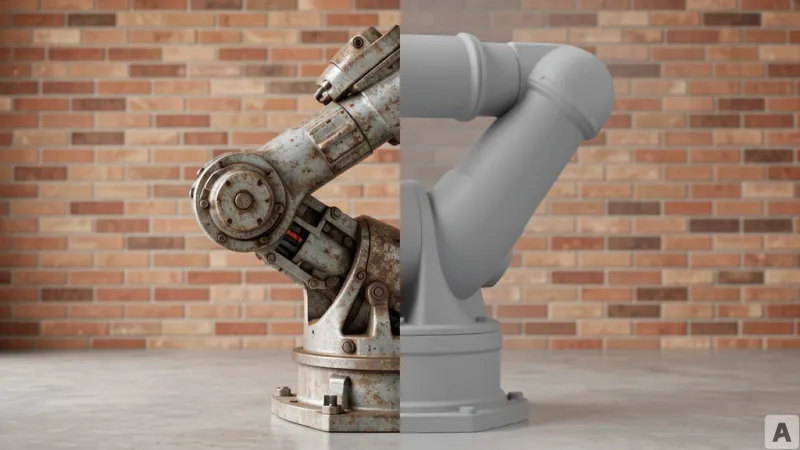
The biggest bottleneck in modern robotics is not the hardware, but the prohibitive cost of failure. While large language models can iterate through millions of text tokens in seconds, a physical robot that makes a mistake in a real-world environment breaks a dish, crashes a drone, or destroys a thousand-dollar sensor. This friction creates the reality gap, a technical chasm where behaviors learned in a digital simulation fail to translate to the physical world. Bridging this gap is now the primary objective for Antioch, a startup that recently secured 8.5 million dollars in funding to democratize high-fidelity virtual training for the next generation of autonomous machines.
The Economic Barrier to Physical Intelligence
Training a robot to perform a simple task, such as cleaning a kitchen or navigating a warehouse, requires thousands of repetitions. In a physical setting, these repetitions are slow, expensive, and dangerous. For industry giants like Waymo, the cost of maintaining massive fleets of autonomous vehicles and building proprietary simulation environments is a manageable overhead. However, for smaller startups and mid-sized engineering firms, the financial burden of real-world testing is often an insurmountable barrier to entry. They lack the capital to build sprawling test tracks or the patience to wait for a physical robot to fail and be repaired a hundred times over.
Antioch addresses this disparity by providing a sophisticated virtual training infrastructure that allows developers to deploy thousands of virtual agents simultaneously. By simulating the exact physical properties of the real world, the platform enables robots to experience a lifetime of trial and error in a matter of hours. This shift transforms the development cycle from a linear process of build-test-break into a parallel process of simulate-optimize-deploy. When a virtual robot fails in an Antioch environment, the cost is zero, and the data gathered from that failure is immediately used to refine the model before a single piece of hardware is ever powered on.
High Fidelity Sensors and the Sim-to-Real Pipeline
The core technical challenge Antioch solves is the precision of sensor simulation. A robot does not see the world as a series of pixels, but as a complex stream of data from LiDAR, cameras, and ultrasonic sensors. If the simulation provides a sanitized version of this data, the robot develops a false sense of confidence that vanishes the moment it encounters real-world noise, lighting changes, or atmospheric interference. Antioch focuses on creating environments where the physics of these sensors are mirrored with extreme accuracy, ensuring that the neural networks trained in the cloud are compatible with the hardware in the field.
Rather than building every component from scratch, Antioch leverages the foundational spatial intelligence provided by industry leaders like Nvidia and World Labs. By refining these base models into specialized tools for robotics developers, Antioch allows teams to focus on high-level behavior rather than low-level physics engine tuning. This approach is currently seeing the most traction in the development of autonomous tractors, delivery drones, and industrial sensors, where the cost of a real-world accident is high but the environmental variables are predictable enough to be modeled with high precision.
The Shift Toward Software-Defined Robotics
We are witnessing a fundamental paradigm shift in how machines are built, moving from a hardware-centric approach to a software-defined one. Recent research from MIT highlights this trend, with experiments showing that large language models can now be used to design robot architectures and then pit those designs against one another in virtual arenas. In this new workflow, the AI acts as both the architect and the tester, iterating on the physical form and the control logic simultaneously within a simulated vacuum. This iterative loop happens at a speed that was previously unimaginable in traditional mechanical engineering.
This evolution mirrors the transformation the software industry underwent with the advent of GitHub and Stripe. Just as those platforms abstracted away the complexities of version control and payment processing, Antioch is abstracting away the physical risks of robotics. By moving the center of gravity from the laboratory floor to the computer screen, the industry is decoupling intelligence from physical presence. The goal is a future where a robot is born in a simulation, achieves mastery over its environment in a virtual world, and is deployed into the physical world as a fully trained professional on day one.
As the cost of high-fidelity simulation drops, the barrier to creating truly autonomous systems will continue to fall. The 8.5 million dollar investment in Antioch is more than just a capital injection for a single company; it is a bet on a future where the reality gap is finally closed, allowing robotics to scale with the same exponential velocity as generative AI.