
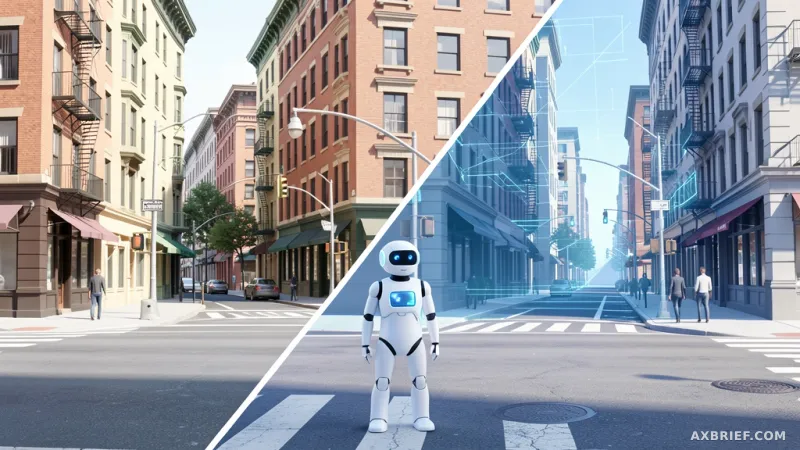
For two decades, using Google Street View has felt like flipping through a massive, high-resolution photo album of the planet. You click an arrow, the screen jumps, and you are suddenly standing in front of a bakery in Paris or a dusty road in Namibia. It is a powerful tool for observation, but it remains a static experience. You are a ghost in a frozen world, unable to change the weather, move an object, or imagine how a robot might navigate the sidewalk in a torrential downpour. This week, at the Google I/O developer conference, that boundary between observation and interaction vanished. Google announced the integration of Street View with Project Genie, transforming the world's largest archive of geographic imagery into a living, breathing simulation.
The Architecture of a Planetary Sandbox
Project Genie is not a simple image generator or a video tool; it is a general-purpose world model. While traditional AI models predict the next word in a sentence or the next pixel in a frame, a world model attempts to learn the underlying laws of physics and spatial interactions of the environment it observes. By connecting this model to Street View, Google is leveraging a dataset of staggering proportions. Over the last 20 years, Google has deployed camera-equipped cars and Tracker Backpacks across 110 countries and seven continents, capturing approximately 280 billion images. This is no longer just a map service; it is the most comprehensive digital twin of human civilization ever assembled.
In August, Google provided a research preview of Genie 3, the engine driving this evolution. Genie 3 can take a single image or a text prompt and extrapolate a fully interactive 3D environment. When this capability is layered over Street View data, the static images are converted into dynamic spaces. Users can now adjust environmental variables, such as changing the time of day or simulating specific weather patterns, within a real-world location. This transition from static data to an interactive simulation represents a strategic pivot in how Google views its data hegemony. The company is moving beyond providing information about the world to providing a platform where the world can be simulated and manipulated.
This technology is already moving toward commercialization. In January, Google began rolling out a feature for AI Ultra subscribers in the United States that allows them to generate interactive game worlds using text and images. A user can describe a setting, and the AI constructs a navigable virtual space in real-time. This feature is currently limited to a subset of US-based Ultra users but is scheduled to expand globally in the coming weeks. By tying this capability to a high-tier subscription, Google is not only creating a new revenue stream but also establishing a massive testbed. Every interaction a user has with these generated worlds provides feedback that helps refine the accuracy and stability of the world model.
From Driver's Seat to Agent Perspective
To understand why this matters, one must look at the current state of autonomous simulation. Waymo, Google's autonomous driving subsidiary, relies on simulators that are primarily locked into a vehicle's point of view. The AI learns by looking through the windshield, focusing on the road ahead and the mirrors to the side. While effective for driving, this perspective is narrow. Project Genie shatters this limitation by introducing the concept of the agent perspective. The model allows for an immediate shift in viewpoint, enabling the simulation to be viewed from the perspective of a pedestrian, a delivery robot, or a drone.
This shift is critical for the deployment of robotics in complex urban environments. Jack Parker-Holder, a researcher at Google DeepMind, notes that this is an essential tool for training agents to handle rare but disruptive visual stimuli. For instance, a robot destined for the streets of London needs to understand how blinding sunlight reflects off the glass and polished surfaces of Victorian-style architecture. In a traditional simulator, such a specific visual glitch would have to be manually programmed. With Project Genie and Street View, the AI can simply simulate that specific location and vary the sun's angle until the robot learns to compensate for the glare. This moves the training process from vehicle-centric learning to space-centric intelligence.
One of the most significant technical breakthroughs here is the achievement of spatial continuity. In many AI-generated videos, the world shifts or warps when the camera moves. If a character turns 360 degrees, the building they saw behind them often disappears or changes shape. Project Genie solves this by maintaining a consistent memory of the environment. When an agent rotates or moves through a simulated Street View environment, the landmarks remain fixed and accurate. This is not because the AI is loading a pre-designed map like a traditional game engine, but because it has developed a latent understanding of 3D space based on the 280 billion images it has ingested. It remembers the world because it has seen it from every possible angle.
However, the simulation is not yet perfect. There is a visible gap in physics-aware reasoning. In current demonstrations, agents sometimes clip through solid objects, such as walking straight through a cactus or a dense shrub. The model understands where things are, but it does not yet fully grasp the causal relationship of collision and resistance. This puts Genie slightly behind Google's other powerhouse, Veo. While Veo can realistically simulate the fluid dynamics of a paper boat floating on a ripple or smoke diffusing in the air, Genie's physical accuracy lags by roughly six to twelve months. Google is opting not to hard-code these physics rules, choosing instead to let the model learn them intuitively through observation, much like a biological entity learns gravity by falling.
This capability is most potent when addressing edge cases—those rare, high-risk scenarios that are too dangerous or improbable to encounter during real-world testing. For Waymo, this means the ability to instantly generate a simulation of a tornado touching down on a highway or an elephant wandering into a suburban street. By training on these synthetic but visually grounded edge cases, Google can drastically reduce the time and cost required to verify the safety of its autonomous systems. The result is a training pipeline where the AI encounters a lifetime of rare disasters in a matter of hours, all within a virtual replica of a real city.
Beyond robotics, this integration signals a paradigm shift for the gaming and education industries. The cost of creating high-fidelity, interactive worlds is currently astronomical, requiring thousands of man-hours of 3D modeling. Project Genie effectively collapses this cost. By using real-world spatial data as a foundation, developers can generate immersive environments that are grounded in reality but customizable via text. Street View has evolved from a digital map into the foundational asset for a new era of spatial computing.
Google is effectively converting twenty years of data collection into operational dominance in the AI era. By merging the world's most detailed visual archive with a general-purpose world model, they have created a gateway to a future where the physical world is no longer a constraint, but a template for infinite simulation.