A developer pauses mid-sentence while crafting a complex prompt for an AI agent on their iPhone. To insert a specific technical term, they reach for the globe icon to switch from Korean to English, but their finger slips by a fraction of a millimeter, triggering an unintended key. As they attempt to switch back to Korean to finish the thought, a notification pops up, and a quick reply to a colleague results in the accidental deletion of the entire meticulously drafted prompt. When they try to move the cursor to fix a typo, they encounter the notoriously clunky cursor navigation of iOS, turning a simple correction into a moment of genuine frustration.
The Mechanics of Frictionless Input
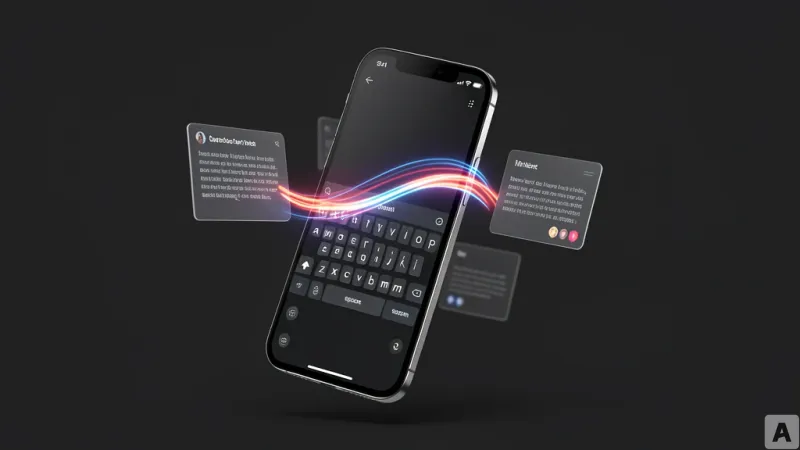
This fragmentation of the mobile typing experience is the primary target of Glidekey, a tool gaining traction within developer circles for its attempt to streamline high-intensity mobile input. The most immediate departure from the standard iOS experience is the removal of the button-based language toggle. Instead of clicking a dedicated key, users can switch between Korean and English layouts using a simple horizontal swipe across the keyboard. This gesture-based transition eliminates the precision requirement of the globe key, reducing input errors during rapid language switching.
Beyond the layout, Glidekey integrates an RSS reader directly into the keyboard area. This allows users to consume short-form content and website updates from the top of the keyboard without ever leaving their current application. This integration is paired with a suite of text management tools designed for power users. An extended editing mode allows for the modification of long sentences with a clearer overview of the text, while a temporary save feature enables users to preserve drafts during a chat session and restore them later, preventing the loss of data during app interruptions.
Efficiency is further enhanced through phrase shortcuts and a system that analyzes clipboard data for faster pasting. To accommodate different typing preferences, the app supports various keyboard layouts. While the standard two-set (Dubul-sik) layout is available, Glidekey also supports the single-vowel (Danmoeum) layout, which reduces the total number of keystrokes required for Korean input, thereby increasing overall typing speed.
From Input Tool to Information Layer
While custom keyboards focusing on layout changes are common, the inclusion of an RSS reader suggests a fundamental shift in how input tools are conceptualized. The integration of information consumption into a typing interface addresses a specific behavioral pattern emerging in the era of AI. Modern mobile interaction is no longer just about sending messages; it is about interacting with AI agents. This process involves a cycle of prompting, waiting for a response, and refining the query based on external information.
In the seconds spent waiting for an LLM to generate a response or the moments spent brainstorming a prompt, users habitually switch apps to verify a fact or check a news feed. This constant context switching creates a cognitive load that breaks focus and slows down the creative process. By embedding an RSS reader into the keyboard, Glidekey attempts to reduce this switching cost to zero. The keyboard ceases to be a passive peripheral and becomes a micro-dashboard where the user can ingest information and output prompts simultaneously.
This philosophy extends to the temporary save and extended editing features. In an environment of asynchronous communication and AI-driven workflows, the ability to preserve a thought-in-progress is a critical productivity requirement. The focus on solving the iOS cursor movement problem through an expanded editing interface shows a deep analysis of the specific pain points that hinder professional productivity on mobile devices. Glidekey is essentially redefining the keyboard as a productivity hub that operates on the topmost layer of the operating system.
The keyboard is evolving from a tool for typing characters into a primary interface for managing the flow of information.