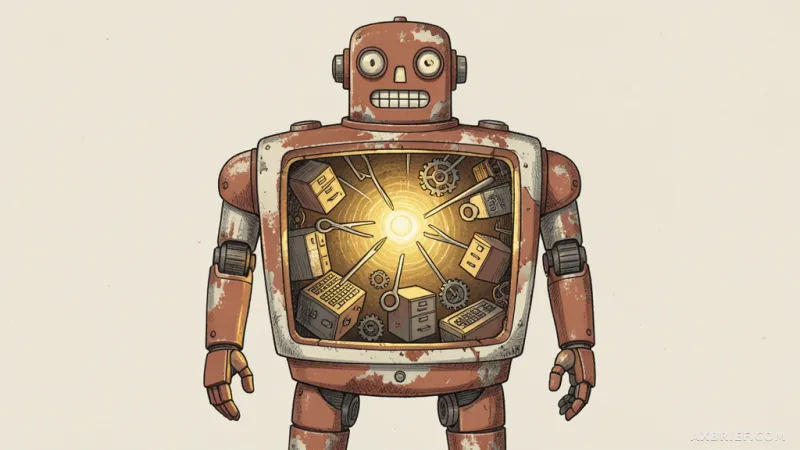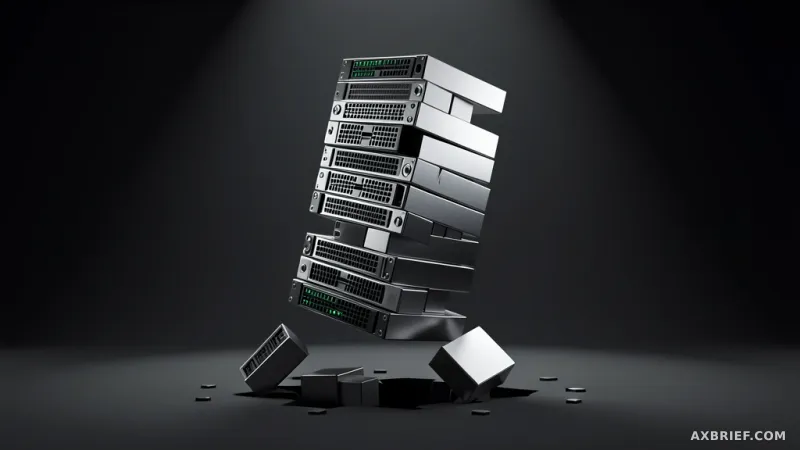
At 3:00 AM, a cron job triggers across a server cluster to handle the payroll for 30,000 employees. Deep within the source code, a comment remains: Ask Ben about this. But Ben has been gone for two years. The only reason the system still functions is because of Sara, an engineer who has lived through every iteration of the company's architecture since the late nineties. Sara is the living archive of the organization, the keeper of invisible operational knowledge that exists nowhere in the documentation. To the executive suite, the system is a black box that simply works. They do not know how it works, and they have no idea who is actually holding the fragile threads together.
The Productivity Illusion and the 30 Percent Cut
In boardrooms across the tech industry, a new narrative has taken hold. Decision-makers are increasingly viewing generative AI not as a tool for augmentation, but as a justification for aggressive headcount reduction. The catalyst is often a high-impact demo: a CEO watches an AI agent write a complete feature in fourteen minutes and concludes that the existing engineering staff is redundant. This perceived leap in productivity leads to a predictable sequence of events. The board is presented with a plan to slash the engineering organization by 30 percent, promising that the remaining staff, augmented by AI, will maintain the same velocity.
This strategy relies on a dangerous misunderstanding of how software is actually built and maintained. When organizations prioritize speed metrics over systemic health, they fall victim to Goodhart's Law, which states that when a measure becomes a target, it ceases to be a good measure. In the rush to prove AI efficiency, companies begin optimizing for story points, commit frequency, and test coverage percentages. These numbers look impressive on a slide deck, but they are proxies for productivity, not indicators of quality. The focus shifts from building resilient systems to hitting numerical targets. Management assumes that junior developers will simply adapt or be replaced by AI, ignoring the fact that the pipeline for creating senior engineers is being dismantled in real-time.
The Death of the Apprenticeship Model
Software engineering has historically been a craft learned through apprenticeship. The most critical growth for a junior developer does not happen during the act of writing code, but during the rigorous, often grueling process of code review. A senior engineer's critique is where the nuance of system architecture, the anticipation of edge cases, and the philosophy of maintainability are transferred to the next generation. However, in the current era of output optimization, these mentorship cycles are viewed as expensive bottlenecks. Code reviews are being streamlined or bypassed entirely to increase the volume of merged pull requests, effectively treating the growth of human talent as a cost center to be minimized.
Many organizations have attempted to solve this by implementing DORA metrics to track deployment frequency and lead time for changes. While these metrics are valuable in a healthy environment, they become weapons in a shrinking one. Companies add more monitoring tools and dashboards while simultaneously pushing out the very people capable of interpreting the signals those tools provide. The result is a codebase that grows increasingly brittle. This mirrors the systemic frustrations highlighted by Peter Welch in his 2014 critique, Programming Sucks, but with a modern, more lethal twist. The industry is no longer just struggling with the inherent difficulties of programming; it is actively destroying the structural capacity to solve those problems.
As the apprenticeship pipeline breaks, the gap between the few remaining veterans and the AI-assisted novices widens. The novices can generate code that looks correct and passes basic tests, but they lack the conceptual map of the system required to debug a catastrophic failure in a legacy module. They are operating on a surface level, while the deep, structural knowledge of the system evaporates with every layoff.
This crisis is not a failure of artificial intelligence, but a failure of corporate greed and short-termism. The industry is trading long-term institutional stability for a temporary bump in quarterly margins. Sara continues to manage the payroll system from a remote location, occasionally using a backup copy on a USB stick to force a reboot when the modern layers of the stack collapse. She is the last line of defense in a system where the knowledge transfer mechanism died years ago. When Sara eventually leaves, there will be no one left who knows why the cron job exists or how to fix it when it finally breaks. The foundation of the company is burning, hidden behind the mask of AI efficiency.