Every morning, the digital news cycle delivers a familiar warning about the environmental cost of artificial intelligence. The narrative is consistent: massive data centers are acting as industrial sponges, draining local aquifers and threatening the water security of surrounding communities. For the general public, the image of the AI data center is that of a water-guzzling monolith, an entity whose thirst for cooling competes directly with the basic needs of human drinking water and the survival of regional agriculture. This anxiety has created a pervasive sense of urgency, framing the AI boom as an ecological crisis in the making. However, these fears often rely on vague projections and the amplified claims of specific interest groups rather than a cold analysis of physical reality. When the actual operational metrics and physical volumes are scrutinized, the water footprint of AI appears significantly smaller than the prevailing discourse suggests.
The Physics of Cooling and the California Metric
To understand the actual impact, one must look at the physical requirements of server infrastructure. Data centers operate thousands of server racks, where the dense concentration of processors generates immense heat that must be dissipated to prevent hardware failure. The primary method for managing this thermal load is evaporative cooling, a process that consumes water to carry heat away from the facility. In California, the total footprint of these facilities is estimated at approximately 15 million square feet. According to Aterio Insights, the energy dissipation rate for these environments typically ranges between 2kW and 12kW per square meter.
When these energy figures are converted into water consumption, the scale becomes clearer. By assuming an efficiency rate of 60 to 90 percent for industrial evaporative cooling systems, the annual evaporation volume is calculated to be between 32,000 and 290,000 acre-feet. To put this in perspective, the total annual human water consumption in California stands at 40 million acre-feet. This means that even at the highest end of the estimate, data centers account for only 0.7 percent of the state's water use, while at the lower end, they represent a mere 0.08 percent. Further cross-verification using multiple AI models to refine these estimates suggests a more conservative and realistic annual figure of 20,000 acre-feet. This brings the actual impact down to 0.05 percent of California's total water usage. The tension between tech growth and resource scarcity is real, but the mathematical reality suggests the impact is marginal. The data indicates that the perceived crisis is a matter of perception rather than a matter of volume.
From Speculative Fear to Engineering Reality
For years, the dominant discourse regarding data center expansion was rooted in the fear that these facilities would deliver a fatal blow to local water infrastructure. This perspective was fueled by a lack of transparency from tech giants, which allowed speculative criticism to fill the information vacuum. The conversation was framed as a moral conflict between corporate profit and community survival. However, the nature of the debate is shifting as engineering-based quantitative analysis replaces anecdotal alarmism. We are moving away from guessing based on corporate opacity and toward calculating based on the laws of thermodynamics.
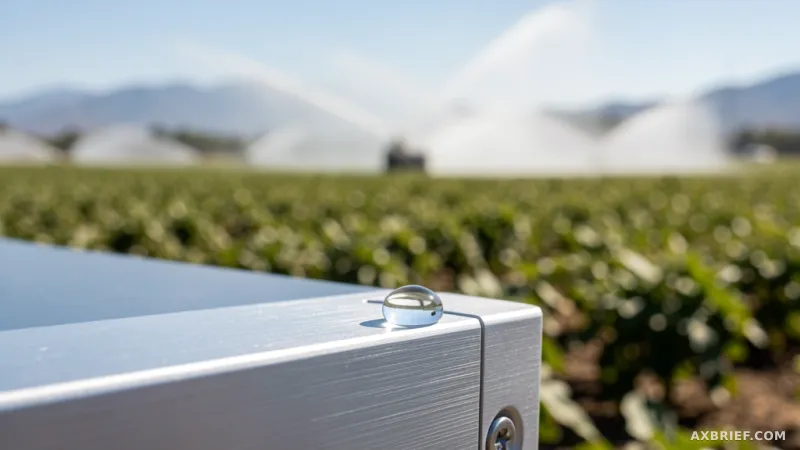
The most striking contrast emerges when data center consumption is compared to the state's primary water consumer: agriculture. California maintains roughly 7 million acres of irrigated farmland. When the water requirements of these vast agricultural tracts are placed side-by-side with the 0.05 percent consumption of data centers, the narrative of the water-guzzling AI changes. The water used by AI facilities does not represent a systemic threat to the regional water balance but rather a manageable industrial requirement that is a tiny fraction of the water used to grow crops. The tension is no longer about whether data centers will deplete the state's water, but about how to optimize the existing industrial consumption. This shift in understanding reveals that the environmental cost of AI is not an insurmountable wall but a technical challenge that can be solved through efficiency. The realization that AI's water footprint is negligible compared to irrigation transforms the data center from a villain into a standard industrial actor.
As cooling technologies evolve and water-recycling systems become standard, the efficiency of these facilities will only improve, turning a perceived liability into a model for sustainable industrial growth.