Modern robotics is currently trapped in a frustrating paradox. We have large language models that can write poetry or debug complex Python scripts in seconds, yet a physical robot often struggles to pick up a plastic cup without knocking over the table. This gap exists because traditional AI lacks embodied intelligence. While a model can describe a kitchen in vivid detail, it does not inherently understand the spatial distance between a counter and a sink or the tactile friction required to grip a handle. The industry has spent years trying to bridge this divide by stuffing massive models into robot controllers, only to find that the latency of a cloud-based brain makes real-time physical interaction nearly impossible.
The MoT Architecture and Technical Specifications of HY-Embodied-0.5
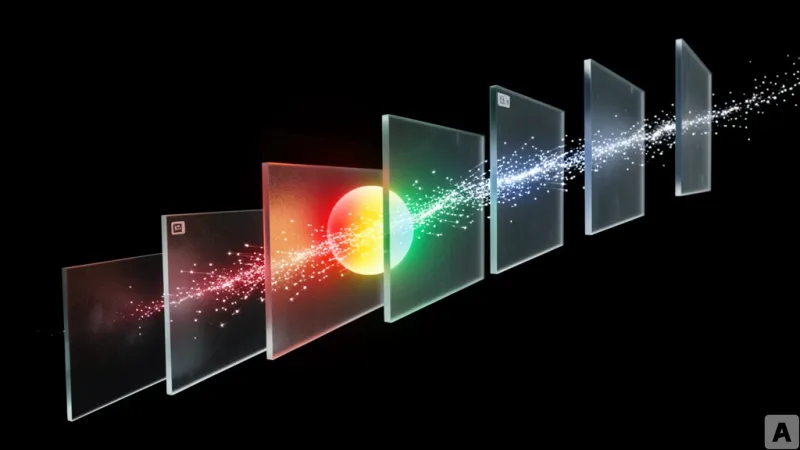
To solve the latency and spatial reasoning problem, Tencent Robotics X and the HY Vision Team have introduced HY-Embodied-0.5, a foundation model specifically engineered for physical agents. The technical core of this system is the Mixture-of-Transformers (MoT) architecture. Unlike standard dense transformers that activate every parameter for every token, MoT utilizes latent tokens to compress data and optimize computation across different modalities. This allows the model to maintain high-fidelity visual perception without the computational overhead that typically freezes a robot's reaction time.
The framework is deployed in two distinct scales to balance raw power with operational agility. The first is a 32B model designed for complex, high-level reasoning and strategic planning. The second is the MoT-2B model, which is optimized for deployment on edge devices. While the MoT-2B model possesses a total of 4 billion parameters, it only utilizes 2.2 billion active parameters during any single inference step. This design allows it to match the inference speed of a dense 2B model while providing the cognitive depth of a much larger system.
The intelligence of HY-Embodied-0.5 is built upon a massive, specialized dataset. The team trained the model on over 100 million embodied and spatial-specific data points, supplemented by a corpus of more than 200 billion tokens. This training regime ensures the model does not just recognize objects but understands 3D spatial relationships, the dynamics of physical movement, and the causal interactions between an agent and its environment.
For developers looking to implement the model, the environment requires a Linux OS, Python 3.12 or higher, CUDA 12.6, and PyTorch 2.8.0, with an NVIDIA GPU being a mandatory requirement. The installation process begins with the following commands:
pip install git+https://github.com/huggingface/transformers@9293856c419762ebf98fbe2bd9440f9ce7069f1a
pip install -r requirements.txt
To run the model for inference, the following workflow is used:
git clone https://github.com/Tencent-Hunyuan/HY-Embodied
cd HY-Embodied/
pip install -r requirements.txt
python inference.py
Distilling 32B Intelligence into an Edge-Ready Brain
The real breakthrough of HY-Embodied-0.5 is not the size of the models, but how the intelligence is transferred between them. Usually, shrinking a model leads to a catastrophic loss in reasoning capability, leaving the smaller version capable of simple pattern matching but incapable of complex planning. The HY Vision Team bypassed this limitation by implementing on-policy distillation combined with a self-evolving post-training pipeline.
In this setup, the 32B model acts as the teacher, and the 2B model as the student. Rather than simply mimicking the final output, the 2B model learns the actual reasoning paths and step-by-step planning logic used by the 32B version. This process effectively transplants high-level cognitive abilities—such as multi-step task decomposition and spatial forecasting—into a lightweight architecture. The results are evident in the benchmarks, where the MoT-2B model outperformed existing models of similar size across 16 different benchmarks. Meanwhile, the 32B version demonstrates state-of-the-art performance that rivals Gemini 3.0 Pro.
This shift transforms the model from a standard Vision-Language Model (VLM) into a Vision-Language-Action (VLA) pipeline. A VLM can look at a photo of a table and say, there is a red ball at the center. A VLA model, however, takes that visual input and the command move the ball to the box and translates it into a series of precise robotic coordinates. It calculates the trajectory of the robotic arm, adjusts for the object's position in 3D space, and executes the physical motion in real time. By moving the brain to the edge via the MoT-2B model, the system eliminates the round-trip latency to a server, which is often the difference between a robot successfully grasping an object and a robot crashing into it.
This architecture proves that the path to autonomous robotics is not simply about building larger models, but about creating efficient pathways to move high-level reasoning into the physical hardware. By optimizing active parameters and utilizing distillation, the industry now has a blueprint for deploying Gemini-class intelligence directly onto the robot's chassis.
This transition from cloud-dependent reasoning to edge-native action establishes a new standard for the VLA model market.